RESTAURANT: Ralph’s Ice Cream Store
LOCATION: 501 Port Richmond Ave, Staten Island
DATE: May 22, 2005
DESSERT: Large Cream Ice with Chunky Monkey and Birthday Cake; Large Cream Ice with Apple Crumb and Pistachio Spumoni
BEVERAGE: None
PRICE: $5.00
What’s the way to end a day full of cheese? More dairy, of course. Especially when it comes in the form of Ralph’s crème ices. Danny, a Staten Island native, grew up on the stuff, but for me the dessert was as untrodden a terrain as the borough in which Ralph’s is located.
Situated literally across the street from Denino’s, Ralph’s seemed a Crying of Lot 49 like sign, and while I don’t share the paranoia of Oedipa Maas (at least not usually), Ralph’s did appear as an inescapable portent of PWT’s finale. Stunned by the extensive list of flavors, it took some time for us to decide – Ralph’s serves ice cream, crème ices, and Italian ices, with a litany of different flavors for each. I eventually went with the Chunky Monkey and Birthday Cake. The Chunky Monkey had an understated hint of banana and the southern crunch of pecans, a very refreshing combination. But I fell in love with the Birthday Cake, an ice bursting with all the sprinkles and frosting of Chuck-E-Cheese birthday parties, but without the greasy arcade joysticks and freakishly large electronic mouse to spoil the fun. The crème was such a splendid sugary sensation, Danny and I stopped paying attention and missed the 44 bus back to the ferry.
Given lemons its best to best to make lemonade. Ralph’s policy is to close when the staff “feels like it” so faced with our bus predicament, we decided (I’d argue logically so) to order another round. While I was less impressed with the Pistachio Spumoni (tasted too strongly of corn syrup and artificial pistachio extract) and Apple Crumb (oddly more lemon meringue than apple deep dish), Ralph’s was still a meteoric end to PWT ’05. We caught the next bus and made it back to Manhattan in time to fill the full weight of 12 slices and two large ices finally sink in. I live in fear of the day when my metabolism starts to slow down…
RATING: 7.2/10
Thursday, May 26, 2005


Wednesday, May 25, 2005
Pizza World Tour 2005 Photos

Clockwise from top left: (all of Di Fara's) Di Fara's in Brooklyn; Dominic in his kitchen; the Square; Porcini Mushroom Slice
Pizza World Tour 2005 Photos

Row 1: Nick's Pizza in Queens; Nick's Half-White, Half Red; Full Moon Pizzeria in the Bronx; Row 2: Full Moon's Eggplant Slice; John's of Bleecker; John's Sausage, Pepperoni and Mushroom Pie. Row 3: World Trade Center Memorial at Twilight; Denino's in Staten Island; Denino's Half Topping Pie.
Tour 3: Pizza World Tour 2005
SPECIAL FEATURE – PIZZA WORLD TOUR 2005
DATE: May 22, 2005
To honor New York’s long pizza making heritage, Danny and I set out on Pizza World Tour 2005, picking up friends along the way. We traveled to a famous pizza place in each of the five boroughs, sampling the best slices this city has to offer.
PWT ’05 QUICK FACTS:
Total Number of Slices I Ate: 12 Slices – 10 Thin Crust, 2 Sicilian Squares
Total Number of Pizzas I Ate: 1.5 Large Pizzas – 1.25 Thin Crust, .25 Sicilian
Total Number of Slices Eaten By All PWT ’05 Participants: 42 Slices – 37 Thin Crust, 5 Sicilian
Total Number of Pizzas Eaten By All PWT ’05 Participants: 5.25 Large Pizzas – 4.625 Thin Crust, .625 Sicilian
Total Time: 12 hours, 38 minutes – Started 11:09 am, Finished 11:47 pm.
Hours After PWT ’05 Conclusion I Next Ate: 13 hours, 21 minutes (1:08 pm Monday May 23rd).
Total Personal Expense: $38.50
Best Pizza: Di Fara’s and Denino’s
FIRST STOP: BROOKLYN
PIZZERIA: Di Fara’s
LOCATION: 1424 Avenue J, Brooklyn
PIZZA: Porcini Mushroom Slice, Sicilian Square Slice
BEVERAGE: Can of Canada Dry Ginger Ale
PRICE: $8.75
Going into PWT ’05, I knew one thing for certain - Di Fara’s would be incredible. After a somewhat crazy decision to partake in the Coney Island Polar Bear Plunge on New Year’s Day, Danny, Libby, and I went to Di Fara’s for the first time. My initial visit had left me fantasizing about the singular sausage and mushroom pizza ever since. Run for over 40 years by the meticulous Dominic, Di Fara’s, despite gaining nationwide fame, has remained the same somewhat dingy and unassuming pizzeria located near the Avenue J tracks that it’s always been. The seating is cramped, the lighting drab and the wait for a slice often extends into the hours. But trust me, this pizza is worth it.
When we arrived at Di Fara’s at 11:45 am on Sunday, there were already people peering into the windows and begging Dominic to have a Sicilian pie ready when the restaurant opened at noon. On both of my visits, I have met diehard Di Fara’s loyalists who eat the pizza at least once a week. Such devotion exists for a reason. Di Fara’s pizza is like nothing else.
Dominic’s ingredients are of the highest grade. His fresh buffalo mozzarella (floating in water) goes directly from sealed containers to the shredder to the pie. The olive oil he sprinkles over the top of his pizzas is imported from Italy and is as light and crisp as a fine white wine. Fresh herbs line the windowsill and customers are free to take sprigs of oregano and basil to adorn their slices.
On my return trip, my goals were twofold: to try the “Square”, Sicilian style slice and also the porcini mushroom slice, which is only offered seasoning. Unlike the Senate Democrats, I succeeded in all my objectives. The porcini mushroom slice was a slice of Di Fara’s normal crust pizza topped with a generous portion of whole porcini mushrooms taken directly from a large jar. The mushrooms dripped with a slightly sweet oil that mingled with the cheese’s smoothness to form what I can honestly say is the best mushroom based pizza I’ve ever tasted. Because the mushrooms were room temperature and the pizza piping from the oven, the contrast of mild and hot provided a kaleidoscope effect. Eating this slice makes me reconsider not selecting funghi biologist as a career path.
And yet, the square managed, almost unbelievably, to be even better than the porcini. To quote Dario’s reaction after biting into the Sicilian slice, “This is the best pizza I’ve had.” Needless to say, I concurred. The mildly runny coalescing of cheese, oil, and tomatoes oozes above a crust as thick, buttery, and crisp as a perfectly baked loaf. Imagine Stouffer’s French Crust pizza juiced on a Mark McGwire amount of steroids – actually, don’t imagine anything. All comparisons to other pizzas are unfair. Nothing can match the crunch of the darkened crust and flowing cheese when it first hits the mouth. Words are inadequate.
Thus thanks to Di Fara’s, PWT ’05 was off to a perfect start.
RATING: 9.5/10
SECOND STOP: QUEENS
PIZZERIA: Nick’s
LOCATION: 108-26 Ascan Ave., Queens
PIZZA: One Slice White with Proscuitto and Spinach, One Slice Red with Proscuitto and Spinach
OTHER: Half of a Caesar Salad
BEVERAGE: Tap Water
PRICE: $9.00
Journeying from Di Fara’s to Nick’s in Forest Hills, I felt like Marco Polo or Amerigo Vespucci, crossing parts of New York that to me were entirely new worlds. For one, we had to use the G Train, which up until Sunday, I didn’t even know existed. And when we finally arrived in Forest Hills, I found an area dominated by German architecture, ambitious homes, and enough trees to leave Rachel Carson grinning wildly. Pat, Dario, Danny and I had been expecting Flushing. Instead, we got Westchester.
Located on Ascan Avenue, Nick’s isn’t your typical New York neighborhood pizza place – well, unless your neighborhood is situated in Greenwich, Connecticut. The restaurant has a clean, modern design, bright light streaming in from its glass wall facing streetside. It is a comfortable space and entering, we were all struck by the wonderful smells emanating from the kitchen.
We opted for a half white, half red pizza with proscuitto and spinach, so that we could have as much variety on PWT as possible. To me, white pizza is like reading Ben Jonson’s plays instead of Shakespeare – sure it’s good but why not choose the best. However, such an assumption pr
oved completely erroneous at Nick’s. I actually preferred the white slice – the luscious layer of ricotta and mozzarella cheeses forming a creamy blanket, as satisfying as well made lasagna. This coats a crust, that though paper thin, failed to become soggy at any point. The spinach was an especially appropriate compliment to the white base, as when the two mixed, they were reminiscent of an Italian version of creamed spinach. The proscuitto was much more noticeable on the red slice, which though excellent, Danny and I both found a bit too salty. However, this was a periphery concern, as the tomato sauce had a tinge of pleasing red pepper spice. Nick’s style was unlike any of the other pizza we tried during PWT, the nouveau gourmet essence akin to California thin crust. While my prior expectations might have been wrong, everything at Nick’s was very much in the right.
RATING: 8.2/10
THIRD STOP: THE BRONX
PIZZERIA: Full Moon Pizzeria
LOCATION: 600 E. 187th St., Bronx
PIZZA: Slice of Eggplant Sicilian
BEVERAGE: Tap Water
PRICE: $2.75
Full Moon Pizzeria is the type of local pizza place every street should have. The cooks speak with thick Italian accents (and are surprisingly friendly), fresh slices constantly emerge from the oven, and customers of all ages shuffle in and out to grab a quick slice. Full Moon looks the part as well, from the conventional seats to the linoleum tiling.
The pizza keeps up the image. Like swimming pool ice cream trucks and Mother Goose rhymes, Full Moon’s pizza is an element that should have been present in everyone’s childhoods. The eggplant Sicilian slice I ordered was commendable for both its foccacia like foundation and the chewy roasted eggplant that crowned it. Crushed tomatoes with fresh basil and French Onion soup-browned mozzarella completed the ensemble. This square bordered on sandwich dimensions and could have been thinner, but the crust would certainly be splendid on its own or with a few drops of refined olive oil.
Though the trip, coupled with the misty weather, was a bit of a headache, Full Moon was a good motive to make my second visit to the Bronx. The distance will keep me from becoming one of Full Moon’s many regulars, but at least the pizza gave me reason to like the Bronx, even if the Yankees play just a few miles away.
RATING: 7.4/10
FOURTH STOP: MANHATTAN
PIZZERIA: John’s of Bleecker Street
LOCATION: 278 Bleecker St.
PIZZA: Half of a Pepperoni, Sausage, and Mushroom Pizza
BEVERAGE: Tap Water
PRICE: $10.00
In Italo Calvino’s If on a winter’s night a traveler (review forthcoming), he mentions various categories of books one encounters in a lifetime of reading. One such category contains books one has always intended to read, but for whatever reason, never has. This is how I felt about John’s of Bleecker, a restaurant I’ve been intending to try since my first week in New York. It took until PWT ’05 for me to finally make it.
Dario and Pat had other obligations, but we picked up Emily and Alex for Full Moon and John’s. The shuttling in and out of friends gave the tour greater authenticity, a meandering of conversation and personalities fit for Calvino’s cerebral world. We were seated in one of John’s cozy, dark wood booths, just a few feet away from the heat of the brick oven.
Having neglected pepperoni during the previous three stops, Danny and I decided to split a pepperoni, sausage, and mushroom pizza. The sausage and pepperoni were fine if somewhat benign, but taken together with the rest, they fused into an outstanding pizza. Emily and Danny weren’t overly enthusiastic about the burned edges of the crust, but I found the brick oven aftertaste as pleasing as a charred, s’more-bound marshmallow. The thin crust was generally sturdy, but in the center, under the burdensome mass of toppings and cheese, it sagged and became faintly gummy. Overall though, I really enjoyed my Manhattan slices. While it may have taken me 11 months to get to John’s, I doubt it will be that many before I go back.
RATING: 7.5/10
FIFTH STOP: STATEN ISLAND
PIZZERIA: Denino’s
LOCATION: 524 Port Richmond Ave., Staten Island
PIZZA: “Half-Topping” Denino’s Special Pizza (Half pizza with sausage and mushrooms, half cheese) – Two slices of each
BEVERAGE: Half-pitcher of Ginger Ale
PRICE: $8.00
Aboard the ferry to Staten Island, it felt less like an ending and more like a new arrival. Though PWT ’05 was in its final throws, I was making my inaugural visit to Staten Island. And for some reason, I had an inkling that Denino’s was going to be spectacular. Danny and I were the only ones making the concluding voyage, but regardless of the outcome, the day was already a triumph. Fortunately, Denino’s heaped onto the success.
Denino’s shares the atmosphere of many suburban family restaurants – but serves food on a scale that puts such places to shame. Echoing one of the day’s themes, the majority of diners at Denino’s seemed like loyal regulars, on a first name basis with the gracious and attentive waitresses. Rose Denino, the daughter of the founding Denino, was even on hand to introduce herself to us. Unless you have Foucault’s aversion to tradition and stability, it’s impossible to not feel at home in Denino’s.
Denino’s offers their pizza with a variety of ingredients ranging from broccoli to clams. But intriguingly, they also allow customers to order “half-topping” pizzas, so that they can also taste the plain cheese. It was an unexpected touch that we pounced upon, anxious to compare the two kinds.
Cheese covers Denino’s pizza’s surface like a snow in Murikami’s Wonderland of the mind. But the cheese is spread thin enough to be enjoyable, avoiding Pizza Hut gag-inducing concretion. Unlike John’s crust, Denino’s stayed firm at all junctures, even after the pizza had cooled on the table for more than 20 minutes. From cheese to sausage, mushroom to crust to sauce, no one aspect outshone the others. But put together, Denino’s tasted like the pizza I’ve always hoped, but never been able to find. Danny and I spent a significant portion of the meal trying to figure out what made Denino’s so particularly sublime. Denino’s pie is very similar to John’s but unites into a more cohesive whole. I had imagined that nothing could match Di Fara’s, yet Denino’s did. While radically different types of pizza, both are transcendent.
Thus, Denino’s closed the curtain on PWT ’05 in a blaze of pyrotechnics to match a Times Square New Year’s celebration. Every leg of the journey showcased features of New York that make it unlike any other city in the world. And as we discovered, it is no accident that pizza is so indelibly associated with New York. PWT ’05 wasn’t only an acclamation of food – it was also an acknowledgement of the city that can be home to such widespread and seemingly inexhaustible unforgettable experiences.
RATING: 9.5/10
Tuesday, May 24, 2005
Havana-Chelsea Photos

Clockwise from top left: Havana-Chelsea on 8th Avenue; Cubano sandwich; Cuban tamal; Fried yellow plantains.
Restaurant 26: Havana-Chelsea
RESTAURANT: Havana-Chelsea Restaurant
LOCATION: 190 8th Avenue
DATE: May 21, 2005
FOOD: Cubano Grande (sandwich); Cuban Tamal; Split orders of White Rice with Black Beans and Fried Yellow Plantains.
BEVERAGE: Tap Water
PRICE: $15.00
Upon moving to the Financial District, I had my first meal in the area at Sophie’s. Sophie’s Cuban cuisine sent my mouth into flavor euphoria, so good I was ready to violate all terms of the trade embargo and sneak into the country on a random weekend getaway. I’ve wanted to go back ever since, but Sophie’s is only open while I’m at work on the Upper West Side, a near impossible journey for a lunch hour. Thus, after reading from many bloggers and food magazines that Havana-Chelsea serves some of the best Cuban food in the city, I decided to make a visit.
I went to Havana-Chelsea specifically for the Cubano, a sodium-laced monster of a pressed sandwich with roast pork, pickles, cheese, and ham. As I took my first delicious bite, I felt my blood pressure rising to all time heights, but didn’t care. The core of Havana-Chelsea’s Cubano is in its lay of pigs (obviously, that was awful, but I haven’t had a bad pun in a while). The roast pork was moist and soft, the thin slice of ham a distant cry from Subway’s processed mystery meat. As if the sandwich needed more salt, the “Sandwich Stacker”-style pickles enhanced the pork’s cured sultriness. In lieu of a sauce, the melted provolone provided enough liquidity to tie all the ingredients together. The sandwich would be better with slimmer slices of bread, as sometimes the pork and cheese get lost amidst the crusted exterior, but otherwise Havana-Chelsea’s Cubano is excellent.
What really shocked me however, was the Cuban tamal, a dish offered as both a side and entrée that I ordered at the end of the meal. Pork was once again a foundation component, but in the tamal, it took a backseat to the slightly sweet cornbread in which it was shrouded. Akin to the Mexican cornbread I grew up on at Anita’s (in Vienna, Virginia), Havana-Chelsea’s Tamal packed full kernels of corn and pulled pork in a bread more wet and sweet than Southern cornbread. Sweet peas surrounded the tamal like fallen leaves and a top the Tamal a pepper slice rested in a swath of red sweetness. The combination was as uniquely remarkable as a Republican graduate of Brown.
But my meal at Havana-Chelsea did have significant let downs. The black beans lacked seasoning of any kind. They were as bland and overcooked as the white rice which accompanied them, and I have to wonder if Havana-Chelsea does anything to these beans other then pour them directly from a can into a pot. Black beans are best when spicy, but even black pepper was absent from Havana-Chelsea’s. Havana-Chelsea’s fried plantains also paled in comparison to Mercadito’s and Sophie’s. They were overly oily and came in such huge chunks that the plantains were not cooked through evenly, leaving some parts soggy.
However, dwelling excessively on the failings of a restaurant’s side dishes is like reading all of Anna Karenina and then focusing only on a typo appearing on page 459. Considering that my knowledge of Cuban culture rests primarily on my college classes, movie depictions (such as the Godfather 2), “60 Minutes” profiles, Elian Gonzalez, and Hemingway’s Old Man and the Sea, to experience food that was authentically Cuban was eye-opening. Sophie’s cooking involved more heat (most wonderfully in the form of a green chile sauce present on every table), so I was disappointed that nothing I ordered at Havana-Chelsea was spicy in the least. I added hot sauce to nearly everything I ate and it augmented each of the dishes, but it wasn’t enough, and hot sauce dominates in a way an integrated spiciness does not.
Havana-Chelsea offers solid if somewhat plain Cuban food. I’m sure if I had the time or appetite to explore the menu more extensively, I’d end up finding nearly as many hidden gems (like the tamal) as there are U.S. led conspiracies against Fidel Castro. But based on a single impression, I prefer Sophie’s and as unbelievable as it is to say, I’ll be returning to the Financial District for Cuban before venturing to Chelsea again.
RATING: 6.9/10
LOCATION: 190 8th Avenue
DATE: May 21, 2005
FOOD: Cubano Grande (sandwich); Cuban Tamal; Split orders of White Rice with Black Beans and Fried Yellow Plantains.
BEVERAGE: Tap Water
PRICE: $15.00
Upon moving to the Financial District, I had my first meal in the area at Sophie’s. Sophie’s Cuban cuisine sent my mouth into flavor euphoria, so good I was ready to violate all terms of the trade embargo and sneak into the country on a random weekend getaway. I’ve wanted to go back ever since, but Sophie’s is only open while I’m at work on the Upper West Side, a near impossible journey for a lunch hour. Thus, after reading from many bloggers and food magazines that Havana-Chelsea serves some of the best Cuban food in the city, I decided to make a visit.
I went to Havana-Chelsea specifically for the Cubano, a sodium-laced monster of a pressed sandwich with roast pork, pickles, cheese, and ham. As I took my first delicious bite, I felt my blood pressure rising to all time heights, but didn’t care. The core of Havana-Chelsea’s Cubano is in its lay of pigs (obviously, that was awful, but I haven’t had a bad pun in a while). The roast pork was moist and soft, the thin slice of ham a distant cry from Subway’s processed mystery meat. As if the sandwich needed more salt, the “Sandwich Stacker”-style pickles enhanced the pork’s cured sultriness. In lieu of a sauce, the melted provolone provided enough liquidity to tie all the ingredients together. The sandwich would be better with slimmer slices of bread, as sometimes the pork and cheese get lost amidst the crusted exterior, but otherwise Havana-Chelsea’s Cubano is excellent.
What really shocked me however, was the Cuban tamal, a dish offered as both a side and entrée that I ordered at the end of the meal. Pork was once again a foundation component, but in the tamal, it took a backseat to the slightly sweet cornbread in which it was shrouded. Akin to the Mexican cornbread I grew up on at Anita’s (in Vienna, Virginia), Havana-Chelsea’s Tamal packed full kernels of corn and pulled pork in a bread more wet and sweet than Southern cornbread. Sweet peas surrounded the tamal like fallen leaves and a top the Tamal a pepper slice rested in a swath of red sweetness. The combination was as uniquely remarkable as a Republican graduate of Brown.
But my meal at Havana-Chelsea did have significant let downs. The black beans lacked seasoning of any kind. They were as bland and overcooked as the white rice which accompanied them, and I have to wonder if Havana-Chelsea does anything to these beans other then pour them directly from a can into a pot. Black beans are best when spicy, but even black pepper was absent from Havana-Chelsea’s. Havana-Chelsea’s fried plantains also paled in comparison to Mercadito’s and Sophie’s. They were overly oily and came in such huge chunks that the plantains were not cooked through evenly, leaving some parts soggy.
However, dwelling excessively on the failings of a restaurant’s side dishes is like reading all of Anna Karenina and then focusing only on a typo appearing on page 459. Considering that my knowledge of Cuban culture rests primarily on my college classes, movie depictions (such as the Godfather 2), “60 Minutes” profiles, Elian Gonzalez, and Hemingway’s Old Man and the Sea, to experience food that was authentically Cuban was eye-opening. Sophie’s cooking involved more heat (most wonderfully in the form of a green chile sauce present on every table), so I was disappointed that nothing I ordered at Havana-Chelsea was spicy in the least. I added hot sauce to nearly everything I ate and it augmented each of the dishes, but it wasn’t enough, and hot sauce dominates in a way an integrated spiciness does not.
Havana-Chelsea offers solid if somewhat plain Cuban food. I’m sure if I had the time or appetite to explore the menu more extensively, I’d end up finding nearly as many hidden gems (like the tamal) as there are U.S. led conspiracies against Fidel Castro. But based on a single impression, I prefer Sophie’s and as unbelievable as it is to say, I’ll be returning to the Financial District for Cuban before venturing to Chelsea again.
RATING: 6.9/10
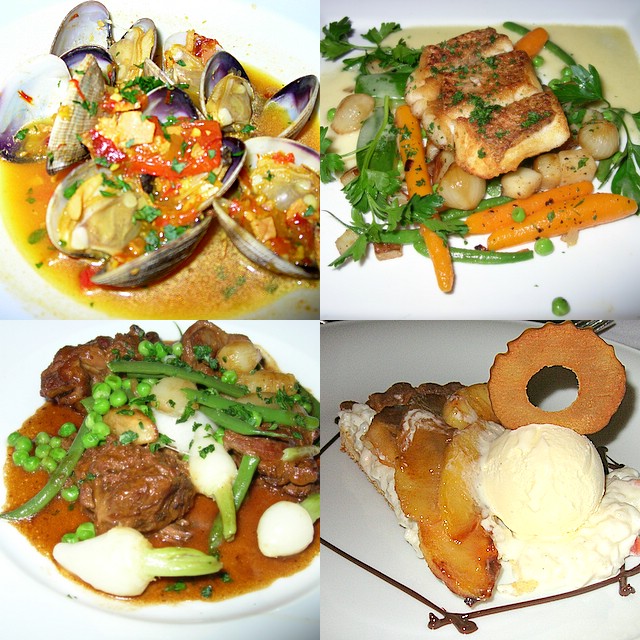
Restaurant 25: L'Ecole
RESTAURANT: L’Ecole (Restaurant of the French Culinary Institute)
LOCATION: 462 Broadway
DATE: May 20, 2005
FOOD: Five Course Tasting – Appetizer: Steamed Clams with Roasted Red Pepper, Hazelnut, and Ham; Fish Course: Red Snapper Filet in a Tart Cream Sauce, Medley of Spring Vegetables; Meat Course: Lamb Stew with Baby Vegetables; Digestive Salad; Dessert: Apple Rice Pudding Tart.
BEVERAGE: Glass of Red Wine; Decaf Coffee
PRICE: $55.00
It was time to go back to school.
Not for sociology, like I dream of, but for a more accessible love – food.
Having made a previous (surprise) visit with Libby to L’Ecole on my birthday, I had been hankering to go back to the restaurant offshoot of the French Culinary Institute ever since. The prior visit had included incredible selections such as a warm mushroom tart and delicious lamb chops, but even more memorably, the house specialty of perfectly seasoned shoestring fries.
What I failed to realize at the time, was that L’Ecole has two seatings per night, each with a different menu. In December, I ate during the earlier sitting, while my most recent visit fell during the later. As our waitress informed us, this unfortunately meant that the fries for which I had so hankered, were not available, offered only during the earlier hours. I felt like Of Human Bondage’s Philip when the prostitute he has fallen in love with informs him that she will be going only holiday with another man – namely, betrayed and dejected. However, I resolved to press on, determined to enjoy the meal regardless.
Many of L’Ecole’s chefs will go on to become stars, noteworthy for their imaginative rethinkings of food. But while at the school, attempts at innovation seem limited. L’Ecole serves very traditional French fair. But at just $31.50, the five course tasting menu is without a doubt one of the best deals in the city, so innovation be damned.
Everything I had at L’Ecole was very good. But I would have a problem calling anything exceptional. Unlike the fries from my previous visit, I won’t be lauding the merits of any of the newer dishes for weeks afterwards. For my appetizer course I selected the steamed clams with roasted red pepper, hazelnut, and ham. The clams came in a golden broth, small bright squares of red pepper and ham producing a collage effect over the gray clamshells. The presentation however was more impressive than the taste. Though the clams were tender and provided no source for complaint, the other flavors of the dish were completely innocuous. I missed the sweet of the pepper, while I tasted the salt of the ham, but not the pork.
But my fish course more than made up for anything that the clams had lacked. Red snapper is my father’s favorite seafood and I have inherited his fondness for the fish. L’Ecole’s was heavenly – seared crisp on the outside and paired with a tart, Key-Lime pie like cream sauce and crunchy fresh vegetables. I’m sure Poseidon would gladly surrender his brethren for such a meal and if children were given this type of fish while young instead of Gordon’s Fish Sticks (despite the ad’s desperate pleas, I can’t trust a man dressed like a large banana), the quantity of chicken fingers and hamburgers consumed in this country would go down exponentially.
My meat course was a lamb stew very akin to American pot roast. The lamb had obviously been simmered for hours, the care evident in the way the lamb appetizingly broke apart at the mere suggestion of my fork. The stew’s sauce was a bit heavy and the vegetables a tad plain, but the dish was an authentic version of rustic French cooking and something I like eating every so often.
Salad then prefaced dessert. While I’m all for cultural integrity, I have to say that for once, I prefer the American concept of serving salad before dinner to the French method of serving salad before dessert. Salad cleanses the palate, but shares the flavors of entrees. I prefer a small amount of sorbet before dessert to the mix of cabbage, oil and vinegar. Though I doubt either side would agree, I’d propose that the French trade their salad etiquette for ours and the U.S. trade Jerry Bruckheimer and all those involved in the American Pie debacles for Godard. Just thought I’d throw that out there.
Dessert was the most adventurous option of the night. An apple-rice pudding tart combined two dessert favorites into one in the same way John Woo manages to combine everything wrong with action films into a single obnoxious aesthetic (he has flying doves in every single movie, I mean seriously, this symbol had already been run into the ground by the time Noah used it). The dessert reminded me somewhat of Galileo’s (of Washington, D.C.) ricotta Italian tart, due less to the taste, than from the appearance and fact that both were excellent desserts without being all that sweet. I loved the way the rice pudding supported the apples and updated a traditional apple dessert to have greater flair.
L’Ecole does nothing to diminish the high-standing of French cuisine in the food hierarchy. While I still miss my fries like the puppy my parents would never let me have as a kid, there was plenty else to make L’Ecole appealing. I may have had better French food, but for $31.50, it’s hard to argue that L’Ecole isn’t worth a visit. If all such training schools were this refined, I’d be getting my haircuts for free and my teeth cleaned at the local dental college. My assignments on 20th century European history at the University of Virginia certainly never tasted this good.
RATING: 7.2/10
LOCATION: 462 Broadway
DATE: May 20, 2005
FOOD: Five Course Tasting – Appetizer: Steamed Clams with Roasted Red Pepper, Hazelnut, and Ham; Fish Course: Red Snapper Filet in a Tart Cream Sauce, Medley of Spring Vegetables; Meat Course: Lamb Stew with Baby Vegetables; Digestive Salad; Dessert: Apple Rice Pudding Tart.
BEVERAGE: Glass of Red Wine; Decaf Coffee
PRICE: $55.00
It was time to go back to school.
Not for sociology, like I dream of, but for a more accessible love – food.
Having made a previous (surprise) visit with Libby to L’Ecole on my birthday, I had been hankering to go back to the restaurant offshoot of the French Culinary Institute ever since. The prior visit had included incredible selections such as a warm mushroom tart and delicious lamb chops, but even more memorably, the house specialty of perfectly seasoned shoestring fries.
What I failed to realize at the time, was that L’Ecole has two seatings per night, each with a different menu. In December, I ate during the earlier sitting, while my most recent visit fell during the later. As our waitress informed us, this unfortunately meant that the fries for which I had so hankered, were not available, offered only during the earlier hours. I felt like Of Human Bondage’s Philip when the prostitute he has fallen in love with informs him that she will be going only holiday with another man – namely, betrayed and dejected. However, I resolved to press on, determined to enjoy the meal regardless.
Many of L’Ecole’s chefs will go on to become stars, noteworthy for their imaginative rethinkings of food. But while at the school, attempts at innovation seem limited. L’Ecole serves very traditional French fair. But at just $31.50, the five course tasting menu is without a doubt one of the best deals in the city, so innovation be damned.
Everything I had at L’Ecole was very good. But I would have a problem calling anything exceptional. Unlike the fries from my previous visit, I won’t be lauding the merits of any of the newer dishes for weeks afterwards. For my appetizer course I selected the steamed clams with roasted red pepper, hazelnut, and ham. The clams came in a golden broth, small bright squares of red pepper and ham producing a collage effect over the gray clamshells. The presentation however was more impressive than the taste. Though the clams were tender and provided no source for complaint, the other flavors of the dish were completely innocuous. I missed the sweet of the pepper, while I tasted the salt of the ham, but not the pork.
But my fish course more than made up for anything that the clams had lacked. Red snapper is my father’s favorite seafood and I have inherited his fondness for the fish. L’Ecole’s was heavenly – seared crisp on the outside and paired with a tart, Key-Lime pie like cream sauce and crunchy fresh vegetables. I’m sure Poseidon would gladly surrender his brethren for such a meal and if children were given this type of fish while young instead of Gordon’s Fish Sticks (despite the ad’s desperate pleas, I can’t trust a man dressed like a large banana), the quantity of chicken fingers and hamburgers consumed in this country would go down exponentially.
My meat course was a lamb stew very akin to American pot roast. The lamb had obviously been simmered for hours, the care evident in the way the lamb appetizingly broke apart at the mere suggestion of my fork. The stew’s sauce was a bit heavy and the vegetables a tad plain, but the dish was an authentic version of rustic French cooking and something I like eating every so often.
Salad then prefaced dessert. While I’m all for cultural integrity, I have to say that for once, I prefer the American concept of serving salad before dinner to the French method of serving salad before dessert. Salad cleanses the palate, but shares the flavors of entrees. I prefer a small amount of sorbet before dessert to the mix of cabbage, oil and vinegar. Though I doubt either side would agree, I’d propose that the French trade their salad etiquette for ours and the U.S. trade Jerry Bruckheimer and all those involved in the American Pie debacles for Godard. Just thought I’d throw that out there.
Dessert was the most adventurous option of the night. An apple-rice pudding tart combined two dessert favorites into one in the same way John Woo manages to combine everything wrong with action films into a single obnoxious aesthetic (he has flying doves in every single movie, I mean seriously, this symbol had already been run into the ground by the time Noah used it). The dessert reminded me somewhat of Galileo’s (of Washington, D.C.) ricotta Italian tart, due less to the taste, than from the appearance and fact that both were excellent desserts without being all that sweet. I loved the way the rice pudding supported the apples and updated a traditional apple dessert to have greater flair.
L’Ecole does nothing to diminish the high-standing of French cuisine in the food hierarchy. While I still miss my fries like the puppy my parents would never let me have as a kid, there was plenty else to make L’Ecole appealing. I may have had better French food, but for $31.50, it’s hard to argue that L’Ecole isn’t worth a visit. If all such training schools were this refined, I’d be getting my haircuts for free and my teeth cleaned at the local dental college. My assignments on 20th century European history at the University of Virginia certainly never tasted this good.
RATING: 7.2/10
Monday, May 23, 2005

Just Desserts 5: Taralluci-E-Vino
RESTAURANT: Taralluci-E-Vino
LOCATION: 163 1st Ave. (corner of 10th and 1st)
DATE: May 19, 2005
DESSERT: Three scoop gelato medley of Kiwi, Tiramisu, and Bacio.
BEVERAGE: Nothing
PRICE: $5.00
Confessions of a Gelato Lover:
"When I close my eyes, I see it. When I lick my lips, I taste it. My addiction grows stronger each day. The shaking won’t stop. The sweating drenches my clothes. I can’t sleep. The voices in my head are getting louder…
Any chance I had to kick the habit, ended when I happened upon Taralluci-E-Vino the other night. During the Winter, they only served dessert and coffee. I was fine. But the warmer temperatures have brought gelato to this coffeshop’s floor. I tired, but I couldn’t resist. I walked in and all was lost.
The tiramisu was only mediocre and perhaps if it had been my lone selection my addiction would still be under control. But the kiwi tasted like I was biting into fresh fruit, black kiwi seeds interlaced in the cream – my junkie track marks. And then the Bacio. Like nothing else – chopped hazelnuts, chocolate – somehow the greatest candy has been bettered. My eyes twitch and my heart races. I get chills for no reason. I’ll try to resist, go to my GA meetings, but I doubt it’ll help. The Bacio’s pull is too strong and my resolve too weak. I need the gelato…"
RATING: 7.9/10
LOCATION: 163 1st Ave. (corner of 10th and 1st)
DATE: May 19, 2005
DESSERT: Three scoop gelato medley of Kiwi, Tiramisu, and Bacio.
BEVERAGE: Nothing
PRICE: $5.00
Confessions of a Gelato Lover:
"When I close my eyes, I see it. When I lick my lips, I taste it. My addiction grows stronger each day. The shaking won’t stop. The sweating drenches my clothes. I can’t sleep. The voices in my head are getting louder…
Any chance I had to kick the habit, ended when I happened upon Taralluci-E-Vino the other night. During the Winter, they only served dessert and coffee. I was fine. But the warmer temperatures have brought gelato to this coffeshop’s floor. I tired, but I couldn’t resist. I walked in and all was lost.
The tiramisu was only mediocre and perhaps if it had been my lone selection my addiction would still be under control. But the kiwi tasted like I was biting into fresh fruit, black kiwi seeds interlaced in the cream – my junkie track marks. And then the Bacio. Like nothing else – chopped hazelnuts, chocolate – somehow the greatest candy has been bettered. My eyes twitch and my heart races. I get chills for no reason. I’ll try to resist, go to my GA meetings, but I doubt it’ll help. The Bacio’s pull is too strong and my resolve too weak. I need the gelato…"
RATING: 7.9/10
Po Photos

Row 1: Po on Cornelia St., White Bean Brushchetta, Salad with Asiago Cheese, Salami and Porcini Mushrooms; Row 2: Ricotta Tortelloni, Smoked Mozzarella with Gnocchi, Lamb with Cumin Yogurt; Row 3: Strawberries in Balsamic Vinegar, Chocolate Hazelnut Terrine, A Local Artist's Depiction of Po.
Restaurant 24: Po (Special Feature)
RESTAURANT: Po
LOCATION: 31 Cornelia St.
DATE: May 19, 2005
FOOD: Tasting Menu – White Bean Brushetta; Mixed Green Salad with Asiago, Porcini Mushrooms, and Salami; Tortelloni with Ricotta and Ramps in a White Truffle Butter Sauce; Homemade Gnocchi with Smoked Mozzarella; Lamb served with White Beans and Cumin Yogurt; Cheese Plate; Chocolate Hazelnut Terrine and Strawberries in Balsamic Vinegar.
BEVERAGE: Half a bottle of white wine; Decaf coffee
PRICE: Danny’s Treat
SPECIAL FEATURE - BEST CURE FOR WORK-A-DAY BLUES
In the movie Tampopo (Mario Battali’s favorite food film), director Juzo Itami illustrates the myriad needs food can fill or help to dissipate. Food is taste but also hinges significantly on emotion. It can act as substitute for that which is missing or augment what is already possessed. It is also a wonderful parallel to the sharing (of all kinds) involved in lasting friendships.
Danny had had a day fit for Charlie Brown. His computer died three days past the warranty expiration date (be wary of Dells), and his work caseload had reached a near maximum stress level. In such a situation, there was only one response – to eat well.
He chose Po (the restaurant Battali started at, yes, I know I use any excuse to mention him), a cozy West Village Italian that became our sanctuary for the night. Its Mediterranean whitewashed walls, pale lighting, and sedate atmosphere made conversation flow as easily as the river it is named for.
We ordered the tasting menu and what ensued were seven courses of adeptly prepared and sapid cuisine. The white bean bruschetta which began our meal contrasted the salty chewiness of the beans with the firm crunch of the bread delightfully. The salad course came next and I was surprised by how well the seemingly disparate ingredients of salami, Asiago cheese and Porcini mushrooms worked together. The mushrooms were warm and adequately firm (instead of many Italian’s places efforts ending in mush) with a resistance that mirrored the bite of the salami. I used two extra pieces of bread to make sure that even a signal drop of the slightly spicy vinegrette wasn’t left on the plate. It was hard not to relax at Po and forget about all the problems of the outside world.
The first of two pasta courses then arrived. In what was my favorite dish of the evening, the pungent flavor of ramps (a seasonal relative of the leek) mixed with the creamy buoyancy of ricotta cheese as the filling for a near perfect tortelloni. While I usually find butter sauces oily and so overbearing as to mask other flavors in a dish, Po’s white truffle butter sauce was as light as a Danielle Steel novel, but with all the substance of Italo Calvino. The white truffle was subtle but definitely present and when it came into contact with the ricotta, the combination was masterful.
Homemade gnocchi with smoked mozzarella followed. While the gnocchi was very good, weightless, but with enough potato taste to make it distinct from normal pasta, the smoked mozzarella was too strong, overmatching the red sauce and the gnocchi. The cheese tasted more like the rind of smoked Gouda than the type of buffalo mozzarella I covet, and the dish would have been better served by a less abrasive cheese. However, Po’s cuisine continued to elicit conversation from us both on itself but also about life in general. Po made me comfortable in the same way as going home for Thanksgiving or as was the case that night, being in the presence of a friend you know incredibly well and never get tired of.
Our main entrée was seared lamb with hints of mid-eastern spices. It came accompanied by cumin yogurt and white beans echoing the bruschetta that started the meal. I loved this legume self-reflection and the lamb was downright succulent. Overall, the dish’s various influences can be described best by one word: harmonious.
The cheese course was a sampling of three Italian cheeses. A mild and soft blue cheese appeared in another echo of an earlier dish, this time the ricotta of the tortelloni. A cacio cheese tasted remarkably similar to Romano or parmesan, wonderfully sharp and a bit tangy. To end the meal, a chocolate hazelnut terrine as rich and pliable as fudge, reminded me of my favorite candy, Bacio. Even more interesting though were the strawberries in balsamic vinegar. While working at the A-Bar-A ranch in Wyoming, I was fortunate enough to eat this slightly strange combination frequently, due to the ranch’s executive chef Kent Trebilcox. Danny had never had strawberries prepared in such a fashion and liked the commingling of sour and sweet. However, based on Kent’s recipe, I wanted more vinegar and black pepper on the strawberries (an absolutely amazing side I would recommend to anyone, adjusting the levels to individual preference), as instead of being able to taste the vinegar in each bite, it was only once we got to the bottom of the glass and the shallow pool of vinegar resting there that the acidity really became noticeable.
The servers at Po made everything seem effortless. I am a prodigious guzzler of water and though my glass was probably refilled more than ten times, it never went empty. The attentiveness just added to an already wonderful evening. By the time Danny asked for the check (somehow even though it was Danny’s bad day, he decided dinner was his treat), I had forgotten about the problems I didn’t have but was please to see Danny noticeably mellowed. Good food, like good friends, makes time inconsequential and life manageable. Danny had chosen well – Po was the perfect place to turn an awful day into one of laughter and cheer. Forgive my propensity for sappiness, but dinner at Po made ever more apparent that the secret to being happy in life is all in the choice of the company you keep.
RATING: 8.0/10
LOCATION: 31 Cornelia St.
DATE: May 19, 2005
FOOD: Tasting Menu – White Bean Brushetta; Mixed Green Salad with Asiago, Porcini Mushrooms, and Salami; Tortelloni with Ricotta and Ramps in a White Truffle Butter Sauce; Homemade Gnocchi with Smoked Mozzarella; Lamb served with White Beans and Cumin Yogurt; Cheese Plate; Chocolate Hazelnut Terrine and Strawberries in Balsamic Vinegar.
BEVERAGE: Half a bottle of white wine; Decaf coffee
PRICE: Danny’s Treat
SPECIAL FEATURE - BEST CURE FOR WORK-A-DAY BLUES
In the movie Tampopo (Mario Battali’s favorite food film), director Juzo Itami illustrates the myriad needs food can fill or help to dissipate. Food is taste but also hinges significantly on emotion. It can act as substitute for that which is missing or augment what is already possessed. It is also a wonderful parallel to the sharing (of all kinds) involved in lasting friendships.
Danny had had a day fit for Charlie Brown. His computer died three days past the warranty expiration date (be wary of Dells), and his work caseload had reached a near maximum stress level. In such a situation, there was only one response – to eat well.
He chose Po (the restaurant Battali started at, yes, I know I use any excuse to mention him), a cozy West Village Italian that became our sanctuary for the night. Its Mediterranean whitewashed walls, pale lighting, and sedate atmosphere made conversation flow as easily as the river it is named for.
We ordered the tasting menu and what ensued were seven courses of adeptly prepared and sapid cuisine. The white bean bruschetta which began our meal contrasted the salty chewiness of the beans with the firm crunch of the bread delightfully. The salad course came next and I was surprised by how well the seemingly disparate ingredients of salami, Asiago cheese and Porcini mushrooms worked together. The mushrooms were warm and adequately firm (instead of many Italian’s places efforts ending in mush) with a resistance that mirrored the bite of the salami. I used two extra pieces of bread to make sure that even a signal drop of the slightly spicy vinegrette wasn’t left on the plate. It was hard not to relax at Po and forget about all the problems of the outside world.
The first of two pasta courses then arrived. In what was my favorite dish of the evening, the pungent flavor of ramps (a seasonal relative of the leek) mixed with the creamy buoyancy of ricotta cheese as the filling for a near perfect tortelloni. While I usually find butter sauces oily and so overbearing as to mask other flavors in a dish, Po’s white truffle butter sauce was as light as a Danielle Steel novel, but with all the substance of Italo Calvino. The white truffle was subtle but definitely present and when it came into contact with the ricotta, the combination was masterful.
Homemade gnocchi with smoked mozzarella followed. While the gnocchi was very good, weightless, but with enough potato taste to make it distinct from normal pasta, the smoked mozzarella was too strong, overmatching the red sauce and the gnocchi. The cheese tasted more like the rind of smoked Gouda than the type of buffalo mozzarella I covet, and the dish would have been better served by a less abrasive cheese. However, Po’s cuisine continued to elicit conversation from us both on itself but also about life in general. Po made me comfortable in the same way as going home for Thanksgiving or as was the case that night, being in the presence of a friend you know incredibly well and never get tired of.
Our main entrée was seared lamb with hints of mid-eastern spices. It came accompanied by cumin yogurt and white beans echoing the bruschetta that started the meal. I loved this legume self-reflection and the lamb was downright succulent. Overall, the dish’s various influences can be described best by one word: harmonious.
The cheese course was a sampling of three Italian cheeses. A mild and soft blue cheese appeared in another echo of an earlier dish, this time the ricotta of the tortelloni. A cacio cheese tasted remarkably similar to Romano or parmesan, wonderfully sharp and a bit tangy. To end the meal, a chocolate hazelnut terrine as rich and pliable as fudge, reminded me of my favorite candy, Bacio. Even more interesting though were the strawberries in balsamic vinegar. While working at the A-Bar-A ranch in Wyoming, I was fortunate enough to eat this slightly strange combination frequently, due to the ranch’s executive chef Kent Trebilcox. Danny had never had strawberries prepared in such a fashion and liked the commingling of sour and sweet. However, based on Kent’s recipe, I wanted more vinegar and black pepper on the strawberries (an absolutely amazing side I would recommend to anyone, adjusting the levels to individual preference), as instead of being able to taste the vinegar in each bite, it was only once we got to the bottom of the glass and the shallow pool of vinegar resting there that the acidity really became noticeable.
The servers at Po made everything seem effortless. I am a prodigious guzzler of water and though my glass was probably refilled more than ten times, it never went empty. The attentiveness just added to an already wonderful evening. By the time Danny asked for the check (somehow even though it was Danny’s bad day, he decided dinner was his treat), I had forgotten about the problems I didn’t have but was please to see Danny noticeably mellowed. Good food, like good friends, makes time inconsequential and life manageable. Danny had chosen well – Po was the perfect place to turn an awful day into one of laughter and cheer. Forgive my propensity for sappiness, but dinner at Po made ever more apparent that the secret to being happy in life is all in the choice of the company you keep.
RATING: 8.0/10
Saturday, May 21, 2005

Book 7: Henry V, by William Shakespeare
In Weber’s analysis of charismatic leadership, he speaks of how the best leaders are those who realize that a person cannot head a government without committing immoral acts. But what separates great leaders from all others is the ability of the elect few to face this dilemma unflinchingly and take responsibility for all their actions, whether good, evil, murderous, or disastrous.
George Bush obviously never had time to read Weber while at Yale – being fratastic and spending daddy’s money does takes up a lot of time after all. But perhaps Laura could turn off “Desperate Housewives” for one night and read her husband Henry V as a goodnight story. There’s plenty of violence and a rather unjustified war, so he’d be sure to like it.
But our fearless GW might be shocked when Laura got to the first scene of Act 4, when Henry V engages in an activity apparently unheard of in contemporary Washington – self-reflection. In a play that fails to measure up to Hamlet, King Lear, or Othello, one of those marvelous Shakespearean moments pops up after pages of threatening gibber jabbing and testosterone driven dialogue. It is the moment when Henry V appears his most human, when he understands that a significant part of being a King is accostuming oneself to acting as if one is separate from the rest of humanity, despite the knowledge that no such divide actually exists. The King laments:
“And what have kings that privates have not too/Save ceremony, save general ceremony?/And what art thou, thou idol Ceremony?/…O Ceremony, show me but thy worth!/What is thy soul of adoration?/Art thou aught else but place, degree, and form,/Creating awe and fear in other men?/Wherein thou art less happy, being feared,/Than they in fearing./What drink’st thou oft, instead of homage sweet,/But poisoned flattery?”
Kings are normal men adorned in the vestments of God – the clothes, pomp and circumstance, gilded environs – is the very “ceremony” of pretense Henry V is astute enough to see through. He is mortal just like the men in his army, just like the French whom he is fighting a war against, a war based largely on solidifying his position as King and proving to his constituency that he does in fact deserve the role. His actions may seem kingly to others, but Henry V knows he can’t escape the layers upon layers of pretense requisite in leading other men.
Henry V seems to embody Weber’s ideal of good leadership. Whether it is when he kills traitors attempting his assassination or dealing with thieves within his own ranks, Henry V is a king who acts and then accepts the consequences of these actions. You would never hear Henry V blame Abu Ghirab on a “few bad eggs” or shelter Donald Rumsfeld or Alberto Gonzalez. Like Kennedy after the Bay of Pigs, Henry V doesn’t shy away from any of the results of his war against the French. It’s refreshing to see a leader respond in such a fashion, even if this is a piece of literature and not “real life”. In many ways similar to Julius Caesar, and suffering many of the same pitfalls of that work, from elongated, insubstantial dialogue (frequently unnecessary and downright boring), to a focus too heavily on violent action and an overlooking of the insight which makes Hamlet the masterpiece it is, Henry V still exhibits many of Shakespeare’s talents. Most importantly as an accurate depiction of how to lead effectively, choosing where there are no right answers, only options that are less harmful than others, the play is an interesting study into the nature of political maneuvering and war. Now if only GW would put down the William Bennett, kick Karl Rove out of the room, and open a book with multi-syllable words. It would make Weber proud.
George Bush obviously never had time to read Weber while at Yale – being fratastic and spending daddy’s money does takes up a lot of time after all. But perhaps Laura could turn off “Desperate Housewives” for one night and read her husband Henry V as a goodnight story. There’s plenty of violence and a rather unjustified war, so he’d be sure to like it.
But our fearless GW might be shocked when Laura got to the first scene of Act 4, when Henry V engages in an activity apparently unheard of in contemporary Washington – self-reflection. In a play that fails to measure up to Hamlet, King Lear, or Othello, one of those marvelous Shakespearean moments pops up after pages of threatening gibber jabbing and testosterone driven dialogue. It is the moment when Henry V appears his most human, when he understands that a significant part of being a King is accostuming oneself to acting as if one is separate from the rest of humanity, despite the knowledge that no such divide actually exists. The King laments:
“And what have kings that privates have not too/Save ceremony, save general ceremony?/And what art thou, thou idol Ceremony?/…O Ceremony, show me but thy worth!/What is thy soul of adoration?/Art thou aught else but place, degree, and form,/Creating awe and fear in other men?/Wherein thou art less happy, being feared,/Than they in fearing./What drink’st thou oft, instead of homage sweet,/But poisoned flattery?”
Kings are normal men adorned in the vestments of God – the clothes, pomp and circumstance, gilded environs – is the very “ceremony” of pretense Henry V is astute enough to see through. He is mortal just like the men in his army, just like the French whom he is fighting a war against, a war based largely on solidifying his position as King and proving to his constituency that he does in fact deserve the role. His actions may seem kingly to others, but Henry V knows he can’t escape the layers upon layers of pretense requisite in leading other men.
Henry V seems to embody Weber’s ideal of good leadership. Whether it is when he kills traitors attempting his assassination or dealing with thieves within his own ranks, Henry V is a king who acts and then accepts the consequences of these actions. You would never hear Henry V blame Abu Ghirab on a “few bad eggs” or shelter Donald Rumsfeld or Alberto Gonzalez. Like Kennedy after the Bay of Pigs, Henry V doesn’t shy away from any of the results of his war against the French. It’s refreshing to see a leader respond in such a fashion, even if this is a piece of literature and not “real life”. In many ways similar to Julius Caesar, and suffering many of the same pitfalls of that work, from elongated, insubstantial dialogue (frequently unnecessary and downright boring), to a focus too heavily on violent action and an overlooking of the insight which makes Hamlet the masterpiece it is, Henry V still exhibits many of Shakespeare’s talents. Most importantly as an accurate depiction of how to lead effectively, choosing where there are no right answers, only options that are less harmful than others, the play is an interesting study into the nature of political maneuvering and war. Now if only GW would put down the William Bennett, kick Karl Rove out of the room, and open a book with multi-syllable words. It would make Weber proud.
Friday, May 20, 2005
Ted Drewes Frozen Custard Photos

Row 1: Oatmeal Cookie Sandwich, Big Apple Concrete, Ted Drewes Stand; Row 2: Ubiquitous Ted Drewes Signs; Row 3: Stand front, Strawberry Shortcake Concrete, the cookie sandwich encore.
Just Desserts 4: Ted Drewes Frozen Custard (St. Louis, Missouri)
RESTAURANT: Ted Drewes Frozen Custard
LOCATION: 6726 Chippewa St.
DATE: May 13, 2005 and May 16, 2005
FOOD: May 13th – Big Apple Concrete with Cashews, Scotch Oatmeal Cookie Sandwich; May 16th – Strawberry Shortcake Concrete with Pistachios, Scotch Oatmeal Cookie Sandwich.
BEVERAGE: Tap Water
PRICE: May 13th - $4.50; May 16th – $5.50
I love Ted Drewes. Let’s just get out there right up front. It is hands down the best custard I’ve ever had. On my flight from New York to St. Louis, I started getting excited about Ted Drewes somewhere around eastern Pennsylvania. I was in St. Louis for less than two full days and yet went to Ted Drewes twice. Like I said, I love Ted Drewes.
My first visit came last fall when Libby introduced me to the famous St. Louis custard stand. At that time, they were offering the seasonal Great Pumpkin concrete, a blend containing a full piece of pumpkin pie. But Fall ended long ago and Spring is now here. And with it, so too the Big Apple concrete, Ted Drewes rich custard mixed with a full piece of apple pie.
Shake Shake’s custard was still fresh in my mind. And while it was excellent, compared to Ted Drewes it comes up short. Ted Drewes vanilla custard is somehow creamier, somehow smoother, somehow better than every other custard out there. Perhaps it’s all in the balance. The concrete comes slightly liquid without being anemic. It melts into the consistency of full cream whereas others end in a watery, milky mess. In its untouched frozen form in the oatmeal sandwich, the custard is firm without being rigidly ossified. Ted Drewes custard is the Olympic gymnast who has no problem doing flips on a balance beam four inches in diameter. In his writing Don LeLillo merges weighty, post-modern ideas with an accessible style, creating a balance that makes him an amazing read. Ted Drewes custard is akin to this. It’s like a Ted Drewes research committee examined the flaws of all other custards and figured out a way to make a product that avoided all their pitfalls. The result is amazing.
The Big Apple concrete takes this mind blowing custard and adds the cinnamon, glazed apples and flaky crust of fresh baked pie. How could the result be anything but astounding? It’s pie drowning in an a la mode sea. The pie chunks are in half-bite pieces, so the texture and integrity of the pie is maintained. I added cashews to mine and the salty crunch was fantastic. Next time (and there will be a next time), I’ll try it with walnuts.
On both my visits, Libby and I split an oatmeal cookie sandwich, a steal at just $1. The cookies come without raisins, but with a faint hint of honey that goes well with a custard exhibiting only a mild level of sweetness. For my second visit, I forced myself to try a concrete other than the Big Apple, opting for the strawberry shortcake. The fruit was wonderful and my only complaint would be for the shortcake to come in as big of pieces as the pie. In some bites I got crumbs, not cake.
Ted Drewes alone makes St. Louis a city I will always enjoying visiting. While frozen custard may never reach the level of dessert perfection that gelato holds for me, at least I know for certain that if custard ever does attain this holy gelato plain, it’ll happen at Ted Drewes before anywhere else.
RATING: 9.0/10
LOCATION: 6726 Chippewa St.
DATE: May 13, 2005 and May 16, 2005
FOOD: May 13th – Big Apple Concrete with Cashews, Scotch Oatmeal Cookie Sandwich; May 16th – Strawberry Shortcake Concrete with Pistachios, Scotch Oatmeal Cookie Sandwich.
BEVERAGE: Tap Water
PRICE: May 13th - $4.50; May 16th – $5.50
I love Ted Drewes. Let’s just get out there right up front. It is hands down the best custard I’ve ever had. On my flight from New York to St. Louis, I started getting excited about Ted Drewes somewhere around eastern Pennsylvania. I was in St. Louis for less than two full days and yet went to Ted Drewes twice. Like I said, I love Ted Drewes.
My first visit came last fall when Libby introduced me to the famous St. Louis custard stand. At that time, they were offering the seasonal Great Pumpkin concrete, a blend containing a full piece of pumpkin pie. But Fall ended long ago and Spring is now here. And with it, so too the Big Apple concrete, Ted Drewes rich custard mixed with a full piece of apple pie.
Shake Shake’s custard was still fresh in my mind. And while it was excellent, compared to Ted Drewes it comes up short. Ted Drewes vanilla custard is somehow creamier, somehow smoother, somehow better than every other custard out there. Perhaps it’s all in the balance. The concrete comes slightly liquid without being anemic. It melts into the consistency of full cream whereas others end in a watery, milky mess. In its untouched frozen form in the oatmeal sandwich, the custard is firm without being rigidly ossified. Ted Drewes custard is the Olympic gymnast who has no problem doing flips on a balance beam four inches in diameter. In his writing Don LeLillo merges weighty, post-modern ideas with an accessible style, creating a balance that makes him an amazing read. Ted Drewes custard is akin to this. It’s like a Ted Drewes research committee examined the flaws of all other custards and figured out a way to make a product that avoided all their pitfalls. The result is amazing.
The Big Apple concrete takes this mind blowing custard and adds the cinnamon, glazed apples and flaky crust of fresh baked pie. How could the result be anything but astounding? It’s pie drowning in an a la mode sea. The pie chunks are in half-bite pieces, so the texture and integrity of the pie is maintained. I added cashews to mine and the salty crunch was fantastic. Next time (and there will be a next time), I’ll try it with walnuts.
On both my visits, Libby and I split an oatmeal cookie sandwich, a steal at just $1. The cookies come without raisins, but with a faint hint of honey that goes well with a custard exhibiting only a mild level of sweetness. For my second visit, I forced myself to try a concrete other than the Big Apple, opting for the strawberry shortcake. The fruit was wonderful and my only complaint would be for the shortcake to come in as big of pieces as the pie. In some bites I got crumbs, not cake.
Ted Drewes alone makes St. Louis a city I will always enjoying visiting. While frozen custard may never reach the level of dessert perfection that gelato holds for me, at least I know for certain that if custard ever does attain this holy gelato plain, it’ll happen at Ted Drewes before anywhere else.
RATING: 9.0/10
Soulard Coffee Garden Photos
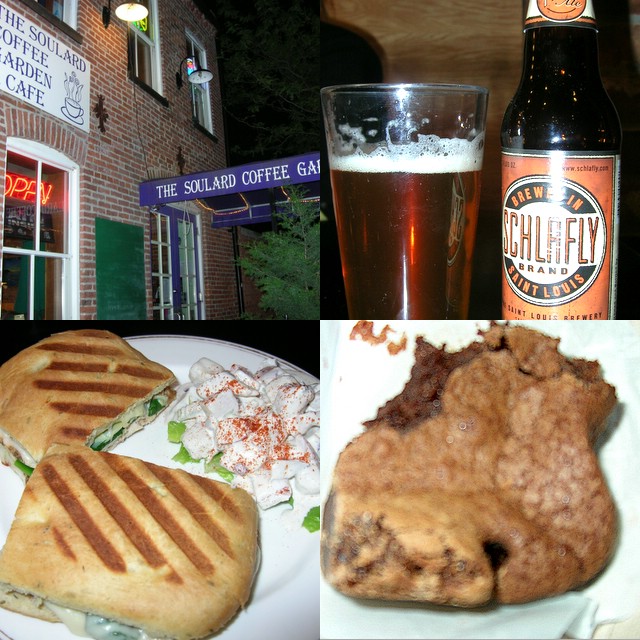
Clockwise from top left: The Soulard Coffee Garden in St. Louis; Schlafly Pale Ale, Fudge Pie Brownie (yes I know it looks like dog turd, but it tasted really good); Chicken Panini and potato salad.
Restaurant 23: Soulard Coffee Garden (St. Louis, Missouri)
RESTAURANT: Soulard Coffee Garden
LOCATION: 910 Geyer Ave.
DATE: May 15, 2005
FOOD: Chicken Panini with Spinach and Swiss Cheese; Side of Potato Salad; Fudge Pie Brownie.
BEVERAGE: Schlafly Pale Ale (St. Louis home brew); Decaf Soy Mocha Latte
PRICE: $20.00
St. Louis, like New York, is a city of neighborhoods. Soulard, a neighborhood mixing the open-minded embrace of all individuals distinct to the West Village (I’m politely trying to suggest that it is an area where many homosexuals live…not that there’s anything wrong with that…yet another of the world’s most overplayed jokes appearing on this blog…) with the townhouse, tree lined sidewalk feel of Brooklyn. If Park Slope, Brooklyn was moved west of the Mississippi, it would most likely be Soulard (yes I was in Saint Louis, Missouri. Never, never, NEVER go to East St. Louis. Trust me on this). Relaxed and slightly artsy, the brown brick buildings and elaborate gardens of Soulard make it one of the most attractive areas in the city.
The Soulard Coffee Garden fits in perfectly with this mildly bohemian atmosphere. In an eclectic neighborhood where a wine shop also sells lawn furniture and costume stores sit next to an Irish pub, the Soulard Coffee Garden is diverse enough to meet all residents’ demands. Half coffee house, half bistro, you can sip a coffee for hours while reading Everything Is Illuminated (review coming soon), or plunk down for one of the many delicious panini, soups, or desserts.
Libby and I arrived at the Soulard Coffee Garden late on Sunday night after returning from Kansas City. I ordered the chicken panini. While the chicken was slightly dry and tough, the fresh spinach had been wilted nicely and the melted cheese made the sandwich overall very tasty. Not a potato salad fan per se (with a visit to Per Se coming up in just a few weeks, be prepared to see a lot of references of this sort), I ordered it anyway and was pleasantly surprised. Though there was too much mayonnaise for my taste, that the dressing had been loaded with herbs and peppers and that the potatoes were firm and offset by pungent red onions made this much better than run of the mill Food Lion, sit in a display counter for weeks on end, potato salad. The Schlafly Pale Ale, a St. Louis staple, was great as always.
For dessert, Libby and I split (by split, I mean I ate 75% and she was lucky not to get her hand bitten off trying to reach in for 25% of the fudge decadence) the fudge pie brownie which was basically pure chocolate. The brownie might have been too much on its own, leaving my mouth with the same thick gooey feel of eating a spoon of peanut butter, but the perfectly bitter and steaming decaf soy mocha broke up the brownie, forming as appropriately formidable a duo as G.B. Shaw and class divisions or Kathy Lee Gifford and slave labor. Soulard Coffee Garden may have a wide menu, but the coffee was the best thing I had, a decaf that truly tasted like “real”, fully caffeinated dark roasted coffee.
The Soulard Coffee Garden is an example of why there need to be less Starbucks and more independent coffee houses. In the perverted future of Mitchell’s Cloud Atlas, corporations have gained such ubiquitous control, that characters call shoes nikes and coffee starbucks. I hope Mitchell’s vision never becomes reality. It would be a shame if there ever came a time when places like the Soulard Coffee Garden no longer existed.
RATING: 6.7/10
LOCATION: 910 Geyer Ave.
DATE: May 15, 2005
FOOD: Chicken Panini with Spinach and Swiss Cheese; Side of Potato Salad; Fudge Pie Brownie.
BEVERAGE: Schlafly Pale Ale (St. Louis home brew); Decaf Soy Mocha Latte
PRICE: $20.00
St. Louis, like New York, is a city of neighborhoods. Soulard, a neighborhood mixing the open-minded embrace of all individuals distinct to the West Village (I’m politely trying to suggest that it is an area where many homosexuals live…not that there’s anything wrong with that…yet another of the world’s most overplayed jokes appearing on this blog…) with the townhouse, tree lined sidewalk feel of Brooklyn. If Park Slope, Brooklyn was moved west of the Mississippi, it would most likely be Soulard (yes I was in Saint Louis, Missouri. Never, never, NEVER go to East St. Louis. Trust me on this). Relaxed and slightly artsy, the brown brick buildings and elaborate gardens of Soulard make it one of the most attractive areas in the city.
The Soulard Coffee Garden fits in perfectly with this mildly bohemian atmosphere. In an eclectic neighborhood where a wine shop also sells lawn furniture and costume stores sit next to an Irish pub, the Soulard Coffee Garden is diverse enough to meet all residents’ demands. Half coffee house, half bistro, you can sip a coffee for hours while reading Everything Is Illuminated (review coming soon), or plunk down for one of the many delicious panini, soups, or desserts.
Libby and I arrived at the Soulard Coffee Garden late on Sunday night after returning from Kansas City. I ordered the chicken panini. While the chicken was slightly dry and tough, the fresh spinach had been wilted nicely and the melted cheese made the sandwich overall very tasty. Not a potato salad fan per se (with a visit to Per Se coming up in just a few weeks, be prepared to see a lot of references of this sort), I ordered it anyway and was pleasantly surprised. Though there was too much mayonnaise for my taste, that the dressing had been loaded with herbs and peppers and that the potatoes were firm and offset by pungent red onions made this much better than run of the mill Food Lion, sit in a display counter for weeks on end, potato salad. The Schlafly Pale Ale, a St. Louis staple, was great as always.
For dessert, Libby and I split (by split, I mean I ate 75% and she was lucky not to get her hand bitten off trying to reach in for 25% of the fudge decadence) the fudge pie brownie which was basically pure chocolate. The brownie might have been too much on its own, leaving my mouth with the same thick gooey feel of eating a spoon of peanut butter, but the perfectly bitter and steaming decaf soy mocha broke up the brownie, forming as appropriately formidable a duo as G.B. Shaw and class divisions or Kathy Lee Gifford and slave labor. Soulard Coffee Garden may have a wide menu, but the coffee was the best thing I had, a decaf that truly tasted like “real”, fully caffeinated dark roasted coffee.
The Soulard Coffee Garden is an example of why there need to be less Starbucks and more independent coffee houses. In the perverted future of Mitchell’s Cloud Atlas, corporations have gained such ubiquitous control, that characters call shoes nikes and coffee starbucks. I hope Mitchell’s vision never becomes reality. It would be a shame if there ever came a time when places like the Soulard Coffee Garden no longer existed.
RATING: 6.7/10
Thursday, May 19, 2005
D'Bronx Pizzeria Photos

Clockwise from top left: D'Bronx Pizzeria; Special Slice; an odd fountain in the Plaza area of Kansas City; Unity Village in the suburbs of Kansas City.
Restaurant 22: D'Bronx Pizzeria (Kansas City, Missouri)
RESTAURANT: D’Bronx Pizzeria
LOCATION: 3904 Bell St. Kansas City, Missouri
DATE: May 14, 2005
FOOD: Two slices of D’Bronx Special Pizza (Pepperoni, Mushrooms, Onions, Peppers, Italian Sausage)
BEVERAGE: Large diet Coke
PRICE: $6.50 (thanks to Steph’s parents)
Where was I?
I had believed Kansas City, but this tasted like New York…
View this as a slice of good things to come. This Sunday, Danny and I, along with a few other friends, will engage on Pizza World Tour 2005, hitting a notable pizza place in each of the five boroughs. But last Saturday I got a preview tasting – well sort of…
Because while the pizza I enjoyed on Saturday tasted like New York pizza, looked like New York pizza, and was even made in a restaurant with the name of a famed New York pizza borough, I was decidedly not in New York. And though my bites of D’Bronx’s Special pie made me more ready for Pizza World Tour than ever before, I was still in Kansas City, the barbeque and NOT pizza capital of the world.
But like the expertly faked Monets in the Pierce Brosnan version of "The Thomas Crown Affair" which are indistinguishable from the originals, D’Bronx’s pizza is a study in perfected forgery. This pizza would survive remarkably well in the New York pizza scene. While the ingredients were not as excellent as those used by Di Fara’s, nor the mozzarella as fresh and authentically Italian as that used by Grimaldi’s, Patsy’s and Di Fara’s, D’Bronx makes a very mean slice. What it does better than either Grimaldi’s or Patsy’s is the crust. The edges pack warm bubbles that taste like a baked baguette taken right from the oven. Though a thin crust, there’s enough density to D’Bronx’s dough to avoid sogginess, even in the center of the pizza, even under the weight of a supreme load of toppings and sauce. The crust was so good in fact I would order it alone (perhaps in the form of breadsticks). If most Italian restaurants served bread half as good as D’Bronx’s crust, red sauce Italian would have a better name in culinary circles.
The vegetable toppings came directly from a garden and not a can (yes this is a dig at Grimaldi’s canned mushrooms) and tasted the better for it. However, the cheese was a bit stringy and came off in clumps. Fortunately, the sauce had been ladled on thick, so even without cheese, the slice wasn’t ruined. The pepperoni was spicy and assisted by the red pepper flakes I sprinkled over my slices, gave my pieces the ideal level of heat. The Italian sausage came in tiny crumbles, instead of the thick slices I prefer, and were often lost in the jumble of other toppings. But all in all, I was immensely impressed by D’Bronx’s pizza. If all the pizzerias we visit this weekend put out a comparable product, Pizza World Tour will be a total success. Until Sunday, I have to live vicariously through my memories of the best New York pizza anywhere outside the tri-state area.
RATING: 7.3/10
LOCATION: 3904 Bell St. Kansas City, Missouri
DATE: May 14, 2005
FOOD: Two slices of D’Bronx Special Pizza (Pepperoni, Mushrooms, Onions, Peppers, Italian Sausage)
BEVERAGE: Large diet Coke
PRICE: $6.50 (thanks to Steph’s parents)
Where was I?
I had believed Kansas City, but this tasted like New York…
View this as a slice of good things to come. This Sunday, Danny and I, along with a few other friends, will engage on Pizza World Tour 2005, hitting a notable pizza place in each of the five boroughs. But last Saturday I got a preview tasting – well sort of…
Because while the pizza I enjoyed on Saturday tasted like New York pizza, looked like New York pizza, and was even made in a restaurant with the name of a famed New York pizza borough, I was decidedly not in New York. And though my bites of D’Bronx’s Special pie made me more ready for Pizza World Tour than ever before, I was still in Kansas City, the barbeque and NOT pizza capital of the world.
But like the expertly faked Monets in the Pierce Brosnan version of "The Thomas Crown Affair" which are indistinguishable from the originals, D’Bronx’s pizza is a study in perfected forgery. This pizza would survive remarkably well in the New York pizza scene. While the ingredients were not as excellent as those used by Di Fara’s, nor the mozzarella as fresh and authentically Italian as that used by Grimaldi’s, Patsy’s and Di Fara’s, D’Bronx makes a very mean slice. What it does better than either Grimaldi’s or Patsy’s is the crust. The edges pack warm bubbles that taste like a baked baguette taken right from the oven. Though a thin crust, there’s enough density to D’Bronx’s dough to avoid sogginess, even in the center of the pizza, even under the weight of a supreme load of toppings and sauce. The crust was so good in fact I would order it alone (perhaps in the form of breadsticks). If most Italian restaurants served bread half as good as D’Bronx’s crust, red sauce Italian would have a better name in culinary circles.
The vegetable toppings came directly from a garden and not a can (yes this is a dig at Grimaldi’s canned mushrooms) and tasted the better for it. However, the cheese was a bit stringy and came off in clumps. Fortunately, the sauce had been ladled on thick, so even without cheese, the slice wasn’t ruined. The pepperoni was spicy and assisted by the red pepper flakes I sprinkled over my slices, gave my pieces the ideal level of heat. The Italian sausage came in tiny crumbles, instead of the thick slices I prefer, and were often lost in the jumble of other toppings. But all in all, I was immensely impressed by D’Bronx’s pizza. If all the pizzerias we visit this weekend put out a comparable product, Pizza World Tour will be a total success. Until Sunday, I have to live vicariously through my memories of the best New York pizza anywhere outside the tri-state area.
RATING: 7.3/10
Murray's Ice Cream and Cookies Photos

Clockwise from top left: Outside Kansas City at sunset; Steph and Libby outside Murray's Ice Cream & Cookies; English Toffee with Pecans Cookie; 3-Nut Tub and Pecan Cinnamon Roll Ice Cream on Waffle Cone.
Just Desserts 3: Murray's Ice Cream and Cookies (Kansas City, Missouri)
RESTAURANT: Murray’s Ice Cream and Cookies
LOCATION: 4120 Pennsylvania Ave Kansas City, MO
DATE: May 14, 2005
DESSERT: Waffle Cone with a scoop of Pecan Cinnamon Roll Ice Cream and a scoop of 3-Nut Tub; English Toffee w/Pecans Cookie
DRINK: Tap Water
PRICE: $6.50
(a dialogue that may or may not have actually occurred)
MURRAY’S ICE CREAM (MIC from here on): You know you want me. I’m tasty, I’m creamy. In fact, I’m offering you everything you like in a dessert.
ME: But see, I have this thing with milk and cream. It can really hurt my stomach. If the ice cream isn’t made with high quality products, after I eat, my stomach feels like a balloon that is about to pop.
MIC: I promise I won’t do that to you. I’m hi-qual, I swear. And look at the wide selection of waffle cones you can have me on.
ME: Is that a brownie waffle cone…?
MIC: That’s right…looks delicious doesn’t it?
ME: No, I can’t. I’m traveling with two girls, one of which is my girlfriend. I can’t be cramping like PreFontaine the rest of the afternoon. If I eat you, I’ll be depleting the ozone layer like one of the cows from my dad’s dairy farm past.
MIC: You’re traveling with girls, or you are one yourself? I didn’t realize I was talking to a timid baby. Wait, even babies like ice cream. In fact, everyone does. Are you saying you’re better than everyone?
ME: No, I didn’t say that, now don’t put words in my mouth.
MIC: Just put me in your mouth and you won’t have room for anything else.
(pause, while I contemplate the offer)
ME: Fine, but you better not be lying to me.
MIC: Look at these caramel swirls, would they lie to you? I’m as honest as my pecan cinnamon roll ice cream is blissful.
ME: Okay. I’ll go with the pecan cinnamon roll on…hmmm. What’s the best way to have you?
MIC: You can have me anyway you want me. I’m good on everything.
ME: Wow. How did this turn sexual? Let’s just stick to dessert. I’ll go with the regular waffle cone, no frills needed. One scoop…wait, is that an ice cream with three different types of nuts? I love nuts…
MIC: (suppresses a giggle)
ME: Come on, nothing sexual, I thought we were gonna be mature about this. Okay so that’ll be my second scoop. Happy now?
MIC: There are cookies too. The English toffee with pecans would go great with the caramel in the cinnamon roll ice cream.
ME: Damnit. Fine. A cookie too. I’m basically a bottomless pit. Didn’t I just have Arthur Bryant’s, where is all this sugar gonna go?
(fifteen minutes later – ice cream and cookie have vanished)
ME: Sweet lord that was good. The 3-Nut Tub was a little innocuous, but man, the pecan cinnamon roll was almost like a concrete in and of itself, blending the flavors of breakfast pastry with the silky luxury of ice cream. And the cookie was so buttery and soft it practically dissolved in my mouth. If I lived in Kansas City, I’d come here all the time…wait a minute. The ice cream is gone. Who exactly am I talking to?
LIBBY: I don’t know honey, we were just gonna let you go on for a while longer. No one wants to interrupt a crazy person.
STEPH: Yeah, conversations with ice cream? Next thing, you’ll be thinking people actually want to hear your ramblings about everything you eat...
ME: Umm, right. Well, whatever, Murray’s ice cream was really good.
(exit stage right to a spattering of boos, hisses, and catcalls (I assume for the girls, though perhaps also for the ice cream))
RATING: 7.5/10
LOCATION: 4120 Pennsylvania Ave Kansas City, MO
DATE: May 14, 2005
DESSERT: Waffle Cone with a scoop of Pecan Cinnamon Roll Ice Cream and a scoop of 3-Nut Tub; English Toffee w/Pecans Cookie
DRINK: Tap Water
PRICE: $6.50
(a dialogue that may or may not have actually occurred)
MURRAY’S ICE CREAM (MIC from here on): You know you want me. I’m tasty, I’m creamy. In fact, I’m offering you everything you like in a dessert.
ME: But see, I have this thing with milk and cream. It can really hurt my stomach. If the ice cream isn’t made with high quality products, after I eat, my stomach feels like a balloon that is about to pop.
MIC: I promise I won’t do that to you. I’m hi-qual, I swear. And look at the wide selection of waffle cones you can have me on.
ME: Is that a brownie waffle cone…?
MIC: That’s right…looks delicious doesn’t it?
ME: No, I can’t. I’m traveling with two girls, one of which is my girlfriend. I can’t be cramping like PreFontaine the rest of the afternoon. If I eat you, I’ll be depleting the ozone layer like one of the cows from my dad’s dairy farm past.
MIC: You’re traveling with girls, or you are one yourself? I didn’t realize I was talking to a timid baby. Wait, even babies like ice cream. In fact, everyone does. Are you saying you’re better than everyone?
ME: No, I didn’t say that, now don’t put words in my mouth.
MIC: Just put me in your mouth and you won’t have room for anything else.
(pause, while I contemplate the offer)
ME: Fine, but you better not be lying to me.
MIC: Look at these caramel swirls, would they lie to you? I’m as honest as my pecan cinnamon roll ice cream is blissful.
ME: Okay. I’ll go with the pecan cinnamon roll on…hmmm. What’s the best way to have you?
MIC: You can have me anyway you want me. I’m good on everything.
ME: Wow. How did this turn sexual? Let’s just stick to dessert. I’ll go with the regular waffle cone, no frills needed. One scoop…wait, is that an ice cream with three different types of nuts? I love nuts…
MIC: (suppresses a giggle)
ME: Come on, nothing sexual, I thought we were gonna be mature about this. Okay so that’ll be my second scoop. Happy now?
MIC: There are cookies too. The English toffee with pecans would go great with the caramel in the cinnamon roll ice cream.
ME: Damnit. Fine. A cookie too. I’m basically a bottomless pit. Didn’t I just have Arthur Bryant’s, where is all this sugar gonna go?
(fifteen minutes later – ice cream and cookie have vanished)
ME: Sweet lord that was good. The 3-Nut Tub was a little innocuous, but man, the pecan cinnamon roll was almost like a concrete in and of itself, blending the flavors of breakfast pastry with the silky luxury of ice cream. And the cookie was so buttery and soft it practically dissolved in my mouth. If I lived in Kansas City, I’d come here all the time…wait a minute. The ice cream is gone. Who exactly am I talking to?
LIBBY: I don’t know honey, we were just gonna let you go on for a while longer. No one wants to interrupt a crazy person.
STEPH: Yeah, conversations with ice cream? Next thing, you’ll be thinking people actually want to hear your ramblings about everything you eat...
ME: Umm, right. Well, whatever, Murray’s ice cream was really good.
(exit stage right to a spattering of boos, hisses, and catcalls (I assume for the girls, though perhaps also for the ice cream))
RATING: 7.5/10
Wednesday, May 18, 2005
Arthur Bryant's Photos

Clockwise from top left: The menu at Arthur Bryant's, painting of the restaurant's founder, the meat, pickles, meat and fries together.
Restaurant 21: Arthur Bryant's (Kansas City, Missouri)
RESTAURANT: Arthur Bryant’s Barbeque
LOCATION: 1727 Brooklyn Ave. Kansas City, Missouri
DATE: May 14, 2005
FOOD: Mixed Meat Sandwich of Pork & Sausage, side of French Fries, Pickles
BEVERAGE: Pitcher of Boulevard Pale Ale (Kansas City based brew)
PRICE: $15.00
The smell of meat, thick as quality barbeque sauce permeates the air. Men flash knives and brisk smiles as they slice and sweat behind the glass partition separating creator from customer. Massive racks of ribs, half chickens, vats of sauce clutter an already hectic kitchen. A line of people, nearly extending out the door, wait patiently to order, their feet shuffling over sticky linoleum floors. Eclectic in composition, these people of diverse backgrounds inspect walls crammed with photographs and press clippings, all pulled here by the same lure. Outside, bright sunshine illuminates an otherwise neglected Kansas City neighborhood, the affluence of former patrons like Steven Spielberg and Sally Fields forgotten amidst abandoned lots of overgrown weeds and cracked sidewalks.
Arthur Bryant’s is as much an institution of Kansas City as the Chiefs or the memory of the Negro-league Monarchs. Founded in the early 1920s, Arthur Bryant’s has been delighting customers from all over the world ever since. Lauded by many magazines as the “best barbeque in the United States”, the original Arthur Bryant’s remains an unassuming and humble establishment, with cheap red seats and iron bars across the door. Entering the restaurant, it’s quickly apparent that this is the environment in which great barbeque thrives.
In a city where debates about the best barbeque are as heated as a Washington filibuster argument, Arthur Bryant’s has maintained its reputation despite competition from the likes of Gates and LC’s. Kansas City barbeque has a ketchup base, a stark contrast to the mustard blends of the Carolinas. Perhaps the sauce is the best place to begin any evaluation of a barbeque restaurant. Arthur Bryant’s is luxuriously thick, tangy, but burning with a soft fire of spice that leaves the tongue humming. Unlike the watery pretenders purchased in stores, it’s quickly apparent that this sauce has barely been strained (if it has at all), the component of thick, sweet molasses obvious in every licked finger and ruined paper napkin.
The procedure to order at Arthur Bryant’s is part of the restaurant’s attraction. The options are limited: sandwich or just barbeque; three selections of sides: fries, beans and coleslaw. Extra sauce? Pickles? The main decision is what meat (or meats) to have. The take-out orders are rolled in maroon butcher paper, fries and meat compressed in a heap of flavors. This isn’t Blue Smoke. One thing Arthur Bryant’s lacks is any sign of pretension.
The sandwiches come with Carnegie Deli sized piles of meat. It is a vegan’s nightmare, a carnivore’s utopia (Libby, overwhelmed by the smells and sights of meat couldn’t even go through the line and had to find a table in back while Steph and I ordered). My selection, the two meat combo of pulled pork and sausage was beyond words. The sausage was robust, but without the heat of Italian sausage, like gyro meat or doner kebab. The pork managed to be even tenderer than Dinosaur’s, pliable enough to be served in a retirement home cafeteria and fatty like moist spare ribs. Food done by experts is always the best.
The health food fad has clearly passed Arthur Bryant’s, as all sandwiches come served on plain Wonder Bread, loafs of which are stacked behind the glass ordering divider. They are the perfect bread for this meat, used to absorb juice and oil and as a convenient way to handle the sandwich, rather than to add any flavor. The meat has hints of sauce, but hasn’t been drowned in it. Coupled with the salty fries and the surprisingly tasty Kansas City brewed Boulevard Pale Ale, Arthur Bryant’s left me in a state no other barbeque has ever been able to. Stuffed, we were put into food comas that left us in a sleepy daze, lingering among the leftovers on our plates. I needed time to recover, but it was mostly because the barbeque had been so amazing and less because I was full. If this wasn’t the best Kansas City barbeque, I would love to be the taste tester to decide what was. Arthur Bryant’s alone is motivation enough to come back to the city.
Arthur Bryant’s has survived for a reason. By the door there hangs one of many testimonials from Arthur Bryant’s loyal customers. There is one particular that caught our attention. A photo shows a middle-aged man with his arms spread and radiating life. An attached letter informs the reader that he was the husband of the letter’s writer, and had died suddenly. Knowing him to be a life-long lover of Arthur Bryant’s, his widow asked the restaurant to keep her husband’s memory alive by hanging his photo. It is the first thing you see entering the restaurant and the last thing you see leaving. As mentioned earlier, this isn’t just barbeque, it’s a community institution.
RATING: 8.5/10
LOCATION: 1727 Brooklyn Ave. Kansas City, Missouri
DATE: May 14, 2005
FOOD: Mixed Meat Sandwich of Pork & Sausage, side of French Fries, Pickles
BEVERAGE: Pitcher of Boulevard Pale Ale (Kansas City based brew)
PRICE: $15.00
The smell of meat, thick as quality barbeque sauce permeates the air. Men flash knives and brisk smiles as they slice and sweat behind the glass partition separating creator from customer. Massive racks of ribs, half chickens, vats of sauce clutter an already hectic kitchen. A line of people, nearly extending out the door, wait patiently to order, their feet shuffling over sticky linoleum floors. Eclectic in composition, these people of diverse backgrounds inspect walls crammed with photographs and press clippings, all pulled here by the same lure. Outside, bright sunshine illuminates an otherwise neglected Kansas City neighborhood, the affluence of former patrons like Steven Spielberg and Sally Fields forgotten amidst abandoned lots of overgrown weeds and cracked sidewalks.
Arthur Bryant’s is as much an institution of Kansas City as the Chiefs or the memory of the Negro-league Monarchs. Founded in the early 1920s, Arthur Bryant’s has been delighting customers from all over the world ever since. Lauded by many magazines as the “best barbeque in the United States”, the original Arthur Bryant’s remains an unassuming and humble establishment, with cheap red seats and iron bars across the door. Entering the restaurant, it’s quickly apparent that this is the environment in which great barbeque thrives.
In a city where debates about the best barbeque are as heated as a Washington filibuster argument, Arthur Bryant’s has maintained its reputation despite competition from the likes of Gates and LC’s. Kansas City barbeque has a ketchup base, a stark contrast to the mustard blends of the Carolinas. Perhaps the sauce is the best place to begin any evaluation of a barbeque restaurant. Arthur Bryant’s is luxuriously thick, tangy, but burning with a soft fire of spice that leaves the tongue humming. Unlike the watery pretenders purchased in stores, it’s quickly apparent that this sauce has barely been strained (if it has at all), the component of thick, sweet molasses obvious in every licked finger and ruined paper napkin.
The procedure to order at Arthur Bryant’s is part of the restaurant’s attraction. The options are limited: sandwich or just barbeque; three selections of sides: fries, beans and coleslaw. Extra sauce? Pickles? The main decision is what meat (or meats) to have. The take-out orders are rolled in maroon butcher paper, fries and meat compressed in a heap of flavors. This isn’t Blue Smoke. One thing Arthur Bryant’s lacks is any sign of pretension.
The sandwiches come with Carnegie Deli sized piles of meat. It is a vegan’s nightmare, a carnivore’s utopia (Libby, overwhelmed by the smells and sights of meat couldn’t even go through the line and had to find a table in back while Steph and I ordered). My selection, the two meat combo of pulled pork and sausage was beyond words. The sausage was robust, but without the heat of Italian sausage, like gyro meat or doner kebab. The pork managed to be even tenderer than Dinosaur’s, pliable enough to be served in a retirement home cafeteria and fatty like moist spare ribs. Food done by experts is always the best.
The health food fad has clearly passed Arthur Bryant’s, as all sandwiches come served on plain Wonder Bread, loafs of which are stacked behind the glass ordering divider. They are the perfect bread for this meat, used to absorb juice and oil and as a convenient way to handle the sandwich, rather than to add any flavor. The meat has hints of sauce, but hasn’t been drowned in it. Coupled with the salty fries and the surprisingly tasty Kansas City brewed Boulevard Pale Ale, Arthur Bryant’s left me in a state no other barbeque has ever been able to. Stuffed, we were put into food comas that left us in a sleepy daze, lingering among the leftovers on our plates. I needed time to recover, but it was mostly because the barbeque had been so amazing and less because I was full. If this wasn’t the best Kansas City barbeque, I would love to be the taste tester to decide what was. Arthur Bryant’s alone is motivation enough to come back to the city.
Arthur Bryant’s has survived for a reason. By the door there hangs one of many testimonials from Arthur Bryant’s loyal customers. There is one particular that caught our attention. A photo shows a middle-aged man with his arms spread and radiating life. An attached letter informs the reader that he was the husband of the letter’s writer, and had died suddenly. Knowing him to be a life-long lover of Arthur Bryant’s, his widow asked the restaurant to keep her husband’s memory alive by hanging his photo. It is the first thing you see entering the restaurant and the last thing you see leaving. As mentioned earlier, this isn’t just barbeque, it’s a community institution.
RATING: 8.5/10
The City Diner Photos

Clockwise from top left: A tire serves as a fan at The City Diner in Kansas City, the blueberry pancake, the wall of successful pancake eaters, "Eastern" omelet.
Restaurant 20: The City Diner (Kansas City, Missouri)
RESTAURANT: The City Diner
LOCATION: 301 Grand Blvd. Kansas City, Missouri
DATE: May 14, 2005
FOOD: Eastern Omelet (Ham, Onions, Peppers, Mushrooms, Tomatoes, American Cheese), Hash Browns, ½ Blueberry Pancake
BEVERAGE: Decaf Coffee
PRICE: $12.00
Often times I grow nostalgic for the America I never knew. The “simpler” America of the 1950s when the American dream could be remarked upon without cynical asides and diners dotted city street-corners with promises of hashbrowns, home-style pancakes and fried eggs. Ah, oh how perfect it was.
Then I remember segregation, McCarthyism, Red scare blacklists, and the wide usage of happy pills by women supposedly content to be stay at home moms. So maybe America was no better then than now, but at least some of the diners survive to hint at the era that never was. And guess what? They still serve pancakes.
The City Diner in Kansas City, Missouri offers such a trip to the ghost of culinary times past. Old-school in feel and biker/Western open-road/Johnny Cash in décor, this diner is exactly the type of place I imagined Kansas City would be home to. Luckily, though the furnishings are old, the food is fresh, time-honored stand-bys done right.
Steph’s parents had suggested The City Diner as an old family favorite, recommending the pancakes and the chance to write your name on the restaurant’s walls if you could finish two of the flapjacks in a sitting. Typically such a challenge would perk my interest, but knowing that I would be sitting down at Arthur Bryant’s a few hours later, I opted to base my manhood on something other than the hollowness of my stomach.
So instead, Libby and I split a blueberry pancake, which was every bit as good as Steph had foretold. While neither as fluffy nor transcendent as Clinton St.’s pancakes, these were still wonderful breakfast fare and like all of Joseph Heller’s works post Catch-22, they should be judged on their own merits and not compared to that which is uniquely monumental. The blueberries in City Diner’s were ripe and spread evenly throughout the light pancake, whose outside was the perfect shade of griddled brown.
I guess I truly was in the Mid-West as my “Eastern” omelet had all the components of the Western omelets I’ve ordered all throughout my life on the Eastern seaboard (the “Western” omelet had bacon instead of ham). The omelet was more of an egg crepe or burrito, as the vegetables and ham were encased inside rather than incorporated into the egg. This detracted from the eggs which were delightful in and of themselves. This is IHOP’s style of omelet preparation and I generally prefer full integration of egg and ingredients. City Diner’s omelet was thus only a partial success though the distribution of cheese inside brought everything together like the conclusion of an Agatha Christie mystery. I especially liked the hashbrowns, crisply fried on the exterior but thick enough so that I could actually taste the spuds, and not have to rely on the texture as sole indicator that I was eating anything at all, as happens with so many restaurant’s burned afterthoughts of hashbrowns.
City Diner was a strong way to kick off my Kansas City dining holiday. My main complaint was that the kitchen was a bit inattentive to details. Libby and I both received white instead of wheat bread and my omelet had American (my least favorite of all cheeses, if you can even call highly processed and congealed oils a cheese) instead of Swiss cheese, though on the order slip used also as receipt, our waitress had written our orders correctly. These weren’t huge mistakes and certainly didn’t ruin an otherwise solid diner breakfast. Perhaps the slip-ups were even appropriate, a reminder that the America of the past was never as ideal as we would like to believe.
RATING: 6.8/10
LOCATION: 301 Grand Blvd. Kansas City, Missouri
DATE: May 14, 2005
FOOD: Eastern Omelet (Ham, Onions, Peppers, Mushrooms, Tomatoes, American Cheese), Hash Browns, ½ Blueberry Pancake
BEVERAGE: Decaf Coffee
PRICE: $12.00
Often times I grow nostalgic for the America I never knew. The “simpler” America of the 1950s when the American dream could be remarked upon without cynical asides and diners dotted city street-corners with promises of hashbrowns, home-style pancakes and fried eggs. Ah, oh how perfect it was.
Then I remember segregation, McCarthyism, Red scare blacklists, and the wide usage of happy pills by women supposedly content to be stay at home moms. So maybe America was no better then than now, but at least some of the diners survive to hint at the era that never was. And guess what? They still serve pancakes.
The City Diner in Kansas City, Missouri offers such a trip to the ghost of culinary times past. Old-school in feel and biker/Western open-road/Johnny Cash in décor, this diner is exactly the type of place I imagined Kansas City would be home to. Luckily, though the furnishings are old, the food is fresh, time-honored stand-bys done right.
Steph’s parents had suggested The City Diner as an old family favorite, recommending the pancakes and the chance to write your name on the restaurant’s walls if you could finish two of the flapjacks in a sitting. Typically such a challenge would perk my interest, but knowing that I would be sitting down at Arthur Bryant’s a few hours later, I opted to base my manhood on something other than the hollowness of my stomach.
So instead, Libby and I split a blueberry pancake, which was every bit as good as Steph had foretold. While neither as fluffy nor transcendent as Clinton St.’s pancakes, these were still wonderful breakfast fare and like all of Joseph Heller’s works post Catch-22, they should be judged on their own merits and not compared to that which is uniquely monumental. The blueberries in City Diner’s were ripe and spread evenly throughout the light pancake, whose outside was the perfect shade of griddled brown.
I guess I truly was in the Mid-West as my “Eastern” omelet had all the components of the Western omelets I’ve ordered all throughout my life on the Eastern seaboard (the “Western” omelet had bacon instead of ham). The omelet was more of an egg crepe or burrito, as the vegetables and ham were encased inside rather than incorporated into the egg. This detracted from the eggs which were delightful in and of themselves. This is IHOP’s style of omelet preparation and I generally prefer full integration of egg and ingredients. City Diner’s omelet was thus only a partial success though the distribution of cheese inside brought everything together like the conclusion of an Agatha Christie mystery. I especially liked the hashbrowns, crisply fried on the exterior but thick enough so that I could actually taste the spuds, and not have to rely on the texture as sole indicator that I was eating anything at all, as happens with so many restaurant’s burned afterthoughts of hashbrowns.
City Diner was a strong way to kick off my Kansas City dining holiday. My main complaint was that the kitchen was a bit inattentive to details. Libby and I both received white instead of wheat bread and my omelet had American (my least favorite of all cheeses, if you can even call highly processed and congealed oils a cheese) instead of Swiss cheese, though on the order slip used also as receipt, our waitress had written our orders correctly. These weren’t huge mistakes and certainly didn’t ruin an otherwise solid diner breakfast. Perhaps the slip-ups were even appropriate, a reminder that the America of the past was never as ideal as we would like to believe.
RATING: 6.8/10
Tuesday, May 17, 2005
1111 Mississippi Photos
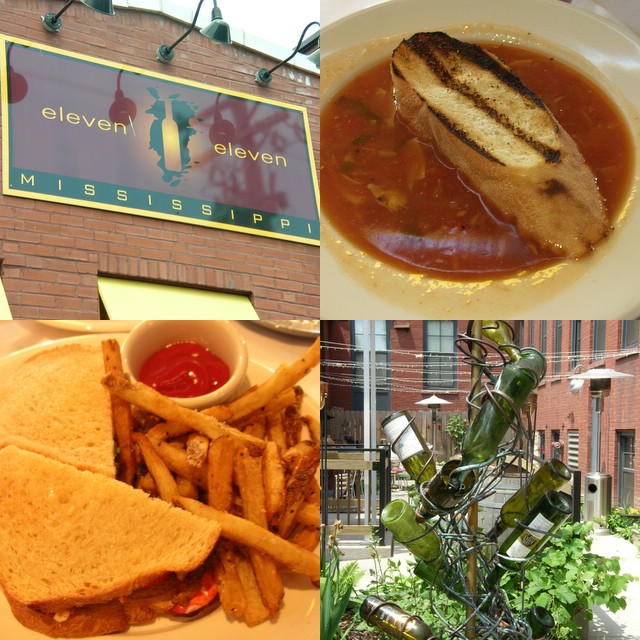
Clockwise from top left: 1111 Mississippi in St. Louis; Artichoke and Tomato Soup; Wine bottle fountain; "BLT".
Restaurant 19: 1111 Mississippi (St. Louis)
RESTAURANT: 1111 Mississippi
LOCATION: 1111 Mississippi Ave, St. Louis, Missouri
DATE: May 13, 2005
FOOD: Fire Roasted Artichoke and Tomato Soup, “1111 BLT”: Lobster, Bourbon Apples, Thyme Rhoulade, Watercress on grilled sourdough
BEVERAGE: Tap Water
PRICE: $15.00
Lunch epitomizes middle child syndrome. Overshadowed by its attention getting big brother dinner and by the cute and adorable endearments of breakfast, even New York power lunches and Hollywood hobnobs, leave lunch the least desirable meal, more perfunctory than pleasing. Well, at least that’s my opinion. Generally, when lunch rolls around, it’s more nuisance than expectation, as I’d either rather be hungry for dinner or I’m still full from breakfast. I know many restaurants can do lunch extremely well. The thing is, most days, I just don’t care.
But when I have a good reason to miss breakfast, lunch can aid the gastro-void like Catherine Barkley in Farewell to Arms. Such an opportunity presented itself on the initial day of my mini-vacation to Missouri (I know, I should have gone to the Bahamas). Libby, despite the trepidation of having to choose a restaurant for my, let’s face it, snobbish tastes, suggested 1111 Mississippi (guess where it’s located?) for the first of my Missouri musings. Contrary to the course of the rest of our relationship, on this at least, she was right. Will wonders never cease.
Unconfined by the high priced rents and space constrictions of New York City, 1111 has the room to create a slick, contemporary design with colors as bright as a Van Gogh canvas during one of his not-so-crazy periods. Goldenrod canopies overhang the windows and leave diners in a surreal sunshine haze. There is an also an intricate fountain made entirely of wine bottles near the entrance that adds a neighborhoody, “we support local artists” type feel to the place.
The menu, while not overwhelming innovative, also offered more than the tired salads and sandwiches of every other pseudo high-end American cuisine enclave. One such offering, perhaps the most imaginative option on the menu, was the 1111 “BLT”. I left traditional BLTs behind in childhood, figuring it was somewhat senseless to pay for a sandwich that was better made by my mom. But there’s nothing traditional about 1111’s version. The “b” is for the bourbon (granny smith) apples, more tart than sweet, and a sharp contrast to the liquid smooth of the “t” thyme mayonnaise that sits in a slather on the two slices of sourdough. But the “l” is the best part – fresh, unadulterated steamed lobster, tender and delicious. A few fresh sprigs of watercress completed the sandwich which had just as much crunch and crispness as its namesake but far more flavor. Lobster can do so much on its own that it was wonderful to see 1111 understood this and let the lobster alone. It made this a sandwich I will crave forever after and changed the way I will look at bacon versions of BLTs from now on. I might have to suggest the whole lobster bit to my mom the next time she offers to make me a sandwich.
The seasoned fries accompanying the BLT were also amazing, heavy on the pepper and salt in a manner that shows 1111 would rather be bold than passive. The seasoning helped the fries stand out and be more than a typical side. I was however, disappointed by the roasted artichoke and tomato soup Libby and I split to begin the meal. Pepper was the dominant flavor in this soup, with the tomato and artichoke as lost as Linda Tripp in a GNC. Thankfully this was how we began our meal, while the BLT was how I ended it.
1111 made me optimistic about the St. Louis food scene. I came expecting Ruby Tuesday’s and left with something closer to a Manhattan bistro, which was fine by me. If Danny Meyer’s Shake Shack can copy St. Louis’ custard, St. Louis can copy New York’s flair. Just don’t expect me to start extolling lunch’s merits anytime soon.
RATING: 7.4/10
LOCATION: 1111 Mississippi Ave, St. Louis, Missouri
DATE: May 13, 2005
FOOD: Fire Roasted Artichoke and Tomato Soup, “1111 BLT”: Lobster, Bourbon Apples, Thyme Rhoulade, Watercress on grilled sourdough
BEVERAGE: Tap Water
PRICE: $15.00
Lunch epitomizes middle child syndrome. Overshadowed by its attention getting big brother dinner and by the cute and adorable endearments of breakfast, even New York power lunches and Hollywood hobnobs, leave lunch the least desirable meal, more perfunctory than pleasing. Well, at least that’s my opinion. Generally, when lunch rolls around, it’s more nuisance than expectation, as I’d either rather be hungry for dinner or I’m still full from breakfast. I know many restaurants can do lunch extremely well. The thing is, most days, I just don’t care.
But when I have a good reason to miss breakfast, lunch can aid the gastro-void like Catherine Barkley in Farewell to Arms. Such an opportunity presented itself on the initial day of my mini-vacation to Missouri (I know, I should have gone to the Bahamas). Libby, despite the trepidation of having to choose a restaurant for my, let’s face it, snobbish tastes, suggested 1111 Mississippi (guess where it’s located?) for the first of my Missouri musings. Contrary to the course of the rest of our relationship, on this at least, she was right. Will wonders never cease.
Unconfined by the high priced rents and space constrictions of New York City, 1111 has the room to create a slick, contemporary design with colors as bright as a Van Gogh canvas during one of his not-so-crazy periods. Goldenrod canopies overhang the windows and leave diners in a surreal sunshine haze. There is an also an intricate fountain made entirely of wine bottles near the entrance that adds a neighborhoody, “we support local artists” type feel to the place.
The menu, while not overwhelming innovative, also offered more than the tired salads and sandwiches of every other pseudo high-end American cuisine enclave. One such offering, perhaps the most imaginative option on the menu, was the 1111 “BLT”. I left traditional BLTs behind in childhood, figuring it was somewhat senseless to pay for a sandwich that was better made by my mom. But there’s nothing traditional about 1111’s version. The “b” is for the bourbon (granny smith) apples, more tart than sweet, and a sharp contrast to the liquid smooth of the “t” thyme mayonnaise that sits in a slather on the two slices of sourdough. But the “l” is the best part – fresh, unadulterated steamed lobster, tender and delicious. A few fresh sprigs of watercress completed the sandwich which had just as much crunch and crispness as its namesake but far more flavor. Lobster can do so much on its own that it was wonderful to see 1111 understood this and let the lobster alone. It made this a sandwich I will crave forever after and changed the way I will look at bacon versions of BLTs from now on. I might have to suggest the whole lobster bit to my mom the next time she offers to make me a sandwich.
The seasoned fries accompanying the BLT were also amazing, heavy on the pepper and salt in a manner that shows 1111 would rather be bold than passive. The seasoning helped the fries stand out and be more than a typical side. I was however, disappointed by the roasted artichoke and tomato soup Libby and I split to begin the meal. Pepper was the dominant flavor in this soup, with the tomato and artichoke as lost as Linda Tripp in a GNC. Thankfully this was how we began our meal, while the BLT was how I ended it.
1111 made me optimistic about the St. Louis food scene. I came expecting Ruby Tuesday’s and left with something closer to a Manhattan bistro, which was fine by me. If Danny Meyer’s Shake Shack can copy St. Louis’ custard, St. Louis can copy New York’s flair. Just don’t expect me to start extolling lunch’s merits anytime soon.
RATING: 7.4/10
Thursday, May 12, 2005

Book 6: Cloud Atlas, by David Mitchell (Infinite Feast XVII)
Paperback: 528 pages
Publisher: Random House Trade Paperbacks (August 17, 2004)
Too often, we end up looking at modernity’s complexities as being especially unique. This ignores the trajectory of history and puts the past into a nostalgic and simple framework, an altogether unfair categorization. But all time is composition of intricate proportions. History speaks in a babel of tongues, so perhaps it is best interpreted by a myriad of voices. For an author to capture all of time, past, present, and future in a single novel, he or she would have to be the ultimate ventriloquist. David Mitchell proves in Cloud Atlas that he is such a magician.
It is erroneous to call Cloud Atlas a book, at least in the traditional sense. Comprised of six distinct narratives set in dramatically different eras, at first glance Cloud Atlas would appear to be closer to a collection of novellas, than a solitary novel. But just as the crimes of one century overlap and bleed into the others, so too do the themes and characters of Mitchell’s novel reappear in each section, the passion of the prose and virtuosity of language on display leaving the reader nothing short of breathless.
Cloud Atlas is like a buffet of only the signature dishes from New York’s finest restaurants. Each section creates a singular world so engaging that the mind becomes lost amidst the pages. Starting with the early 19th century journal of an American notary stranded in the South Pacific, the novel jumps mid-sentence to the Oscar Wilde like meanderings of an aspiring English musician who has traveled to Belgium during the World Wars. Then the scene moves to 1970s California, in what the New York Times review accurately described as a sub-Grisham detective story involving nuclear fallout and government conspiracy. Next comes contemporary England and a book publisher wrongly (or so he thinks) imprisoned in a retirement home, then to a not to distant Korea and a Huxley-esque dystopia showcasing a privileged class of humans exploiting a race of worker drones (not that exploitation is unique to the future). And then finally, the narrative concludes in a future Hawaii, when corporatism has destroyed the majority of the world, and human beings once again live in warring tribes. Mitchell manages these diverse genres masterfully, manipulating language to illuminate the plights and suffering we inflict upon one another. Each section can and does, stand on its own. At one point, while describing a musical score in the Belgium based section, Mitchell also self-consciously reflects on his experimental style and its effectiveness at conveying an emotional capacity, as his character states, “In the first set, each solo is interrupted by its successor: in the second, each interruption is recontinued, in order. Revolutionary or gimmicky? Shan’t know until it’s finished.” Such an inference is not only humorous, but a keen insight into all innovative literature.
Cloud Atlas bears a lot of similarities to Cormac McCarthy’s Blood Meridian. Both works delve into mankind’s seeming obsession with violent self-destruction and the cyclical course of human history. McCarthy ends his novel ambiguously, the possible redeemer killed by evil incarnate. Mitchell, in contrast, offers a chance, however slim, that humanity will stop viewing one another as predators and eventually realize the futility of perpetual cruelty. In one of the novel’s many endings, this occurring in the section set in a post-apocalyptic future Hawaii, the civilized Meronym explains to the more primitive Zachry, “List’n, savages an’ Civ’lizeds ain’t divvied by tribes or b’liefs or mountain ranges, nay, ev’ry human is both yay…Some savages what I knowed got a beautsome Civ’lized heart beatin’ in their ribs…Not ‘nuff to say so their hole tribe, but who knows one day? One day.” It is the promise of this one day that we as readers are left with. The one day may never arrive, but Mitchell offers this as the only olive branch we have to cling on to. For some reason, humanity survives century after century despite itself.
And thus emerges the dominant idea flowing through Cloud Atlas’ myths. Violence seems the most elementary aspect of human nature, the factor we can not eradicate from our souls. But as Mitchell plays this motif out over centuries of wars, he parades a litany of concurring thoughts as well. One of the most prevalent is the power of words and literature, as the only factor connecting the narratives are the novel’s other narratives. In each segment, a character happens upon the book, journal, memoir, etc, that comprises another section of Cloud Atlas. This begs the question of whether any of these stories are supposed to be “real” – or if this even matters. For we may pass violent aggression on from generation to generation like our genetics, but when we die, all that truly survives us are the written accounts of our lives. This notion goes as far back as Homer, but Mitchell makes the importance of oral and written traditional freshly relevant.
Cloud Atlas is my favorite of the many incredible selections Danny and I have read for “Infinite Feast”. In Mitchell’s adeptness at adaptability, his impersonation of lesser writers only highlights his skills all the more. At times poetic and touching, at others as harsh as the violence he depicts, his prose is always controlled and luminescent. Through his forgery of other genres and existences, Mitchell is able to create something truly original.
Cloud Atlas’ final passage, the conclusion of “The Pacific Journal of Adam Ewing”, is perhaps the finest demonstration of Mitchell’s prodigious ability to capture all of human life in his prose. He writes:
“Belief is both prize & battlefield, within the mind & in the mind’s mirror, the world. If we believe humanity is a ladder of tribes, a colosseum of confrontation, exploitation & bestiality, such a humanity is surely brought into being…why fight the “natural” (oh, weaselly word!) order of things? Why? Because of this: - one find day, a purely predatory world shall consumer itself…for the human species, selfishness is extinction. If we believe that humanity may transcend tooth & claw, if we believe divers races & creeds can share this world as peaceably as the orphans share their candlenut tree, if we believe leaders must be just, violence muzzled, power accountable & the riches of the Earth & its Oceans shared equitably, such a world will come to pass. I am not deceived. It is the hardest of worlds to make real. Torturous advances won over generations can be lost by a single stroke of a myopic president’s pen or a vainglorious general’s sword…He who would do battle with the many-headed hydra of human nature must pay a world of pain & his family must pay it along with him! & only as you gasp your dying breath shall you understand your life amounted to no more than one drop in a limitless ocean!” Yet what is any ocean but a multitude of drops?”
Mitchell stares at the reality of human nature with a frank determinism, saying I’ve seen your worst, but I will continue to try to better this world, come what may. As individuals we may just be tiny drops, but united we are an ocean. Cloud Atlas asks if one day we will have the courage and selflessness to make the world more than just potential, more than unfulfilled wishes. He elicits hope without being either too uncomplicated or sentimental, just one of his many talents. Mitchell and his characters show us it’s not enough to be a drifting cloud – you have to be the whole sky. Perhaps that will happen – one day.
Publisher: Random House Trade Paperbacks (August 17, 2004)
Too often, we end up looking at modernity’s complexities as being especially unique. This ignores the trajectory of history and puts the past into a nostalgic and simple framework, an altogether unfair categorization. But all time is composition of intricate proportions. History speaks in a babel of tongues, so perhaps it is best interpreted by a myriad of voices. For an author to capture all of time, past, present, and future in a single novel, he or she would have to be the ultimate ventriloquist. David Mitchell proves in Cloud Atlas that he is such a magician.
It is erroneous to call Cloud Atlas a book, at least in the traditional sense. Comprised of six distinct narratives set in dramatically different eras, at first glance Cloud Atlas would appear to be closer to a collection of novellas, than a solitary novel. But just as the crimes of one century overlap and bleed into the others, so too do the themes and characters of Mitchell’s novel reappear in each section, the passion of the prose and virtuosity of language on display leaving the reader nothing short of breathless.
Cloud Atlas is like a buffet of only the signature dishes from New York’s finest restaurants. Each section creates a singular world so engaging that the mind becomes lost amidst the pages. Starting with the early 19th century journal of an American notary stranded in the South Pacific, the novel jumps mid-sentence to the Oscar Wilde like meanderings of an aspiring English musician who has traveled to Belgium during the World Wars. Then the scene moves to 1970s California, in what the New York Times review accurately described as a sub-Grisham detective story involving nuclear fallout and government conspiracy. Next comes contemporary England and a book publisher wrongly (or so he thinks) imprisoned in a retirement home, then to a not to distant Korea and a Huxley-esque dystopia showcasing a privileged class of humans exploiting a race of worker drones (not that exploitation is unique to the future). And then finally, the narrative concludes in a future Hawaii, when corporatism has destroyed the majority of the world, and human beings once again live in warring tribes. Mitchell manages these diverse genres masterfully, manipulating language to illuminate the plights and suffering we inflict upon one another. Each section can and does, stand on its own. At one point, while describing a musical score in the Belgium based section, Mitchell also self-consciously reflects on his experimental style and its effectiveness at conveying an emotional capacity, as his character states, “In the first set, each solo is interrupted by its successor: in the second, each interruption is recontinued, in order. Revolutionary or gimmicky? Shan’t know until it’s finished.” Such an inference is not only humorous, but a keen insight into all innovative literature.
Cloud Atlas bears a lot of similarities to Cormac McCarthy’s Blood Meridian. Both works delve into mankind’s seeming obsession with violent self-destruction and the cyclical course of human history. McCarthy ends his novel ambiguously, the possible redeemer killed by evil incarnate. Mitchell, in contrast, offers a chance, however slim, that humanity will stop viewing one another as predators and eventually realize the futility of perpetual cruelty. In one of the novel’s many endings, this occurring in the section set in a post-apocalyptic future Hawaii, the civilized Meronym explains to the more primitive Zachry, “List’n, savages an’ Civ’lizeds ain’t divvied by tribes or b’liefs or mountain ranges, nay, ev’ry human is both yay…Some savages what I knowed got a beautsome Civ’lized heart beatin’ in their ribs…Not ‘nuff to say so their hole tribe, but who knows one day? One day.” It is the promise of this one day that we as readers are left with. The one day may never arrive, but Mitchell offers this as the only olive branch we have to cling on to. For some reason, humanity survives century after century despite itself.
And thus emerges the dominant idea flowing through Cloud Atlas’ myths. Violence seems the most elementary aspect of human nature, the factor we can not eradicate from our souls. But as Mitchell plays this motif out over centuries of wars, he parades a litany of concurring thoughts as well. One of the most prevalent is the power of words and literature, as the only factor connecting the narratives are the novel’s other narratives. In each segment, a character happens upon the book, journal, memoir, etc, that comprises another section of Cloud Atlas. This begs the question of whether any of these stories are supposed to be “real” – or if this even matters. For we may pass violent aggression on from generation to generation like our genetics, but when we die, all that truly survives us are the written accounts of our lives. This notion goes as far back as Homer, but Mitchell makes the importance of oral and written traditional freshly relevant.
Cloud Atlas is my favorite of the many incredible selections Danny and I have read for “Infinite Feast”. In Mitchell’s adeptness at adaptability, his impersonation of lesser writers only highlights his skills all the more. At times poetic and touching, at others as harsh as the violence he depicts, his prose is always controlled and luminescent. Through his forgery of other genres and existences, Mitchell is able to create something truly original.
Cloud Atlas’ final passage, the conclusion of “The Pacific Journal of Adam Ewing”, is perhaps the finest demonstration of Mitchell’s prodigious ability to capture all of human life in his prose. He writes:
“Belief is both prize & battlefield, within the mind & in the mind’s mirror, the world. If we believe humanity is a ladder of tribes, a colosseum of confrontation, exploitation & bestiality, such a humanity is surely brought into being…why fight the “natural” (oh, weaselly word!) order of things? Why? Because of this: - one find day, a purely predatory world shall consumer itself…for the human species, selfishness is extinction. If we believe that humanity may transcend tooth & claw, if we believe divers races & creeds can share this world as peaceably as the orphans share their candlenut tree, if we believe leaders must be just, violence muzzled, power accountable & the riches of the Earth & its Oceans shared equitably, such a world will come to pass. I am not deceived. It is the hardest of worlds to make real. Torturous advances won over generations can be lost by a single stroke of a myopic president’s pen or a vainglorious general’s sword…He who would do battle with the many-headed hydra of human nature must pay a world of pain & his family must pay it along with him! & only as you gasp your dying breath shall you understand your life amounted to no more than one drop in a limitless ocean!” Yet what is any ocean but a multitude of drops?”
Mitchell stares at the reality of human nature with a frank determinism, saying I’ve seen your worst, but I will continue to try to better this world, come what may. As individuals we may just be tiny drops, but united we are an ocean. Cloud Atlas asks if one day we will have the courage and selflessness to make the world more than just potential, more than unfulfilled wishes. He elicits hope without being either too uncomplicated or sentimental, just one of his many talents. Mitchell and his characters show us it’s not enough to be a drifting cloud – you have to be the whole sky. Perhaps that will happen – one day.
Subscribe to:
Posts (Atom)