Wednesday, June 15, 2005

Tangra Masala Photos


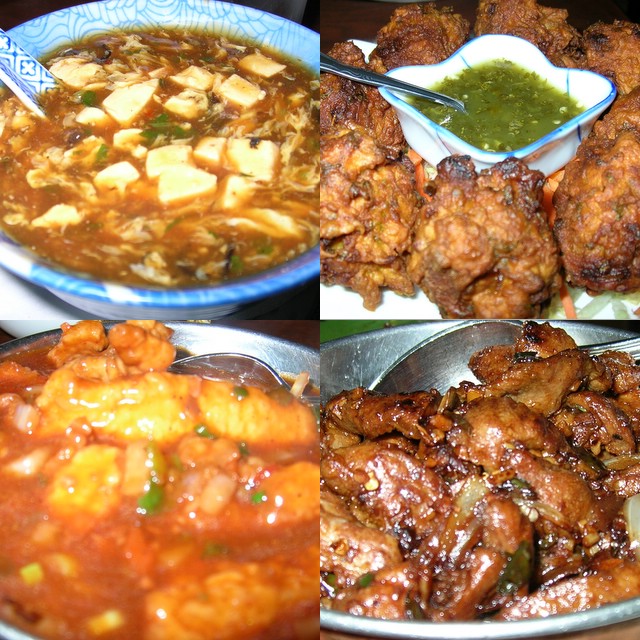
Clockwise from top left: Chicken hot and sour soup; chicken and shrimp pakoras; Chili-Goat; Tangra Masala Fish.

Restaurant 39: Tangra Masala

RESTAURANT: Tangra Masala
LOCATION: 8709 Grand Ave, Flushing, Queens
DATE: June 12, 2005
FOOD: Chicken Hot and Sour Soup; Split the following - Chicken and Shrimp Pakoras; Chili-Goat (Dry); Tangra Masala Fish in Gravy
BEVERAGE: Diet Coke
PRICE: $25.00

Every night as I leave work I hear it calling. In the days since my Sunday night visit to Tangra Masala in Flushing, I have found it nearly impossible not to suffer through the tortuously long subway ride to reach the warm embrace of this restaurant. Tangra Masala serves what is best described as “Chinese food as it’s made in India”. It’s an organic fusion, one brought about not by audacious chefs, but by naturally occurring geographical and cultural integrations, a de-facto culinary evolution that stays true to The Origin of Species. It’s Chinese food running an Indian temperature – mundane dishes created anew by levels of spice unknown outside of Delhi. It’s gastro globalization shimmering brightly. It’s, to put it simply, extraordinary.

Thomas Friedman might have been right to declare the world flat – at least culinary-wise, all boundaries have vanished. Tangra Masala’s staff is almost exclusively of Chinese descent. The clientele, in contrast, is nearly one hundred percent Indian (one obvious exception being this here blogger). But demographics aside, Tangra Masala’s cooking is the main aspect to notice. A menu that is expansive, but not daunting, shows dishes both familiar and unknown. Chinese restaurant standards like hot and sour soup, chicken and corn soup, and all sorts of fried rice, pop-up on the menu with the same commonplace recognition as elements on the Periodic Table. But there’s an entire section devoted to goat. And the dim sum is far from anything found near Canal Street. What becomes rapidly apparent, is that even the assumedly blasé dishes are not what they seem at Tangra Masala. A meal at Tangra Masala is like learning to eat Chinese food all over again.

The chicken hot and sour soup is as brash and untamed as postmodern poetry. Unlike the disastrous soup at Yeah Shanghai Deluxe, Tangra Masala infuses this traditional soup with a heavy and completely unexpected bout of pure heat. Tangra Masala is not for the meek and the hot and sour soup is the best example of this all-out fire. The soup’s mushrooms and chicken were perfectly cooked and added to the dish’s many layers. Such layering became a common theme throughout the meal.

But even as sensational as the hot and sour soup was, nothing else compared to the jaw-dropping chicken and shrimp pakoras. The pakoras are like an Indian hushpuppy – except larger and much more flavorful. The shrimp might have been the better of the two varieties, but the difference was negligible. The pakoras exemplified Tangra Masala’s layering of complex flavors. The balls are fried and use a mixture of spicy minced vegetables as their base. The chicken or shrimp, also seasoned, is then joined to this foundation. Biting into these is like diving into the ocean in mid-December – both send chills through the body. A sharp cilantro and hot pepper oil comes with the pakoras and a liberal sprinkling enhances the pakoras to even new levels. Astonishing, the flavors in one’s mouth constantly are in flux with this dish. From the initial touch of the oily exterior, to the bread-like smoothness inside, to the lasting zest left behind, this dish is unbelievable. If samosas, dumplings, and hushpuppies decided to mate, pakoras would be that love child.

The entrees nearly matched the supremacy of the pakoras. The goat, a meat which according to a recent New York Times article, is gaining in popularity, was by appearance and taste beef transcended. My only other experience with goat was Scott Conant’s delicious stewed capretto (kid) at L’Impero, but Tangra Masala served goat and not kid. The dish looked like beef and broccoli stripped of the greenery. Thin strips of pleasantly chewy goat had been elevated by robust red chiles. The heat of the dish seemingly escalated with each successive bite so that by the end, our waitress was refilling my water glass every few minutes.

The white fish in tangra masala sauce was equally outstanding. The red sauce has the consistency of honey and thus immediately brought to mind sweet and sour sauce. But tangra masala gravy is as much sweet and sour sauce as the Backstreet Boys are a “band”. In taste, the tangra masala was entirely unique. Fluent and glossy, this sauce challenged the palate while still harmonizing with the steamed fish. The fish was so plump and substantial, I initially believed a mistake had been made and we had been served chicken or pork. But there were no mistakes at Tangra Masala.

Starbucks recently expanded to France and there are now more McDonald’s abroad than in the U.S. Globalization permeates the world and every new chef wants to cut his or her teeth on fusion techniques. National borders may now have as much relevance to the modern world as Ptolemy’s model of the universe, but Tangra Masala is an indication that not all cultural mixes have negative results. Tangra Masala is a beacon, a reason to venture to Queens for something other than a flight. Just be forewarned – a beacon this excellent is impossible to forget. And the urge to jump on the E or F train may dominate your thoughts for days afterwards.

I might just have to go back tonight…

RATING: 9.0/10

Book 11: The Death of Artemio Cruz, by Carlos Fuentes (Infinite Feast XIX)

Translated by Alfred MacAdam
Paperback
: 307 pages
Publisher: Farrar, Straus and Giroux; Revised edition (May 1, 1991)

Bill Clinton’s memoir was just the latest reminder of American politicians’ apparent love of the autobiographical form. While self-promotion seemingly comes hand in hand with political leadership, it is rare when a politician displays any signs of erudite self-reflection – anecdotal confessions do not necessarily indicate thoughtful consideration. Rarer still, is an elected official who has the ability to write about something other than his or her own personal accomplishments. Carlos Fuentes, the Mexican novelist, was such a unique figure, addressing his country’s fate through both pen and action. He served as Mexico’s ambassador to France, while also creating some of the most renowned pieces of literature in all of Mexican history. The Death of Artemio Cruz is considered by most critics to be his best work.

The novel opens with Artemio Cruz, a man of immense wealth and prestige, on his death bed. He is surrounded by his faithful associates and the venomous hatred of his daughter and wife. Everyone is waiting for him to die – and waiting for the disclosure of the whereabouts of his will. The novel plots a trajectory through the refractions of Cruz’s memory of his and Mexico’s history. The story is told in the first, second, and third person, making the style reminiscent of the stream of consciousness works of Woolf and Joyce.

Artemio Cruz, though written in 1962, around the birth of postmodernism, thus reeks of modernism and all its conventions. Fuentes assumes his audience has a high level of education and literary knowledge and his heavy-handed form seems anachronistic at points. While Fuentes has often been coupled with Borges, the comparison, based strictly on Artemio Cruz, is unfounded. Borges dwells in fantasy, creating worlds within worlds to mimic the mechanisms of the mind. His style, though at times strenuous for the reader, never sounds like Faulkner. Fuentes, oppositely, stays completely in reality – the reality of 20th century Mexico. Cruz lives in a country ruled by corruption and though he rose from humble beginnings and fought in the revolution, as he came to have greater prestige, money, and most importantly power, Cruz became just as corrupt as the leaders he once fought against. The story is one of betrayed obligations – Cruz’s and Mexico’s. The great promise of Mexico’s revolutionary leaders has all but been destroyed by the time Cruz is dying in a plush apartment in the 1960s.

Cruz’s desire but ultimate inability to find anyone to share love with is the core of this story. While the pursuit of money dominates the plot’s surface (and Artemio’s), this only occurs because after his initial love of a woman named Regina during his revolutionary days, no women in his life care about him the same way. They use him as he uses them – in the same breadth they curse his maniacal drive for wealth and all the people he has to exploit to garner it, they spend his money on elaborate vacations, perfumes, and other frivolities. This wonderful juxtaposition highlights how trapped Cruz is by all those around him who supposedly have his best interests in mind. He acts villainously, but through his recounting, we learn he is not a villain. He is the embodiment of Mexico’s tumultuous history and confused identity. Fuentes makes a powerful comment on all the aspirations Mexico has ever had – and all that it has not achieved.

But what makes The Death of Artemio Cruz fail to a certain extent is Fuentes in ability to express himself concisely. His prose is often beautiful and deeply suggestive, but at key junctures it has the unintended propensity to leave the reader unaffected because each section debates a point too laboriously. Put more simply – Fuentes should have made this book shorter. The emotional core of his characters are lost in a mess of words – no matter the aesthetic merit his language has on its own, taken together, one wants to ask, “is this guy ever going to die?”. Each of the episodic memories Cruz reveals starts powerfully, but ends only after the point has been beaten to death (bad pun, sorry). Fuentes obviously drew on Tolstoy’s “The Death of Ivan Ilych” for this novel. And Fuentes masterfully inverts the religious fervor Ivan undergoes in Artemio’s turning away from any God that is not himself or that can be put to useful ends. But perhaps he should have looked to Tolstoy’s work for a more base inspiration. Tolstoy limited "Ivan" to a novella. That length would have been adequate for The Death of Artemio Cruz as well.

Tuesday, June 14, 2005

Bonita Photos


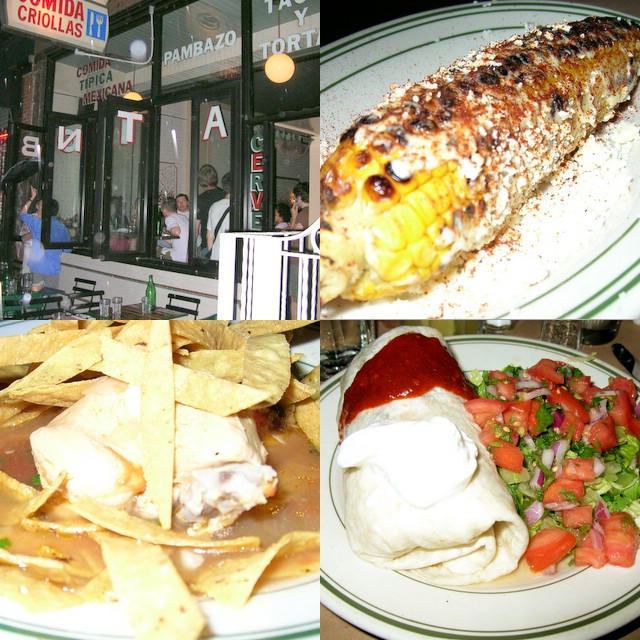
Clockwise from top left: Bonita on Bedford Ave.; Mexican Corn; Tilapia Burrito; Lime Soup.

Restaurant 38: Bonita (Infinite Feast XIX)

RESTAURANT: Bonita
LOCATION: 338 Bedford Ave., Williamsburg, Brooklyn
DATE: June 11, 2005
FOOD: Mexican Corn; Lime Soup; Chips and Pico de Gallo; Fried Tilapia Burrito
BEVERAGE: Half a pitcher of White Wine Margarita
PRICE: $30.00

For some reason, paying $25 for a Mexican entrée seems egregious to me. I mean how expensive can a tortilla really be? But many of the better known Manhattan Mexican restaurants like Rosa Mexicano and Mama Mexico, charge such rates. And while restaurants like Mercadito and Itzocan offer innovative re-imaginings on Mexican classics, to find authentic, affordable cuisine from our southern neighbor, it’s the outer boroughs that present the best possibilities. Thus, Danny and I arrived at Bonita in Williamsburg, just blocks from the L, for the latest installment of Infinite Feast, this time discussing Carlos Fuentes’ The Death of Artemio Cruz.

While neither of us felt the need to rave about Fuentes’ novel, Bonita’s food brought mutual exaltations. With a layout reminiscent of the retro bistro style of Schiller’s Liquor Bar, Bonita was hip without being faddy, full without being crowded. The open-air kitchen allows diners to see their meals through all stages of preparation and adds to the neighborhood feel of Bonita. Our waiter doted on us, frequently asking (and re-asking) us if we liked our food in a manner showing he genuinely cared. His attention was one of Bonita’s many charms and spoke of sincerity rather than the type of uncertainty common to 14-year old girls inspecting their reflections, left to wonder if their mother’s assessment of “pretty” is accurate or if it’s a lie to help the teenager forget the colossal sized zits playing havoc on her cheeks.

However, the joys of puberty need no further elaboration – Bonita’s outstanding Mexican dishes do. We began with the ultimate of Mexican ubiquity – chips and salsa. The pico de gallo was milder than typical jalapeno salsas, but still had enough bite to satisfy the calling for caliente. But it was my first appetizer, the Mexican corn, which really convinced me Bonita wasn’t messing around. Bringing a street vendor staple indoors, this grilled corn was lathered in red chili spices. But what made it exceptional was the crumbled blend of soft white cheeses (I believe mozzarella and jack) added as a final coat once the corn had cooked. The cheese melted over the kernels to form a veneer ripe with flavor – it will be hard to go back to American buttered corn cobs in the future. The cheese provided a gooey contrast to the blackened corn and a milky sheen that mingled wonderfully with the corn’s sweetness.

The lime soup, if not equally as tantalizing as the corn, was very nearly so. In my experience, this soup has been called tortilla soup, but as Bonita’s version of Mexican chicken soup was superior to my previous tastes, the Wiliamsburg restaurant can call it whatever they like. Crisp tortilla strips floated in a chicken broth seasoned with delicious and relatively neutral Mexican spices and the accent of lime juice. Stewed tomatoes added an acidic-sugar, but the succulent chunks of roast chicken really made the soup. Bonita roasts whole chicken and I can only imagine how sensational these birds must be after tasting the guacamole like pliancy of the chicken in the soup.

To wash down all these savory supernovas, Danny and I split a pitcher of Bonita’s white wine margarita. While the title of margarita was just a fancy name for what tasted like white lime sangria, this near juice like drink worked well to alleviate the oppressiveness of June humidity and made up for Bonita’s lack of a liquor license. The drink, while enjoyable, needed to be a tad stronger, though at $18 for two and half glasses a piece, I won’t complain too vociferously.

As we debated over whether Artemio’s death really needed to go on for 300 densely constructed pages of stream of consciousness (couldn’t he have died on say page 170?), our entrees arrived. Though my fried tilapia, rice and vegetable filled burrito was humungous, upon finishing it, I literally wanted to beg for more. The fish itself was incredible – taking an overly flaky and dry white fish like tilapia and turning it into the meaty, juicy and entirely non-greasy golden brown tendrils of seafood perfection as Bonita did, requires the type of magician "Arrested Development"’s Gob continuously tries and but can quite manage, to be. Bonita also packed the burrito with fish, instead of using rice as filler. Thus, the rice and creamy sour cream sauce filling the burrito provided satisfying enhancements to the fish, but still remained as background flavors. Reflecting at the end of the meal, it was impossible for me to decide whether the burrito or the corn had been the better dish. I only knew I couldn’t have done without either.

Bonita may refer to an anonymous beautiful woman, but perhaps it is more deserving as an adjective for the restaurant’s food. Every part of Bonita functioned flawlessly and the touch of giving Chiclet-like Canel’s Gum with the bill only proved this point. For what I might have paid for a single entrée at a Manhattan Mexican tourist trap, I got an entire authentic Mexican meal at Bonita. The L train may operate as sporadically as a soap-opera surgeon, but since it takes me to Bedford Avenue and Bonita, I’ll be willing to wait as long as it takes the next time a Mexican craving hits me as hard as one of Fuentes’ sentences.

RATING: 8.5/10

Monday, June 13, 2005

Fleur de Sel Photos


Clockwise from top left: Fleur del Sel at 5 E. 20th St.; Goat Cheese and Artichoke Ravioli; Panna Cotta; Roasted Cod.

Restaurant 37: Fleur de Sel

RESTAURANT: Fleur de Sel
LOCATION: 5 East 20th St.
DATE: June 10, 2005
FOOD: $25 Prix Fixe Lunch: Appetizer - Goat Cheese & Artichoke Ravioli, Paddlefish Caviar, Beet-Dijon Reduction; Entrée - Roasted Cod, Tomato Confit & Spring Garlic Coulis; Dessert - Crème Fraiche & Vanilla Panna Cotta, Confit of Rhubarb, Strawberry Sorbet.
BEVERAGE: Tap Water.
PRICE: $32.00

Everybody loves a deal. Rich or poor, the lure of a specially priced quality item is enough to catch just about anybody’s attention. Perhaps, this is especially true when it comes to gourmet food. Paying $3.50 for a bargain basement selection of reheated frozen “delicacies” at Old Country Buffet lures no one but the incredibly cheap or incredibly obese. But, a $25 prix fixe lunch menu at a two star Manhattan restaurant, whose dinner tasting menu runs to $75? – Now that’s something unique. While Manhattan’s restaurant week offers the best chance at such value, that’s only twice a year. Fleur de Sel, the lovely Flatiron French restaurant, dishes up their $25 lunch year round, seven days a week. If Fleur del Sel hired Morrie from Goodfellas for some 15 second TV spots to plug the deal, word would get out, and this lunch “secret” might explode.

Fleur de Sel’s design would appease Fredric Jamison with its postmodern blends. The exterior façade is that of a country, Province bistro, while the interior is slick and contemporary. It’s a peaceful, quiet space, if a bit too small for the number of tables. The lunch menu includes three courses: an appetizer, entrée and dessert, each with two selections to choose from. The menu changes daily and includes dishes from the regular menu. There is even a three course $17 wine pairing for those who want to revive the ‘80s, American Psycho/Wall Street get smashed on your lunch hour of power.

I began with the goat cheese and artichoke ravioli. With two of my favorite ingredients as the filling for my preferred pasta, this dish had the same pre-assured stink of success as a Vanderbilt heir. But the addition of the robust beet saucing and subtle daubs of caviar made this dish something even Babbo diehards would love. In a dish with this many loud flavors, it would be easy for internal competition to ruin any shot of cohesion (see last year’s Lakers). Luckily, that wasn’t the case. The fresh and velvety goat cheese received bolstering from the artichoke, while the caviar and beets worked as stark contrasts to the ravioli’s smoothness. A larger portion of this pasta would have been an outstanding lunch (or dinner) entirely on its own.

The roasted cod which followed was good if somewhat nondescript. Reminiscent of the cod at L’Ecole, the fish and saucing were simple and straightforward. The cod could have been tenderer, but was far from dry. The tomato and garlic coulis provided the dish with a beautiful green color, but little else. It had a pleasant buttery taste, but failed to really augment the cod in a meaningful way. The cod was like a Horatio Alger novel – given as a seafood introduction to a fish novice, it would have been entirely successful – given to an English professor, and it would have imparted significantly less of a reward.

Fortunately, the meal didn’t end on the mediocre cod – though with the lag time between entrée and dessert, it very well seemed to have. While expecting a Chili’s-esque 15 minutes or less guarantee would have been fallacious (and such needless rushing, completely unwanted in that type of environment), the service was too lackadaisical for a lunch hour in this city. After all this is New York, not some sleepy, Yoknapatawpha County (I had a high school English teacher offer extra credit to anyone who could spell Faulkner’s fictional region correctly) backwater town. Twenty minutes between entrée and dessert is just too long.

However, when it finally did arrive, the panna cotta was well worth the wait. With the luxurious, feathery creaminess of an Italian cheesecake, this panna cotta made me seriously reconsider my avowed dislike of this dessert. The vanilla hues were restrained but noticeable, allowing the crème fraiche to dominate and not result in a taste too much like vanilla ice cream. The rhubarb, sliced into four, thin leaf-like strips, segmented the panna cotta into quadrants, but added a delightful bitter contrast to the sugary sweetness of the strawberry sorbet and caramelized brittle. It was an inversion of strawberry-rhubarb pie a la mode that acted as if it were the original and not the update.

$25 can go a long way. It can buy hundreds of ballpoint pens, enough candy for Halloweens now and into the future, and at least one cocktail (two might be a stretch) at a Manhattan lounge. But if you have some time to kill at lunch, it might be best spent at Fleur de Sel, where a taste of excellent contemporary French cuisine can be had on the cheap. Now where’s Morrie and his awful wigs for the classy commercial?

RATING: 7.3/10

Friday, June 10, 2005

Per Se Photos


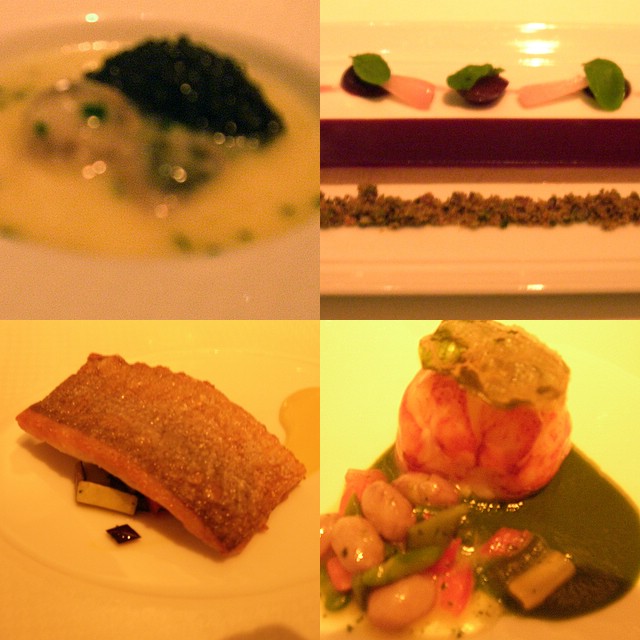
Clockwise from top left: Pork Shoulder; Veal; "Snickers"; Sorbet.

Per Se Photos


Clockwise from top left: "Pearl and Oysters"; "Foie Gras"; Lobster; Mo'i.

Restaurant 36: Per Se (Danny's Birthday)

RESTAURANT: Per Se
LOCATION: 10 Columbus Circle
DATE: June 5, 2005
FOOD: Chef’s Tasting Menu: “Oyster and Pearls” – “Sabayon” of Pearl Tapioca with Island Creek Oysters and Russian Sevruga Caviar; Terrine of Hudson Valley Moulard Duck “Foie Gras” – Poached Burlat Cherries, Pickled Ramps, Blue Moon Acres Mezza Arugula and Pistachio “Crumble”; Crispy Skin Fillet of Mo’I – Sauteed Yellow Squash, Zucchini, Sweet Peppers and Italian Eggplant with “Moulin des Penitents” Extra Virgin Olive Oil Emulsion; Nova Scotia Lobster “Cuit Sous Vide” – “Ragout” of Spring Pole Beans” and “Sauce au Pistou”; All-Day Braised Four Story Hill Farm’s Pork Shoulder – Wilted Dandelion Greens, Poached Granny Smith Apples and Whole Grain Mustard Sauce; Rib-Eye of Nature Fed Veal “Roti A La Broche” – California Green Asparagus, Mousseron Mushrooms, Parsley Root “Puree” and “Bearnaise” Reduction; “Tomme Du Berger” – Roasted Heirloom Beets, Bulls Blood Greens, Red Beet Essence and Horseradish “Aigre-Doux”; Pineapple Sorbet – Tamarind “Sponge”, Rosewater “Gelee”, Whole Milk Yogurt and “Freeze-Dried” Raspberries; “Snickers Bar” – Milk Chocolate “Cremeux”, Chocolate “Sacher” and Salted Caramel “Glacage” with Spanish Peanut “Nougatine” and “Nougat” Ice Cream; “Mignardises”; Petit-Fours.
BEVERAGE: Per Se Cocktail; Split a bottle of Riesling amongst Libby, Danny and I; Non-alcoholic pairings, including: Virgin Margarita, Virgin Bloody Mary, Gossamer Grape Juice, Pinot Noir Grape Juice, Almond Flavored Steamed Milk; Decaf Coffee
PRICE: Worth It (it being Danny’s birthday, it’d be inappropriate to discuss specific numbers)

Per Se is a “restaurant” in as much as Harvard is a “school”. During a night at Thomas Keller’s Time Warner Center landmark of culinary brilliance, the ritual act of “eating” is replaced by an experience both novel and transporting. Keller left New York admist failure, but reestablished himself with America’s best restaurant, California’s “French Laundry”. But thankfully, he’s returned and brought with him the same “magic” that made French Laundry as highly reputed as it is. The “food” at Per Se is designed to be pleasurable for the palate – but also to challenge the diner’s conventional assumptions. This is “thinking” cuisine, though it never becomes as esoteric as the adventures of WD-50. At Per Se, “taste” still reigns supreme. To visit Per Se, is to witness “perfection” – cooking turned ecstasy.

From the moment you pass through the automatic frosted glass “door”, it’s apparent you’ve entered a different, and perhaps better, world. The luxurious “lounge” is a huge open space, but manages to still feel comfortable and airy. Central Park’s foliage rustles, viewable from every table in the restaurant. The “staff” operates with the polished decorum of an Edith Wharton socialite – but without the arrogance and stuffy pretension of many lesser restaurants. Even the “bathrooms” are models of perceptive ingenuity – refuges of tranquility in the midst of New York’s hectic avenues.

Per Se’s “menu” changes nightly, with three separate tasting menus to choose from – the chef’s tasting, the five-course tasting, and the vegetable tasting. The menu is beautifully explained and each of the “tastings” entice as if daubed in a French perfumed aphrodisiac. Many of the dishes are imaginative take-offs of more common entrees – the vegetarian menu including a “Red Rice and Beans” with haricot verts and cranberry beans; the five course offered a “Grilled Cheese Sandwich” with tomato marmalade. Per Se’s adaptations evoke a clever play on gourmet food – it reminds us how much we enjoy less labor intensive fair (Keller has stated his love of Burger King) and makes us see our “favorites” in a completely new light. All in all, it is this aspect of Per Se that most delighted us, as it engaged both mind and tongue.

After extensive “deliberation”, “Danny” and “I” both selected the nine course chef’s tasting, while “Libby” went with the nine courses of vegetables. As we watched the immaculate service bring revelation after revelation to the tables around us, our excitement only compounded. It felt like my first night in New York all over again.

In an article in The New York Times on Chicago’s Moto restaurant (unfortunately, I was unable to locate the link), Per Se was mentioned for the novelty of its non-alcoholic wine pairings. Practically every restaurant that serves a tasting menu offers wine pairings to match, but Per Se’s “pairings” came in a different and more unique variety. With each course, we were given a beverage – ranging from grape juice to steamed milk – which complimented the tastes in the dish. Libby’s “Red Rice and Beans” was completed by a lime margarita. My foie gras with a gossamer grape juice that was finer than most wines. We all marveled over the creativity and the way our food was enhanced, yet another sign of why Per Se is perhaps New York’s “premier” restaurant.

Before our first courses even arrived, I could have been satisfied. The one dish I wanted to have at Per Se more than any other was Keller’s signature “Ice Cream Cone”. An unsweetened “cone” filled with crème fresh and salmon tartare was every bit as wonderful as I had imagined. Akin to a Philadelphia Maki, the flavors in this “dessert” hybrid convinced me that I will never look at a lox and cream cheese bagel the same way again – even if it comes from Russ and Daughters.

A team of waiters then presented our preliminary dishes. The single dish Danny had been speaking about constantly in the weeks leading up to Per Se, was the “Pearl and Oysters”. Fortunately for all of us (as he probably would have cried otherwise) it was on the menu the night of our visit. The heavenly tastes in this course are more difficult to describe than its appearance – reminiscent of a shucked oyster shell, fresh oysters rest atop a sabayon of pearl tapioca, all of which is crowned by some of the world’s finest caviar. What made this appetizer so special was the way the ingredients coalesced, without competing. The caviar was shockingly unsalty and for the first time, I understood why this gourmet staple is so highly regarded. The freshness of the oysters and caviar can only be compared to top-tier sushi. And when combined with the buttery tapioca sabayon produced an enjoyment similar to bringing the best aspects of clam chowder and a summer on the Eastern coast together.

Next came the terrine of duck. Per Se easily could have told me the dish was chocolate and I would have believed them. The richness of the duck “foie gras”, coupled with the bitter pickled flavors of ramps and dry, texturally complex pistachio crumbles could not have been better. Charlie Trotter might have stopped serving foie gras, but luckily Per Se has no such qualms – even if this was only a “take” on the standard serving.

Our waiter informed us that the crispy Mo’i is a Hawaiian fish, renowned in Hawaiian mythology as being “fit” only for the gods. I could see why. If turkey jerky could swim, it would be this fish. As salty and crisp as a scene from Kushner’s Angels in America, the Mo’i left me wanting more and more. The medley of vegetables provided the needed neutral base so that the fish could come to the fore.

The Modern’s lobster in herb folly had been the greatest use of a claw since Michelle Pfifer played catwoman. Per Se went one better. This was Maine without the bib. The way the meat literally softened liked warmed snow upon first bite was astonishing. The firm white beans reminded me of the Modern again, this time the Chatham Cod, and considering that is my favorite dish of the year, the comparison is very favorable. But just as the conversation at our table soared with each new flavor and Danny’s birthday “merriment” became more and more apparent, so too did the food. The “pork loin” which followed was basically Arthur Bryant’s on acid. Joining the flavors of Texas and Kansas City red-sauce barbeque with a revamped version of collard greens consisting of wilted dandelion greens, this was Per Se’s mischievous intelligence in gaudy neon lights.

Promises are made to be broken, and I decided to forget my non-beef vow for one night to engage in Per Se’s veal tenderloin. This dish doffed its hat to chateaubriand, with mushrooms and a jazzed up “béarnaise sauce” to round out the allusion. But the real star was the veal – as pink as pork but as tender as a soft cheese. The veal segue-wayed into the cheese platter, which came with beets instead of the more traditional figs or dried fruit. The combination was masterful, as the beets acerbity translated nicely with the sharp rigidity of the cheese and tangy bite supplied by the horseradish.

Even the sorbet was extraordinary. The plating was artful if not suggestive. An orbital circle of raspberry syrup enabled the planets of delicate pineapple sorbet, subtle rosewater gelee, and luscious tamarind sponge a clear path on which to rotate. The lofty presentation would have been pompous if the tastes were any less successful. It being Danny’s birthday, the staff was even kind enough to serve us a complimentary “Coffee and Doughnuts”, which turned out to be my most beloved tasting of the evening. Instead of coffee, there was a froth covered chocolate mousse. The “donut” – well let’s just say Krispy Kreme and Dunkin Donuts would declare bankruptcy if America’s “cops” ever got a taste of Keller’s “fried sweetness”.

Finally, there was the sweet oblivion that was “dessert”. In a “deconstruction” to make Derrida jump like the Lucky Charms mascot, Per Se undid a Snickers bar into its more utopian components. Peanut and chocolate smears underlined the plate, upon which a chocolate “log” and nougat ice cream teamed with a caramel foundation, the “diving board” from which the whole dessert “sprung”. I was wowed, I was amazed. In stoner movies, weed fiends revel in the way they can taste individual flavors in complex foods. That was how I felt eating this “Snickers”, each flavor was maximized to its fullest. There is no way the actual candy could ever attain the heights this dish hit.

I have written in numerous reviews about my jealousy of Libby’s vegetarian based orders. At Per Se, this green blindness came to a head. I only tried three of her dishes, but it was enough to confirm my suspicions that her tasting “might” (I fear the truth) have been better than mine. Her “Garganelli Oreganata” mimicked the pepper and salt boldness of Cacio e Pepe’s signature dish. Her artichoke “Croquetas” made me dream of days in Spain – or Tia Pol. But even more astounding was the “Moelleux Aux Amandes”, her dessert, and a plate of white chocolate and yogurt flavors so pure as to make even the palest of Vermeer’s models blush. Once again, Libby had demonstrated the intriguing possibilities of non-meat based food; and she had shown women might not have a sixth sense, but they certainly have an elevated sense of taste.

Per Se was the culmination of multiple streams in my life. It was the highlight of my New York dining experiences and I doubt anything will be able to equal it. It was the peak of a weekend spent with the only person who could ever make St. Louis seem like a “city” worth living in. But mostly, it was the apex of a friendship that began three years ago, but it took New York to bring to fruition – and no quotes are needed when I say happy birthday to my best friend. Per Se is the “best”. And on my best friend’s birthday, where else could we possibly have “gone”?

RATING: 11/10 (possible only in the case of Per Se)

Thursday, June 09, 2005


Everything Is Illuminated, by Jonathan Safran Foer

Book 10: Everything Is Illuminated, by Jonathan Safran Foer (Multitude of Drops 1)

Paperback: 288 pages
Publisher: Perennial (March 1, 2003)

In an age when Fukuyama declared the end of history and when the death of the novel is seemingly proclaimed with the same regularity as the sun’s daily ascent, writing continues, great writing in fact, apparently plunging forward, heedless of its own impending doom. Perhaps, Jonathan Safran Foer lost the memo or forgot to watch Fox News the day creative (literary) fiction reached its demise. Perhaps, he is set on proving such pessimistic statements wrong. Or perhaps, he’s just a gifted writer with a story to tell. All possibilities aside, his first novel, Everything Is Illuminated is a masterful piece of literature and a passionate denial that nothing new can (or is) being written.

The novel is an intertwining of voices and narratives, settings and times. It opens with Alex, a Ukrainian teenager, whose travel guide father has been contacted by Jonathan Safran Foer, the fictionalized alter-ego of the author. Foer carries only a photograph of a woman named Augustine, whom he believes survived the Nazis and might possibly be able to provide him with information about the final days of the Trachimbrod Shetl, his grandfather’s Jewish hometown. But all this can be gathered from the plot summary on the back of the novel. What makes Everything Is Illuminated so stunning is the juxtaposition of humor and tragedy, Foer’s innovative use of form, and the One Hundred Years of Solitude like depiction of the Jewish past.

The story is revealed through Alex’s letters to Jonathan about the novel Jonathan is writing on his trip to the Ukraine. We see Alex’s initial attempts to show himself as a ladies man and a player at the novel’s opening, turn into earnest confessions of love for his brother and grandfather by the book’s end. We see Jonathan’s configuration of the Shetl 200 years before its destruction, the life and loves of past generations (his ancestors) and the way the mournful Brod is both used and user. At the beginning of the novel, Alex calls Jonathan a hero, but in truth, no correct in Everything Is Illuminated is perfect enough to conform to this model. All have their flaws, all desire to change some aspect of his or her life. No one is left blameless but no one is completely to blame.

With such complexity, like in Lermontov’s A Hero Of Our Time, Foer brings authorial veracity into question time and time again. At one point, Alex mentions that he changed his description of Foer as short at the latter’s behest. At various other times, Alex begs of Foer to remove the parts of his narrative mentioning how Alex’s grandfather allowed his best friend, a Jew, to be murdered. In a wonderful parallel to the Trachimbrod Shetl’s Jews obsession with detailed and accurate accounting of their history (which is the novel Foer is writing), Alex’s grandfather tries to change the past by denying Augustine’s memory of the events. Foer exposes the way we all manipulate memory to make ourselves appear better than our actions would suggest. In writing we try to correct all the mistakes and tragedy the life brings with it.

In line with this, Foer is questioning the power of words. The Jews in the Shetl believe they only exist so far as their lives are captured in writing. Thus, each member of the town records the minutiae of their lives – from what they ate to breakfast to what they did during a specific afternoon thirty years prior. Foer’s fictionalized glimpse of this accumulated history even breaks into two pages with the words “We are writing, we are writing…” repeated over and over. In a world where everyone is your enemy, as it was for the Jews, Foer is illustrating that the only way to preserve one’s heritage is through pen and paper.

True tragedy, in the Greek tradition, always includes significant elements of comedy. The sadness of the Nazi’s slaughter, the tremendous and inescapable guilt many of the novel’s characters feel are all made even more poignant by the intermixing of humor – Alex’s dog, Sammy Davis Jr. Jr’s proficient flatulence; the Ukrainians inability to understand that Foer is a vegetarian and that pork is thus off limits. Without these and countless other moments, the novel might be trite and certainly less original. The Holocaust is a topic so frequently dealt with in art that its horror must be made new to be made real. Foer manages to avoid sentimentality and the rehashing of other’s works. Everything Is Illuminated is pioneering in its form, but so too in its treatment of one of the worst genocides in world history. As Alex writes Jonathan on page 53, "Humor is the only truthful way to tell a sad story."

The novel’s title is a multi-allusion in the Nabakov tradition. It’s an eloquent reference to the light visible from space when two people make love, but it also connects to the way truth is revealed and memory evades. Foer draws on a myriad of other writers – one notable example, is Günter Grass’ Tin Drum, in the way the figure of the grandmother is used as an indication of security. But Foer doesn’t throw his erudition in the face of readers, rather incorporating it seamlessly into the novel. What we are left with at the end of the book, is the hard-fought possibility that love enables us to live – and survive. His characters may be overwhelmed by guilt, their love might not always be returned or even recognized, but it is humanity’s ability to give such sincerity that keeps us from oblivion – even in the face of an event as monstrous as the holocaust.

A first novel of such ambition and accomplishment sparked a fair amount of backlash against Foer’s quickly achieved success (and the unusually large advance he received from his publishing house). However, focusing strictly on the work, it becomes apparent why others might be jealous. At the age of just 25, Foer achieved what it takes other writers a lifetime (if ever) to complete. Thus, Everything Is Illuminated might be the work of someone young, but its words are those of someone incredibly mature.

A Reader’s Guide and Interview with Jonathan Safran Foer
Wednesday, June 08, 2005

Chinatown Ice Cream Factory Photo


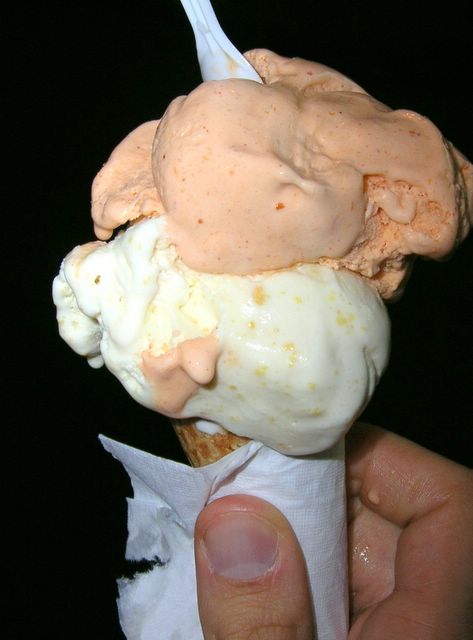
Pumpkin Pie and Almond Cookie Ice Cream on a sugar cone.

Just Desserts 9: Chinatown Ice Cream Factory

RESTAURANT: Chinatown Ice Cream Factory
LOCATION: 65 Bayard St.
DATE: June 5, 2005
DESSERT: One Scoop each of Pumpkin Pie and Almond Cookie Ice Cream on a Sugar Cone; One Almond Cookie
BEVERAGE: None
PRICE: $5.50

A proposed television advertising campaign for Chinatown Ice Cream Factory (if I was their marketing analyst, which, sadly, I am not)

(close-up of Chinatown’s rich, delicious ice cream being scooped onto cone – preferably either the lychee or almond cookie flavors)

Announcer: It’s time to turn in your fortune cookies, folks. For all these years you’ve thought a generic sentence, so lacking in specificity as to make even Ms. Cleo wince, was the proper way to end a Chinese dinner. How wrong you’ve been.

(cut to outside of Chinatown Ice Cream Factory on any given night. Bayard Street is electric with energy and the line extending out the creamery’s door and onto the street is unsurprisingly long. They wait patiently, but enviously glare at the cones and spoonfuls of decadence in the hands of customers already served)

Announcer: Why sublimate your desires, why not give into your urges? Throw the crack-pot predictions in the garbage and rush to Chinatown Ice Cream Factory. What better way to follow up Peking Duck then lychee ice cream or orange sorbet? If you want to remember your fortune cookie days, try the almond cookie – crumbles of buttery, sweetly almond cookie incorporated into luscious vanilla. You can even get the cookie by itself if you want and believe you me, just like John Lennon, its amazing on its own. Had green tea at dinner? Have it again in your ice cream for dessert. Red bean too adventurous? What’s more American than pumpkin pie (well apple, but pumpkin is a close second)?

(cut to the Halloween colored scoop of pumpkin pie ice cream in profile. Orange beads drip down the sides of the cone, practically begging to be licked)

Announcer: This ice cream begs the questions – why go a la mode, when you can just go all in one? Pumpkin pie was made for ice cream and ice cream for pie, so bringing the two together is only natural. Think of it as cutting out the middle man. Bask in the sweetness, savor the unique combinations. Haagen-Dazs may be located a block away, but haven’t you heard? European imperialism is dead, so too the EU. So go East, instead. We promise, once you realize the merits of the Factory, like Andy Warhol, you’ll never want to go anywhere else.

(end on close-up of children smiling as they devour ice cream, their messy faces generating the "Full-House" like chorus of “awws” that everyone knows no parent can resist)

RATING: 8.3/10

Yeah Shanghai Deluxe Photos


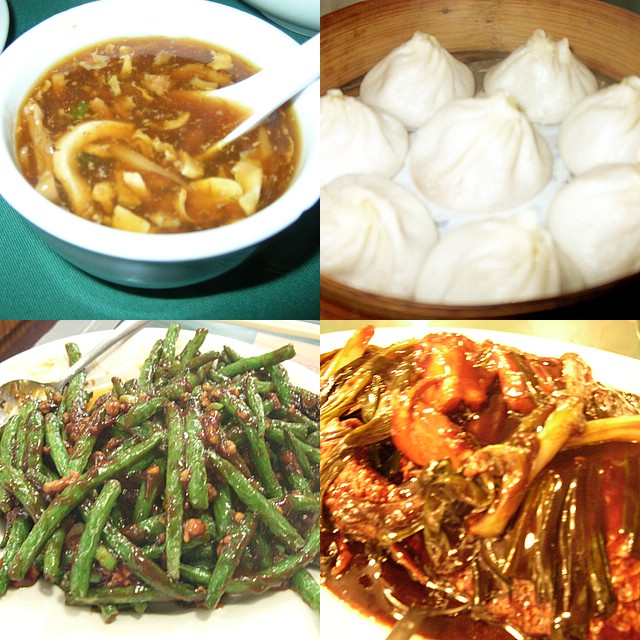
Clockwise from top left: Hot and Sour Soup; Soup Dumplings; Tilapia in Brown Sauce; Spicy String Beans.

Restaurant 35: Yeah Shanghai Deluxe

RESTAURANT: Yeah Shanghai Deluxe
LOCATION: 65 Bayard St.
DATE: June 5, 2005
FOOD: Split the following: Hot and Sour Soup; Steamed Pork Buns (Soup Dumplings); Half Northern Style Roast Chicken; Chef’s Special Tilapia in Brown Sauce; Spicy String Beans with Meat.
BEVERAGE: Tap Water
PRICE: $23.00

It’s an old adage, often repeated, employed to justify everything from music preferences to Senate confirmations of judicial nominees – a democracy is all about the rule of the majority. Supporting a minority perspective on any issue can leave one in a fevered state of anxiety, John Donne’s “no man is an island” stanza rumbling through the mind. However, when it comes to food, maybe its better to swim against the current – one only has to be reminded McDonald’s is the world’s most popular restaurant to realize the full, palate deadening implications of culinary majority rule.

Thus, while users of Citysearch.com, food bloggers, and general word of mouth all lauded Chinatown’s Yeah Shanghai Deluxe as being equally excellent as New Green Bo and Congee Village, I found no such similarities. Situated directly across Bayard Street from the throngs wisely lining up for New Green Bo’s meteoric soup dumplings, Yeah Shanghai carries the reputation of being the Chinese place for people in the know. Apparently, the people in the know have the same problems with reliable sources as Doris Kearns Goodwin and Stephen Ambrose – Yeah Shanghai Deluxe in no way compares to its more highly reputed neighbor.

The evening began ominously. While waiting for Jordan to arrive from work, I noticed that the ceiling had a leak – a leak that was dripping directly into my cup of tea. Part of the enjoyment of venturing to Chinatown is feasting cheaply in the less than four star digs. The dusty floors and half-cleaned bathrooms of Chinatown haunts can add to the experience, but contaminated beverages helps no one save emergency room workers and the makers of digestive aids. Though the wait staff had no problems when I switched tables, I found it interesting that they did nothing to address the leak and actually seated the next customers to enter the restaurant at the table I had just deemed toxic.

The only Americanized dish of the five Jordan and I split, was the hot and sour soup – Yeah Shanghai Deluxe failed not on its inability to make Chinese food suitable for American assumptions but rather because its authentic Chinese food was sub-par, especially in a local so rich in quality. In a case of false advertising to make an ambulance chasing lawyer grin with excitement, the aforementioned hot and sour soup was neither hot nor sour, exuding a flavor that was disturbingly acidic and otherwise bland. However, I was willing to forgive this as being an error in ordering on our part. But Yeah Shanghai Deluxe did nothing to sustain such a notion of gastro-guilt.

Introduced to soup dumplings at New Green Bo, I have come to love the deliberate ritual involved in eating these delicacies. First one bites off the stem-like top. Then blow on the liquid inside the dumpling until it becomes cool enough to slurp. Finally, finish off by devouring the remaining dumpling. Altogether, the measured process makes the dumplings a cultural, rather than a strictly culinary, indulgence. Unfortunately, at Yeah Shanghai Deluxe, there’s no indulgence to be had.

The pork bun (in this case, synonymous with soup dumpling) wrappers were overly coated in flour and as pasty as an Alaskan’s thighs in Winter. The mealy texture greatly detracted from the pork filling, which was actually quite good. Unlike New Green Bo’s version, the soup liquid at Yeah Shanghai seemed more like a Texas pipeline of oil then lightly simmered broth. My disappointment was severe, and New Green Bo’s proximity only seemed to mock my pain.

The meal finally showed some signs of promise with the arrival of the northern style roast chicken and spicy string beans. However, the promise was short lived. Included on the platter of shredded chicken was a fried chicken foot – oddly it was more appetizing than the dumplings. The chicken was under-seasoned, but made up for this deficiency by being extremely tender and moist. Reminiscent of a fried Thanksgiving turkey, the chicken was the evening’s high point, but could have been enhanced by the presence of a plum sauce.

The string beans continued the oily trend of the meal’s dishes, swimming in a sea of unblended liquids. Again, a dish labeled as spicy was instead incredibly mild. The green beans tasted like mud-soaked grass, with an appearance to match. Finally, the tilapia in brown sauce arrived; a whole fish lathered in murky, purplish oils and green onions that sagged like cereal sitting in milk for too long. The fish itself was fine, flaky and not overcooked. But, the sauce pooling in swampy puddles across the plate’s surface was like drinking a bath tub full of soap suds. Jordan and I left all of our dishes unfinished. The best thing I can say about Yeah Shanghai is that it’s literally next door to Chinatown Ice Cream Factory which never fails to amaze. Yeah Shanghai’s polite service couldn’t make up for the lackluster food. I guess there is no clear moral to this story – “the majority” may love Yeah Shanghai Deluxe, but they also form lines in front of New Green Bo. So ignore the majority and the minority and try for yourself – New Green Bo that is…the majority is simply dead wrong about Yeah Shanghai Deluxe. At least, that’s my not so major opinion.

RATING: 4.8/10

Tuesday, June 07, 2005

Murray's Bagels Photos


Multigrain Bagel with Scallion Cream Cheese.

Restaurant 34: Murray's Bagels

RESTAURANT: Murray’s Bagels
LOCATION: 500 6th Avenue
DATE: June 4, 2005
FOOD: Multigrain Bagel with Low-Fat Scallion Cream Cheese
BEVERAGE: Tropicana Orange Juice
PRICE: $5.00

The argument over who makes the best New York bagel is ultimately a discussion of Promethean proportions. Like debating with the World Bank about whether it is economically sound to assist the world’s poor, there is no way universal agreement will ever be reached on the Five Borough’s favorite holed round. So, even as my voice becomes lost in the sea of opinion, I’ll put forward a more moderate line of reasoning: Murray’s Bagels serves up an outstanding, if not the best, bagel in the city.

Murray’s bagels are serious and dense. Biting into these, it’s easy to recognize a taste and composition that is distinctly New York. The crusty, chewy exterior is just as a bagel should be – firm enough to give your teeth a workout, but not so resistant as to become gummy. The interior is dense but not bready – thick enough to serve as a sandwich, but better equipped for cream cheese and lox then pastrami and corned beef. What’s even more enticing is the extensive variety of Murray’s bagels – standard sesame and poppyseed alongside health conscious multi-grain and whole wheat and even off the wall jalapeno and spinach. And unlike H & H Bagels, Murray’s actually puts cream cheese directly on the bagel for you. Luckily, the cream cheese isn’t applied in artery clogging cakes as at national chains Einstein’s and Chesapeake Bagels; instead its spread so that it maintains its proper place in the food hierarchy. If you want to taste only cream cheese, buy a tub of Philadelphia and grab a spoon. But if you want to eat a BAGEL with cream cheese, Murray’s has the proportions all figured out.

The case of cream cheese, spreads, and salads displayed at Murray’s is a selection in line with Baskin Robbins 32 flavors. The scallion is delicious, the pieces of green onion large, prominent, and sharp, instead of the pureed confusion of many a chive cream cheese. Libby’s choice of the honey raisin walnut, however, made me envious, the three components all announcing themselves in a sweet, but not too sweet, blend. It is a perfect breakfast cream cheese, containing the crunch/sugar contrast of raisin brand or cinnamon oatmeal. And since most of the cream cheeses come in both regular and low fat varieties, Murray’s caters to the New Yorker’s awareness of fitness as well. All in all, Murray’s exemplifies why this city is known for its bagels. The debate over bagel supremacy will rage on – but Murray’s asserts a claim for the top spot with the quiet confidence that comes from the secure knowledge of having an excellent product.

RATING: 8.0/10

Congee Village Photos


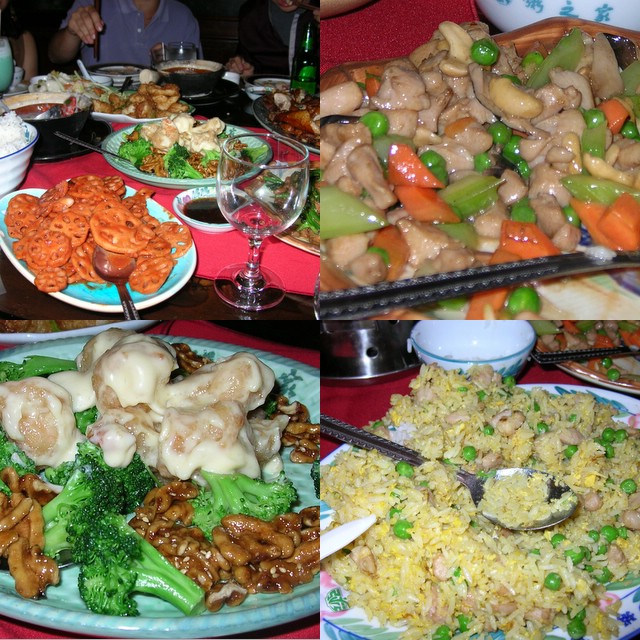
Clockwise from top left: A spread of food (lotus root is closest); Chicken and Cashews; Pork Fried Rice; Shrimp and Walnuts.

Restaurant 33: Congee Village

RESTAURANT: Congee Village
LOCATION: 100 Allen Street
DATE: June 3, 2005
FOOD: Sauteed Shrimp Ball with Walnut; Chicken w/ Black Mushroom Congee Porridge; Roast Pork Fried Rice; Chicken and Cashews; Corn and Chicken Soup; Steamed Vegetable Dumplings; Sauteed Lotus Root with Special Bean Paste Sauce.
BEVERAGE: Two Vodka Tonics; Two Blue Hawaiians; One Whiskey Sour; One Purple Haze
PRICE: $60.00

HAPPY BIRTHDAY TO DANNY!

Sometimes it really does take a village. To raise a child, sure, but also to erase the past – especially when the past involves the tasteless, grease riddled, disgustingly mangled Chinese food of Charlottesville, Virginia. Spending college at the University of Virginia had many benefits – education, great people, big-time sports, beautiful countryside – but deftly prepared Chinese food was not one of them. Thank god, for Congee Village.

The Times Square of the Lower East Side, Congee Village’s entrance is illuminated by gaudy strings of multi-colored flashing lights. It might be an eyesore, if the restaurant didn’t feel so inviting and familial. The clientele is largely Chinese, which is always a good sign and the staff is friendlier than at many Chinatown haunts, even willing to explain the menu.

This was my second trip to Congee and it was in honor of Danny’s 23rd birthday. He rented out one of the backrooms, and the allure of $4 drinks and karaoke brought a large crowd of his friends. But despite the distractions of alcohol, the ridiculous costumes, and the ear-piercing renditions of “Can’t Touch This”, the food at Congee was just as incredible as I remembered it to be.

Ordering as tables, we ended up trying a bit of everything. For once, it was easy to appease Libby’s aversion to all meats save chicken and turkey, as the corn and chicken soup is perhaps the best I’ve ever tasted. The thick off-white soup has a strange, almost egg-drop soup like consistency, but a flavor that is a blissful mix of a Maryland crab cake and creamed corn. I’ve eaten this dish since childhood, but Congee’s version is superior to all others. Equally as amazing were the sautéed shrimp balls with walnuts. Huge shrimp, covered in a creamy, Hollandaise like sauce, were joined with the candied walnuts usually reserved only for desserts. Like many of Congee Village’s dishes, novel combinations of ingredients taste much better than their description might suggest. The contrast of the walnuts sweet and the shrimp’s fishy sour, worked wonderfully, and is a great introductory dish to authentic Chinese.

Of course, no visit to Congee is complete with an order of the restaurant’s namesake dish. Congee (the food) is an unsweetened porridge with the appearance of cream of wheat or grits. While it tastes like neither of these American breakfast staples, the congee’s tang is extraordinary all the same. The musky black mushrooms and weightless steamed chicken are as immersed in this Chinese stew as a 13 year old girl at a live session of “TRL”. The congee is the type of food one could eat every night and never get tired of, as there is always something unexpected to savor in the depths of the creamed rice.

The lotus root, sliced into circles and covered in a red bean paste, actually beat Kittichai’s adaptation of a similar dish – the lotus was softer, the sauce integrated completely into the root like a marinade. It was yet another example of the way Congee scoffs at Americanized-Chinese and the repellant lessening of flavors it has spawned. While Congee offers some common dishes (such as the chicken and cashews, which we ordered and was the least inspired dish of the evening), ordering such banalities is like not reading David Foster Wallace because you’re afraid his style might be too unconventional. Congee’s menu offers dishes normal for China, but unfamiliar to Americas. But when in China, or Congee in this case, do as the…

We drank our fair share as well. Perhaps it was the daiquiri like Blue Hawaiians or the Purple Haze margarita that disappeared as quickly as David Caruso’s career, but by the end of the evening, I was thoroughly knackered. Regardless, the drinks, despite being extremely inexpensive by New York standards, were surprisingly enjoyable. The whiskey sour had absolutely no resemblance to a real whiskey sour, but other than that, I was impressed by Congee’s bar.

Though it was Danny’s birthday, Congee’s food was reason enough to celebrate. Too often, in situations calling for drunken revelry and joyous embarrassment inducing spectacles, our surroundings make us self-conscious and the pleasure of the moment is lost. At Congee, we were free to act like fools while eating with the serenity of Lao-Tzu. Anytime you can leave an ethnic restaurant and say “That’s the best __________ (insert cuisine nationality here) I can remember having”, your night has certainly been a success. I’ve been to Congee Village twice. I’ve left saying it’s the greatest Chinese both times.

RATING: 8.2/10

Monday, June 06, 2005

Menkui-Tei Photos


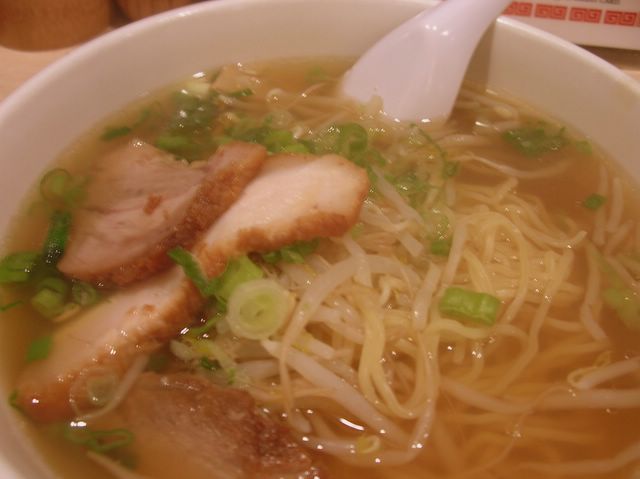
The Menkui-Tei Ramen.

Restaurant 32: Menkui-Tei

RESTAURANT: Menkui-Tei
LOCATION: 60 W. 56th St.
DATE: May 30, 2005
FOOD: Menkui Ramen (Seaweed broth flavored house special noodle soup – 3 pieces of roast pork, bean sprouts, bamboo shoots, and scallion).
BEVERAGE: Tap Water
PRICE: $10.00

An homage to Tampopo, the ultimate film guide to proper noodle(wo)manship

First, I admired the soup - how the surface of the broth glittered with beads of oil; how the pieces of roast pork floated in the embrace of the golden noodles and bean sprouts like floatsam and jetsam from a wrecked ship moored atop seaweed; how the noodles lurked enticingly beneath the surface; how the green of the scallion reflected against the white ceramic bowl.

Second, I tried the noodles. I delicately slid my chopsticks into the steaming liquid in a gesture with enough vague sexuality to make Goro proud. I wrapped the seemingly endless strand around the wooden chopstick, forming coils with as much conduciveness as electrical wire. Then I brought the noodles to my lips, using a few breaths to reduce the soup’s scald. I slurped the noodles in the American fashion the Ms. Manners in Tampopo claims Americans find obnoxious – for a brief moment, I was George Costanza without the paunch and receding hairline.

Third, I savored the flavors. The noodles were delicious – soft but chewy, completely fresh and utterly filling. The broth was a Tokyo rhapsody of seafood and vegetable accents, served at Tampopo’s avowed degree of heat reached right before the liquid begins to boil. The bamboo shoots provided a contrasting crunch, while the scallions a needed pungent sting. It was a reinvigorating stew, light but surprisingly filling – I dreamt of eating the dish in the dead of winter surrounded by the mythical unicorns of Murikami’s snowscape Hard-boiled wonderland.

Fourth, I ate the first of three pieces of roast pork, savoring the meat’s tenderness and the how the seafood broth practically marinated the pork post-roasting, enhancing an already succulent ensemble of flavors. I even closed my eyes, as the enjoyment of this meal was definitely not lost in translation.

And then finally, noodles, pork, and vegetables consumed, I drank the remaining broth. As heartwarming as mom’s chicken soup during a case of the flu, I felt fortified and restored, ready to face the night ahead, even if I was a bit thirsty from the rampant use of sodium in the soup’s base. But one complaint is not enough to dissatisfy. My first experience with Japanese ramen concluded, I was ready to travel East and hone my noodle technique in the home of noodles – and slurping.

RATING: 7.4/10

Thursday, June 02, 2005

Jean-Georges Photos


Clockwise from top left: Grapefruit Gelee with Honey-Ginger Ice Cream; Amuse; Artic Char; Sea Scallops.

Restaurant 31: Jean-Georges

RESTAURANT: Jean-Georges
LOCATION: 1 Central Park West
DATE: May 30, 2005
FOOD: 1st Course: Sea Scallops, Caramelized Cauliflower, Caper-Raisin Emulsion; 2nd Course: Arctic Char, Rhubarb Compote, Gingered Sugar Snap Peas; Dessert: “Citrus” Tasting – Warm White Chocolate Cake, Mandarin Carpaccio, Grapefruit Gelee, Blood Orange, Tarragon, Honey-Ginger Ice Cream
BEVERAGE: Black Cherry-Yuzu Soda
PRICE: $48.00

During Manhattan’s restaurant week earlier this year, I ate lunch at Nougatine, the more moderately priced café offshoot of Jean-Georges. Nougatine is located in a separate room from the formal main dining room and the division evoked the feel of an exclusive club for which I couldn’t obtain membership. Like the fat kid no team picks in gym class, I was left on the culinary sidelines and I vowed to return for a lunch in the “real” restaurant. Memorial Day presented the occasion for this visit.

Of course, the lunch at Nougatine had been incredible, and I had no source for dissatisfaction other than wounded pride. Now, I see the Asian-European fusion cuisine of Nougatine as preparation for the indulgence of Jean-Georges. But regardless, lunch at Jean-Georges transcended Nougatine’s best efforts and I was left in an enraptured state from all that I tried. It was quickly apparent why Jean-Georges is one of the five current restaurants in New York with four stars from The New York Times.

The restaurant is beautiful if a bit austere. A clean, contemporary, sparsely furnished space, at mid-day, Jean-Georges, becomes brilliantly lit from the sun streaming through Central Park’s greenery. The wait staff displays a serious demeanor as they go about their jobs which I found at some points too intense for a meal amongst friends. While I didn’t expect the levity of Babbo, Jean-Georges was more like dining in a museum than my dinner at The Modern. Perhaps such gravity is necessary to maintain a four-star reputation and a clientele willing to drop multiple hundreds of dollars on wine at lunch.

However, the food is beyond all criticism. At Jean-Georges, lunch is ordered in courses – two for $24, with each additional course $12 extra – as close to a Luby’s (a Texas cafeteria chain and horror from my childhood for which I will never forgive my father) a la carte buffet as a Hampton home owner will ever get. Choosing two courses from the menu was like attempting to select only two books from all of the Western Canon – everything (even the beef dishes) sounded fantastic. My hardest decision was forgoing the porcini risotto, which Libby ordered and upon tasting, made me wish she had filled up on bread, so that I could finish her leftovers. Unfortunately, I had no such luck.

I selected the sea scallops largely based on the intriguing caper-raisin emulsion with which it was served. Three sautéed scallops, so perfectly prepared using the word tender as a description would be like labeling Nabakov mildly intelligent, came crowned with thin slices of caramelized cauliflower. But the emulsion was what made the dish exceptional. Combining the flavors of east and west as is common in much of Jean-Georges’ (the chef, not the restaurant) cooking, hints of Asian curry and North African spices brought my mouth to life. Grocery stores shelves are stocked with KC Masterpiece and Ken’s Steakhouse Dressings, but I crave for this sauce to be available for take-home purchase. The sweetness of the raisins added to the sugared cauliflower, and united with the goat-cheese texture of the scallops for a blissful symphonic.

My second course was just as luminous. The artic char, similar to Salmon in appearance and taste, came as a filet topped with grains of coarse rock salt. Additionally, our waiter added sweet snap peas in a ginger butter sauce to the char tableside from a tiny metal container. The presentation was ornate, the flavor sensational. For concealed beneath the char like a railcar stowaway was a rapturous layering of rhubarb compote and what I took to be artichoke hearts. The dish staged a play on sweet and salty as masterful as a Stoppard dialogue.

Unlike Prince Charles, dessert lived up-to its predecessors high standards. Two small, but distinct desserts come with each order, centered around a common theme. I opted for the “Citrus”, though the “Rhubarb” Courtney ordered and the “Exotic” selected by Danny and Libby were both tempting. The warm chocolate cake was as soft and pliant as warm banana bread and greatly enhanced by the Italian ice like mandarin carpaccio. The grapefruit gelee and honey ginger was a tad overwhelmed by the intensity of the blood-orange, but the soup-like nature of the gelee nodded at Jello reinvented for a new century. My drink was my only slight disappointment, as the black cherry was too diminished by the bubbles of club soda. However, our entire lunch at Jean-Georges left me astounded. As we exited the main dining room through the holiday diners lunching at Nougatine, for just a moment, I felt like a dignitary or at least someone a little less ordinary. Class divisions may revolt me, but based on Jean-Georges and Nougatine, culinary separations definitely work in all our flavors (it’d been too long since I included a bad pun).

RATING: 9.1/10

Wednesday, June 01, 2005

Stamatis Photos


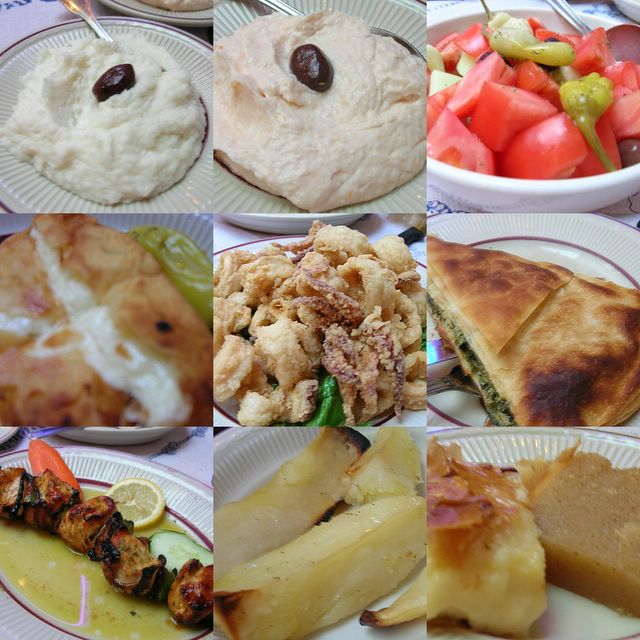
Row 1: Garlic Dip; Salmon Roe Dip; Tomato and Cucumber Salad; Row 2: Fried Cheese; Fried Calamari; Spinach Pie; Row 3: Chicken Kebab; Lemon Potatoes; Desserts, Complimentary but Bad.

Restaurant 30: Stamatis

RESTAURANT: Stamatis
LOCATION: 31-14 Broadway, Astoria, Queens
DATE: May 29, 2005
FOOD: Split orders of the following: Fried Calamari, Spinach Pie, Garlic Dip, Salmon Roe Dip, Fried Cheese, Small Cucumber and Tomato Salad, Chicken Kebab with Lemon Potatoes. Complimentary Dessert of Custard Filled Phyllo Square.
BEVERAGE: Two Mythos (Greek Beer)
PRICE: $36.00

As much as I love the Greek-gone-gourmet of such Manhattan noveau-Aegean restaurants as Molyvos and Pylos, authentic Greek cuisine in its un-rarified form still holds a special place in my stomach. Northern Virginia may be the universe’s leader in strip malls and McMansions, but it’s also home to many excellent Greek restaurants. I grew up on my mother’s incomparable spinach pie and gyros and slouvaki aplenty. Thus, both of my visits to Astoria have felt reminiscent of a homecoming – at least gastrointestinally – despite the fact Edith Hamilton is the closest I’ve ever been to the Isles.

On my first visit in February, Danny and I tired Taverna Klycades, and I left amazed at every dish we sampled. I decided to venture back to Greece’s home away from home, this time with Libby, making her inaugural visit to Queens. Stamatis, one of two family run Astoria-based restaurants of the same name, was our destination. While Taverna Klycades had had the Sunday night dinner buzz of families and singles a like, Stamatis was only half-filled and subdued. But the food did the talking and I once again exited Astoria immensely happy and wishing I lived amongst the pages of Corelli’s Mandolin or in the city-states of Thucydides and Plato.

The Mediterranean diet has gained notoriety recently for the health benefits of its vegetable based lifestyle. Vegetables and fitness are all well and good, but Stamatis’ fried calamari and fried cheese squares would make even Body By Jake take a night off. The cheese oozes between twin sheets of crisp phyllo and reminds one of why the monstrosity that is American mozzarella sticks should remain relegated to the likes of TGI Fridays and Ruby Tuesdays. Once the cheese cools, it’s not nearly as flavorful, so inhaling the greasy delicacies as soon as they reach tableside is advisable. The calamari is light and has an appropriate level of resistant chew, instead of the pulpy tenderizing or silly putty stringiness of many a more expensive restaurant. Served with a plate of lemon wedges, the generous portion is enough to feed three or four.

Stamatis really excelled at dips. The pinkish hue of Salmon roe dip frequently hides Great Salt Lake quantities of sodium, but Stamatis’ version avoided this failure. Covering the point of a grilled pita triangle, the dip provides all the taste of caviar, but with a creamy texture to replace the obnoxious spherical eggs. As fluffy as a cloud, the garlic dip was best when placed on our other dishes – from the surprisingly moist but greasy grilled chicken kebabs to the forgettable lemon potatoes the chicken came with (which once they lost their heat, because almost inedible) to the aforementioned calamari. The garlic taste was present, but so low key it would be easy to tell blind Oedipus it was bean dip and have him believe you.

Libby’s seemingly nonplus selection of the tomato and cucumber salad proved surprisingly delightful. The tomatoes were perfectly ripe and firm and the cucumbers tasted fresh from the garden. Libby and I both found the spinach pie mediocre. The feta in the spinach filling had fully melted and had become a runny mess. And while one should never complain about free desserts, Stamatis’ should keep their sweets to themselves. The custard wrapped in phyllo was alright, but a brown square that tasted like honey soaked sand, disgusted Libby and I both.

However, the meal was less about individual dishes, and more about the wholesome rewards of many tastes taken together. It’s seldom when a dinner contains nothing that stands out and yet diners can leave completely satisfied. But we did. Thus, Stamatis illustrates why Astoria is the Greek capital of the U.S. Stamatis might not make Greek newcomers like Libby crave the food at all hours, it certainly offers ample reason to remember that though Zeus and Athena may have fallen, their descendants are still finding ways to soar to grand, if not Olympic, heights.

RATING: 7.1/10

Veniero's Photos


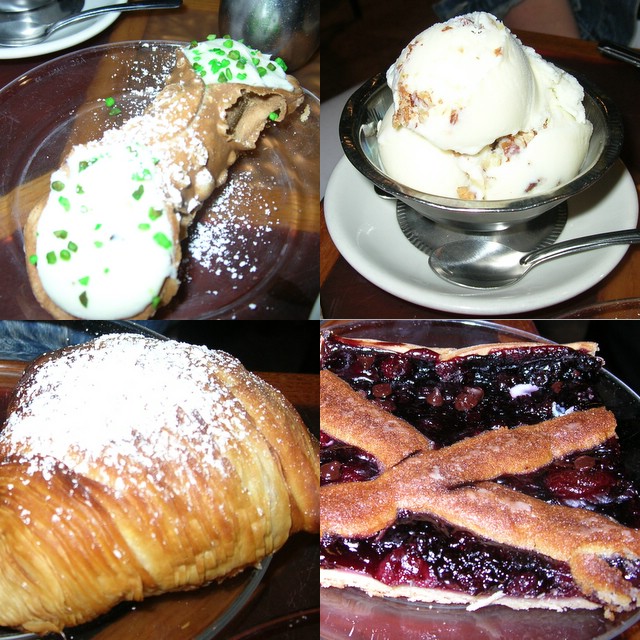
Clockwise from top left: Cannoli, Hazelnut Gelato; Blueberry Pie; Sfogliatella

Just Desserts 8: Veniero's

RESTAURANT: Veniero’s
LOCATION: 342 E 11th Street
DATE: May 28, 2005
DESSERTS: Sfogliatella, Cannoli, Hazelnut Gelato, Blueberry Italian Pie
BEVERAGE: Decaf Hazelnut Coffee
PRICE: $20.00

There must be a secret ingredient Italians use in their desserts that make the sweets especially addictive. Perhaps there’s something in the water of Italy and the dough in Italian pastries becomes infused with the same lighthearted spirit which has led the country to have as many governments since Mussolini as Jenna Jamison has had “male encounters”. Whatever the cause, in my experience, Italian desserts are best enjoyed in gangs of four, as just like listening to the band of the same name, once is never enough.

Veniero’s reputation extends well beyond the East Village and even New York. Lines have formed under its easily distinguishable neon sign for over a hundred years, hungry eyes taking in the wide variety of desserts in the display cases with a desire akin to that of a five year old at FAO Schwartz.

Let down by a sold-out sign at Chick-a-licious, Libby and I wandered into Veniero’s intent on sugar satisfaction. Though I should have known better, I ordered a cannoli, and I blame my post-Madonia disappointment as much on myself as on any fault of Veniero’s. Theirs is an average cannoli and having already tasted perfection once that day, I should have left well enough alone.

Luckily, my date flashed the quick thinking skills requisite of anyone crazy enough to teach in the St. Louis Public School System, and ordered an Italian version of blueberry pie. Served warm and in appearance like a French tart, the pie was splendid, the filling delightfully containing many whole blueberries and enriched in a syrupy glaze which rested on top of a crust with the flakiness of a biscuit. When we added spoonfuls of the hazelnut gelato to the pie, America a la mode suddenly went Roman. The gelato doesn’t measure up to Otto’s and melts extremely quickly, but was still very tasty. Finally, we ordered my Veniero’s stand-by, the lemon and ricotta filled Sfogliatella. Shaped like a clam shell, the taste is anything but fishy, and has become one of my favorite desserts because it satisfies the sweet tooth without being too sugary and the citrus hints at limoncello, making the pastry distinctly Italian.

What makes Veniero’s special is its bustling environment. The tables sit practically on top of each other, which when paired with the irresistible temptation to share desserts, causes Veniero’s to take on an intimacy lacking in most late night establishments. Your voices get lost in the din of all those around you, but oddly you can always hear every interesting comment from your companion. Veniero’s is a comfortable space despite its fervent activity, and this is a hard balance to maintain. Lucky for us, it finds such an equilibrium – oh yeah, and the desserts are pretty damn good as well.

RATING: 7.3/10

Roberto's Photos


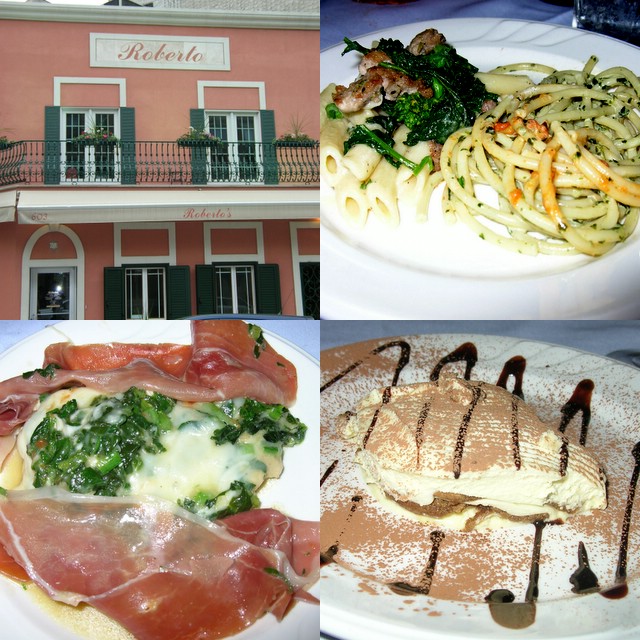
Clockwise from top left: Roberto's in the Bronx; Penne and Buccatini family style; Tiramisu; Pollo alla Chef.

Restaurant 29: Roberto's

RESTAURANT: Roberto’s
LOCATION: 603 Crescent Ave., The Bronx
DATE: May 28, 2005
FOOD: Appetizer: Gamberi & Fagoli (Shrimp tossed with white cannellini beans and a sprinkling of balsamic vinegar); Pasta: Bucatini alla tre salse (Long, thick pasta with a blend of three sauces: pesto, mascarpone cheese and a touch of tomato sauce); Penne con salsiccia e broccoli di rapa (Penne with Italian sausage and broccoli rabe sauteed in garlic and oil); Entrée: Pollo alla Chef (Chicken with spinach, proscuitto, mozzarella, and sherry wine); Dessert: Tiramisu; Tartuffo.
BEVERAGE: San Giorgio in Villa, Chianti Classico 2001; Decaf Cappucino
PRICE: $80.00 (for two, courtesy of Libby, with much thanks)

Roberto’s opens for dinner at four p.m. on Saturdays. By five, there’s already a line and by six, the wait for a table is at least an hour. Situated just east of Arthur Avenue, Roberto’s is the highest rated Bronx restaurant in Zagat’s, with a 26 overall. But in the same way ESPN’s pre-season college basketball rankings become inconsequential once the season starts, so too must a restaurant prove itself on its actual food and not exist solely on its reputation. Unfortunately, based on our visit, Roberto’s might be thriving more from hype than substance.

While the atmosphere is buoyant, the portions large and served family style, and the staff more than willing to accommodate any request, Roberto’s Italian fare is only average – a classic example of good but definitely not great offerings. Maybe it’s because traditional Italian has been as overplayed as a CD of the Rolling Stones “Satisfaction” (at Roberto’s, I didn’t get no) stuck on repeat. Or maybe it’s because traditional Italian presents a chef with limitations that inhibit the type of intense flavor innovations utilized so deftly by the likes of Mario Battali and Scott Covent. Whatever the reason, our meal at Roberto’s was more about what went on outside of the kitchen than what emerged from within.

The Gamberi and Fagoli with which we started was an oily mix of shrimp, cannelini beans, bruschetta chunks and balsamic vinegar. While the shrimp was overcooked and the bruschetta sunk by an over application of oil olive, the dish showed some promise, as it was apparent that the saltiness of the beans could contrast well with more expertly prepared shrimp. However, as served, the appetizer tasted like chunky hummus flavored with fish seasoning.

Though the pasta with “tres salse” typically comes with farfalle, Danny and I both prefer wearing bow-ties to eating them, so our waiter graciously allowed us to substitute bucatini. The noodles themselves had been cooked nicely, the long tubes left with a subtle chew. The three sauces however, turned out to be more like one and half, with the rather bland pesto dominating the dish, while the mascarpone and tomato sauce were as absent as John Bolton at an employee sensitivity training session.

Better was the penne, a garlic and olive oil base harmonizing well with the excellent crumbles of Italian sausage and broccoli rabe (which was slightly limpid). With a sprinkling of cheese, this course would have been outstanding, but it was worthwhile even without the dairy, the hearty Italian sausage carrying the other ingredients.

Libby and I split the Pollo alla Chef, which was a surprisingly tender chicken cutlet literally smothered (imagine the type of extra extra extra cheese pizza Rosie O’Donnell must enjoy) in mozzarella. Beneath this white cloud, there was some very tasty spinach and to help alleviate Libby’s fear of all things pork, our waiter served the proscuitto on the side (as in both sides of my plate). While the cheese, like the oil in our opener, was layered too heavily, both Libby and I enjoyed the entrée, despite feeling that we could have easily made the chicken ourselves. There were no secret ingredients for my tongue to decipher – the four components listed on the menu were the only four in the dish.

For dessert, a light and creamy tiramisu was wonderful, while the coffee grind coating on the tartuffo was too thick to allow a fluid blend of ice cream and chocolate shell to form. As our meal concluded, I was struck by both the many near misses of the evening. Every course had seemed to be lacking that certain something to make it really exceptional. There’s no question Roberto’s provides it’s customers with a great night out and a glimpse of the boisterous Italian spirit I’ve come to know only through the cinema. But Zagat’s might need to redo its rating on Roberto’s – like many a preseason All-American has found, the awards handed out before the game starts mean nothing once it does.

RATING: 6.0/10