Thursday, June 09, 2005


Everything Is Illuminated, by Jonathan Safran Foer

Book 10: Everything Is Illuminated, by Jonathan Safran Foer (Multitude of Drops 1)

Paperback: 288 pages
Publisher: Perennial (March 1, 2003)

In an age when Fukuyama declared the end of history and when the death of the novel is seemingly proclaimed with the same regularity as the sun’s daily ascent, writing continues, great writing in fact, apparently plunging forward, heedless of its own impending doom. Perhaps, Jonathan Safran Foer lost the memo or forgot to watch Fox News the day creative (literary) fiction reached its demise. Perhaps, he is set on proving such pessimistic statements wrong. Or perhaps, he’s just a gifted writer with a story to tell. All possibilities aside, his first novel, Everything Is Illuminated is a masterful piece of literature and a passionate denial that nothing new can (or is) being written.

The novel is an intertwining of voices and narratives, settings and times. It opens with Alex, a Ukrainian teenager, whose travel guide father has been contacted by Jonathan Safran Foer, the fictionalized alter-ego of the author. Foer carries only a photograph of a woman named Augustine, whom he believes survived the Nazis and might possibly be able to provide him with information about the final days of the Trachimbrod Shetl, his grandfather’s Jewish hometown. But all this can be gathered from the plot summary on the back of the novel. What makes Everything Is Illuminated so stunning is the juxtaposition of humor and tragedy, Foer’s innovative use of form, and the One Hundred Years of Solitude like depiction of the Jewish past.

The story is revealed through Alex’s letters to Jonathan about the novel Jonathan is writing on his trip to the Ukraine. We see Alex’s initial attempts to show himself as a ladies man and a player at the novel’s opening, turn into earnest confessions of love for his brother and grandfather by the book’s end. We see Jonathan’s configuration of the Shetl 200 years before its destruction, the life and loves of past generations (his ancestors) and the way the mournful Brod is both used and user. At the beginning of the novel, Alex calls Jonathan a hero, but in truth, no correct in Everything Is Illuminated is perfect enough to conform to this model. All have their flaws, all desire to change some aspect of his or her life. No one is left blameless but no one is completely to blame.

With such complexity, like in Lermontov’s A Hero Of Our Time, Foer brings authorial veracity into question time and time again. At one point, Alex mentions that he changed his description of Foer as short at the latter’s behest. At various other times, Alex begs of Foer to remove the parts of his narrative mentioning how Alex’s grandfather allowed his best friend, a Jew, to be murdered. In a wonderful parallel to the Trachimbrod Shetl’s Jews obsession with detailed and accurate accounting of their history (which is the novel Foer is writing), Alex’s grandfather tries to change the past by denying Augustine’s memory of the events. Foer exposes the way we all manipulate memory to make ourselves appear better than our actions would suggest. In writing we try to correct all the mistakes and tragedy the life brings with it.

In line with this, Foer is questioning the power of words. The Jews in the Shetl believe they only exist so far as their lives are captured in writing. Thus, each member of the town records the minutiae of their lives – from what they ate to breakfast to what they did during a specific afternoon thirty years prior. Foer’s fictionalized glimpse of this accumulated history even breaks into two pages with the words “We are writing, we are writing…” repeated over and over. In a world where everyone is your enemy, as it was for the Jews, Foer is illustrating that the only way to preserve one’s heritage is through pen and paper.

True tragedy, in the Greek tradition, always includes significant elements of comedy. The sadness of the Nazi’s slaughter, the tremendous and inescapable guilt many of the novel’s characters feel are all made even more poignant by the intermixing of humor – Alex’s dog, Sammy Davis Jr. Jr’s proficient flatulence; the Ukrainians inability to understand that Foer is a vegetarian and that pork is thus off limits. Without these and countless other moments, the novel might be trite and certainly less original. The Holocaust is a topic so frequently dealt with in art that its horror must be made new to be made real. Foer manages to avoid sentimentality and the rehashing of other’s works. Everything Is Illuminated is pioneering in its form, but so too in its treatment of one of the worst genocides in world history. As Alex writes Jonathan on page 53, "Humor is the only truthful way to tell a sad story."

The novel’s title is a multi-allusion in the Nabakov tradition. It’s an eloquent reference to the light visible from space when two people make love, but it also connects to the way truth is revealed and memory evades. Foer draws on a myriad of other writers – one notable example, is Günter Grass’ Tin Drum, in the way the figure of the grandmother is used as an indication of security. But Foer doesn’t throw his erudition in the face of readers, rather incorporating it seamlessly into the novel. What we are left with at the end of the book, is the hard-fought possibility that love enables us to live – and survive. His characters may be overwhelmed by guilt, their love might not always be returned or even recognized, but it is humanity’s ability to give such sincerity that keeps us from oblivion – even in the face of an event as monstrous as the holocaust.

A first novel of such ambition and accomplishment sparked a fair amount of backlash against Foer’s quickly achieved success (and the unusually large advance he received from his publishing house). However, focusing strictly on the work, it becomes apparent why others might be jealous. At the age of just 25, Foer achieved what it takes other writers a lifetime (if ever) to complete. Thus, Everything Is Illuminated might be the work of someone young, but its words are those of someone incredibly mature.

A Reader’s Guide and Interview with Jonathan Safran Foer

Wednesday, June 08, 2005

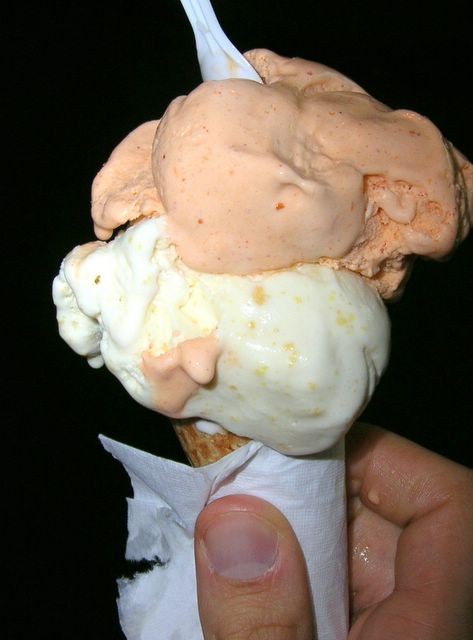
Chinatown Ice Cream Factory Photo


Pumpkin Pie and Almond Cookie Ice Cream on a sugar cone.

Just Desserts 9: Chinatown Ice Cream Factory

RESTAURANT: Chinatown Ice Cream Factory
LOCATION: 65 Bayard St.
DATE: June 5, 2005
DESSERT: One Scoop each of Pumpkin Pie and Almond Cookie Ice Cream on a Sugar Cone; One Almond Cookie
BEVERAGE: None
PRICE: $5.50

A proposed television advertising campaign for Chinatown Ice Cream Factory (if I was their marketing analyst, which, sadly, I am not)

(close-up of Chinatown’s rich, delicious ice cream being scooped onto cone – preferably either the lychee or almond cookie flavors)

Announcer: It’s time to turn in your fortune cookies, folks. For all these years you’ve thought a generic sentence, so lacking in specificity as to make even Ms. Cleo wince, was the proper way to end a Chinese dinner. How wrong you’ve been.

(cut to outside of Chinatown Ice Cream Factory on any given night. Bayard Street is electric with energy and the line extending out the creamery’s door and onto the street is unsurprisingly long. They wait patiently, but enviously glare at the cones and spoonfuls of decadence in the hands of customers already served)

Announcer: Why sublimate your desires, why not give into your urges? Throw the crack-pot predictions in the garbage and rush to Chinatown Ice Cream Factory. What better way to follow up Peking Duck then lychee ice cream or orange sorbet? If you want to remember your fortune cookie days, try the almond cookie – crumbles of buttery, sweetly almond cookie incorporated into luscious vanilla. You can even get the cookie by itself if you want and believe you me, just like John Lennon, its amazing on its own. Had green tea at dinner? Have it again in your ice cream for dessert. Red bean too adventurous? What’s more American than pumpkin pie (well apple, but pumpkin is a close second)?

(cut to the Halloween colored scoop of pumpkin pie ice cream in profile. Orange beads drip down the sides of the cone, practically begging to be licked)

Announcer: This ice cream begs the questions – why go a la mode, when you can just go all in one? Pumpkin pie was made for ice cream and ice cream for pie, so bringing the two together is only natural. Think of it as cutting out the middle man. Bask in the sweetness, savor the unique combinations. Haagen-Dazs may be located a block away, but haven’t you heard? European imperialism is dead, so too the EU. So go East, instead. We promise, once you realize the merits of the Factory, like Andy Warhol, you’ll never want to go anywhere else.

(end on close-up of children smiling as they devour ice cream, their messy faces generating the "Full-House" like chorus of “awws” that everyone knows no parent can resist)

RATING: 8.3/10

Yeah Shanghai Deluxe Photos


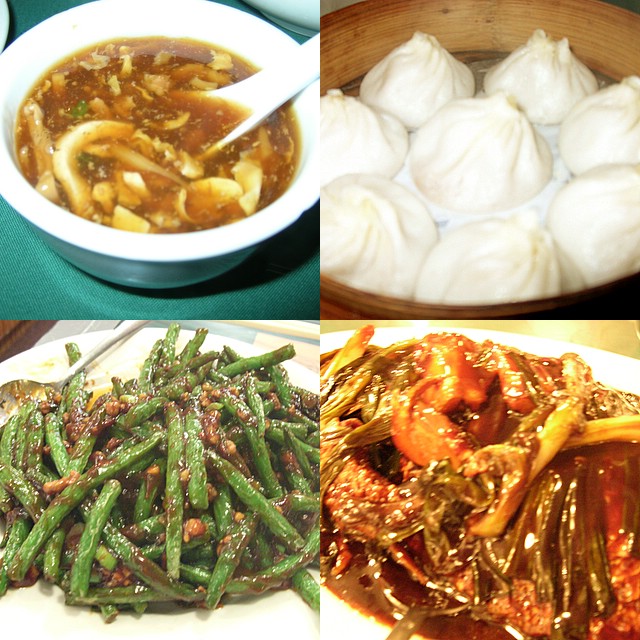
Clockwise from top left: Hot and Sour Soup; Soup Dumplings; Tilapia in Brown Sauce; Spicy String Beans.

Restaurant 35: Yeah Shanghai Deluxe

RESTAURANT: Yeah Shanghai Deluxe
LOCATION: 65 Bayard St.
DATE: June 5, 2005
FOOD: Split the following: Hot and Sour Soup; Steamed Pork Buns (Soup Dumplings); Half Northern Style Roast Chicken; Chef’s Special Tilapia in Brown Sauce; Spicy String Beans with Meat.
BEVERAGE: Tap Water
PRICE: $23.00

It’s an old adage, often repeated, employed to justify everything from music preferences to Senate confirmations of judicial nominees – a democracy is all about the rule of the majority. Supporting a minority perspective on any issue can leave one in a fevered state of anxiety, John Donne’s “no man is an island” stanza rumbling through the mind. However, when it comes to food, maybe its better to swim against the current – one only has to be reminded McDonald’s is the world’s most popular restaurant to realize the full, palate deadening implications of culinary majority rule.

Thus, while users of Citysearch.com, food bloggers, and general word of mouth all lauded Chinatown’s Yeah Shanghai Deluxe as being equally excellent as New Green Bo and Congee Village, I found no such similarities. Situated directly across Bayard Street from the throngs wisely lining up for New Green Bo’s meteoric soup dumplings, Yeah Shanghai carries the reputation of being the Chinese place for people in the know. Apparently, the people in the know have the same problems with reliable sources as Doris Kearns Goodwin and Stephen Ambrose – Yeah Shanghai Deluxe in no way compares to its more highly reputed neighbor.

The evening began ominously. While waiting for Jordan to arrive from work, I noticed that the ceiling had a leak – a leak that was dripping directly into my cup of tea. Part of the enjoyment of venturing to Chinatown is feasting cheaply in the less than four star digs. The dusty floors and half-cleaned bathrooms of Chinatown haunts can add to the experience, but contaminated beverages helps no one save emergency room workers and the makers of digestive aids. Though the wait staff had no problems when I switched tables, I found it interesting that they did nothing to address the leak and actually seated the next customers to enter the restaurant at the table I had just deemed toxic.

The only Americanized dish of the five Jordan and I split, was the hot and sour soup – Yeah Shanghai Deluxe failed not on its inability to make Chinese food suitable for American assumptions but rather because its authentic Chinese food was sub-par, especially in a local so rich in quality. In a case of false advertising to make an ambulance chasing lawyer grin with excitement, the aforementioned hot and sour soup was neither hot nor sour, exuding a flavor that was disturbingly acidic and otherwise bland. However, I was willing to forgive this as being an error in ordering on our part. But Yeah Shanghai Deluxe did nothing to sustain such a notion of gastro-guilt.

Introduced to soup dumplings at New Green Bo, I have come to love the deliberate ritual involved in eating these delicacies. First one bites off the stem-like top. Then blow on the liquid inside the dumpling until it becomes cool enough to slurp. Finally, finish off by devouring the remaining dumpling. Altogether, the measured process makes the dumplings a cultural, rather than a strictly culinary, indulgence. Unfortunately, at Yeah Shanghai Deluxe, there’s no indulgence to be had.

The pork bun (in this case, synonymous with soup dumpling) wrappers were overly coated in flour and as pasty as an Alaskan’s thighs in Winter. The mealy texture greatly detracted from the pork filling, which was actually quite good. Unlike New Green Bo’s version, the soup liquid at Yeah Shanghai seemed more like a Texas pipeline of oil then lightly simmered broth. My disappointment was severe, and New Green Bo’s proximity only seemed to mock my pain.

The meal finally showed some signs of promise with the arrival of the northern style roast chicken and spicy string beans. However, the promise was short lived. Included on the platter of shredded chicken was a fried chicken foot – oddly it was more appetizing than the dumplings. The chicken was under-seasoned, but made up for this deficiency by being extremely tender and moist. Reminiscent of a fried Thanksgiving turkey, the chicken was the evening’s high point, but could have been enhanced by the presence of a plum sauce.

The string beans continued the oily trend of the meal’s dishes, swimming in a sea of unblended liquids. Again, a dish labeled as spicy was instead incredibly mild. The green beans tasted like mud-soaked grass, with an appearance to match. Finally, the tilapia in brown sauce arrived; a whole fish lathered in murky, purplish oils and green onions that sagged like cereal sitting in milk for too long. The fish itself was fine, flaky and not overcooked. But, the sauce pooling in swampy puddles across the plate’s surface was like drinking a bath tub full of soap suds. Jordan and I left all of our dishes unfinished. The best thing I can say about Yeah Shanghai is that it’s literally next door to Chinatown Ice Cream Factory which never fails to amaze. Yeah Shanghai’s polite service couldn’t make up for the lackluster food. I guess there is no clear moral to this story – “the majority” may love Yeah Shanghai Deluxe, but they also form lines in front of New Green Bo. So ignore the majority and the minority and try for yourself – New Green Bo that is…the majority is simply dead wrong about Yeah Shanghai Deluxe. At least, that’s my not so major opinion.

RATING: 4.8/10

Tuesday, June 07, 2005

Murray's Bagels Photos


Multigrain Bagel with Scallion Cream Cheese.

Restaurant 34: Murray's Bagels

RESTAURANT: Murray’s Bagels
LOCATION: 500 6th Avenue
DATE: June 4, 2005
FOOD: Multigrain Bagel with Low-Fat Scallion Cream Cheese
BEVERAGE: Tropicana Orange Juice
PRICE: $5.00

The argument over who makes the best New York bagel is ultimately a discussion of Promethean proportions. Like debating with the World Bank about whether it is economically sound to assist the world’s poor, there is no way universal agreement will ever be reached on the Five Borough’s favorite holed round. So, even as my voice becomes lost in the sea of opinion, I’ll put forward a more moderate line of reasoning: Murray’s Bagels serves up an outstanding, if not the best, bagel in the city.

Murray’s bagels are serious and dense. Biting into these, it’s easy to recognize a taste and composition that is distinctly New York. The crusty, chewy exterior is just as a bagel should be – firm enough to give your teeth a workout, but not so resistant as to become gummy. The interior is dense but not bready – thick enough to serve as a sandwich, but better equipped for cream cheese and lox then pastrami and corned beef. What’s even more enticing is the extensive variety of Murray’s bagels – standard sesame and poppyseed alongside health conscious multi-grain and whole wheat and even off the wall jalapeno and spinach. And unlike H & H Bagels, Murray’s actually puts cream cheese directly on the bagel for you. Luckily, the cream cheese isn’t applied in artery clogging cakes as at national chains Einstein’s and Chesapeake Bagels; instead its spread so that it maintains its proper place in the food hierarchy. If you want to taste only cream cheese, buy a tub of Philadelphia and grab a spoon. But if you want to eat a BAGEL with cream cheese, Murray’s has the proportions all figured out.

The case of cream cheese, spreads, and salads displayed at Murray’s is a selection in line with Baskin Robbins 32 flavors. The scallion is delicious, the pieces of green onion large, prominent, and sharp, instead of the pureed confusion of many a chive cream cheese. Libby’s choice of the honey raisin walnut, however, made me envious, the three components all announcing themselves in a sweet, but not too sweet, blend. It is a perfect breakfast cream cheese, containing the crunch/sugar contrast of raisin brand or cinnamon oatmeal. And since most of the cream cheeses come in both regular and low fat varieties, Murray’s caters to the New Yorker’s awareness of fitness as well. All in all, Murray’s exemplifies why this city is known for its bagels. The debate over bagel supremacy will rage on – but Murray’s asserts a claim for the top spot with the quiet confidence that comes from the secure knowledge of having an excellent product.

RATING: 8.0/10

Congee Village Photos


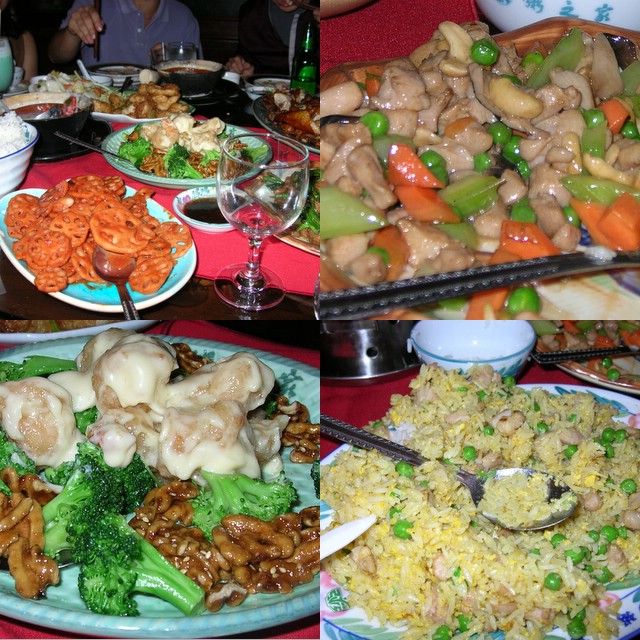
Clockwise from top left: A spread of food (lotus root is closest); Chicken and Cashews; Pork Fried Rice; Shrimp and Walnuts.

Restaurant 33: Congee Village

RESTAURANT: Congee Village
LOCATION: 100 Allen Street
DATE: June 3, 2005
FOOD: Sauteed Shrimp Ball with Walnut; Chicken w/ Black Mushroom Congee Porridge; Roast Pork Fried Rice; Chicken and Cashews; Corn and Chicken Soup; Steamed Vegetable Dumplings; Sauteed Lotus Root with Special Bean Paste Sauce.
BEVERAGE: Two Vodka Tonics; Two Blue Hawaiians; One Whiskey Sour; One Purple Haze
PRICE: $60.00

HAPPY BIRTHDAY TO DANNY!

Sometimes it really does take a village. To raise a child, sure, but also to erase the past – especially when the past involves the tasteless, grease riddled, disgustingly mangled Chinese food of Charlottesville, Virginia. Spending college at the University of Virginia had many benefits – education, great people, big-time sports, beautiful countryside – but deftly prepared Chinese food was not one of them. Thank god, for Congee Village.

The Times Square of the Lower East Side, Congee Village’s entrance is illuminated by gaudy strings of multi-colored flashing lights. It might be an eyesore, if the restaurant didn’t feel so inviting and familial. The clientele is largely Chinese, which is always a good sign and the staff is friendlier than at many Chinatown haunts, even willing to explain the menu.

This was my second trip to Congee and it was in honor of Danny’s 23rd birthday. He rented out one of the backrooms, and the allure of $4 drinks and karaoke brought a large crowd of his friends. But despite the distractions of alcohol, the ridiculous costumes, and the ear-piercing renditions of “Can’t Touch This”, the food at Congee was just as incredible as I remembered it to be.

Ordering as tables, we ended up trying a bit of everything. For once, it was easy to appease Libby’s aversion to all meats save chicken and turkey, as the corn and chicken soup is perhaps the best I’ve ever tasted. The thick off-white soup has a strange, almost egg-drop soup like consistency, but a flavor that is a blissful mix of a Maryland crab cake and creamed corn. I’ve eaten this dish since childhood, but Congee’s version is superior to all others. Equally as amazing were the sautéed shrimp balls with walnuts. Huge shrimp, covered in a creamy, Hollandaise like sauce, were joined with the candied walnuts usually reserved only for desserts. Like many of Congee Village’s dishes, novel combinations of ingredients taste much better than their description might suggest. The contrast of the walnuts sweet and the shrimp’s fishy sour, worked wonderfully, and is a great introductory dish to authentic Chinese.

Of course, no visit to Congee is complete with an order of the restaurant’s namesake dish. Congee (the food) is an unsweetened porridge with the appearance of cream of wheat or grits. While it tastes like neither of these American breakfast staples, the congee’s tang is extraordinary all the same. The musky black mushrooms and weightless steamed chicken are as immersed in this Chinese stew as a 13 year old girl at a live session of “TRL”. The congee is the type of food one could eat every night and never get tired of, as there is always something unexpected to savor in the depths of the creamed rice.

The lotus root, sliced into circles and covered in a red bean paste, actually beat Kittichai’s adaptation of a similar dish – the lotus was softer, the sauce integrated completely into the root like a marinade. It was yet another example of the way Congee scoffs at Americanized-Chinese and the repellant lessening of flavors it has spawned. While Congee offers some common dishes (such as the chicken and cashews, which we ordered and was the least inspired dish of the evening), ordering such banalities is like not reading David Foster Wallace because you’re afraid his style might be too unconventional. Congee’s menu offers dishes normal for China, but unfamiliar to Americas. But when in China, or Congee in this case, do as the…

We drank our fair share as well. Perhaps it was the daiquiri like Blue Hawaiians or the Purple Haze margarita that disappeared as quickly as David Caruso’s career, but by the end of the evening, I was thoroughly knackered. Regardless, the drinks, despite being extremely inexpensive by New York standards, were surprisingly enjoyable. The whiskey sour had absolutely no resemblance to a real whiskey sour, but other than that, I was impressed by Congee’s bar.

Though it was Danny’s birthday, Congee’s food was reason enough to celebrate. Too often, in situations calling for drunken revelry and joyous embarrassment inducing spectacles, our surroundings make us self-conscious and the pleasure of the moment is lost. At Congee, we were free to act like fools while eating with the serenity of Lao-Tzu. Anytime you can leave an ethnic restaurant and say “That’s the best __________ (insert cuisine nationality here) I can remember having”, your night has certainly been a success. I’ve been to Congee Village twice. I’ve left saying it’s the greatest Chinese both times.

RATING: 8.2/10

Monday, June 06, 2005

Menkui-Tei Photos


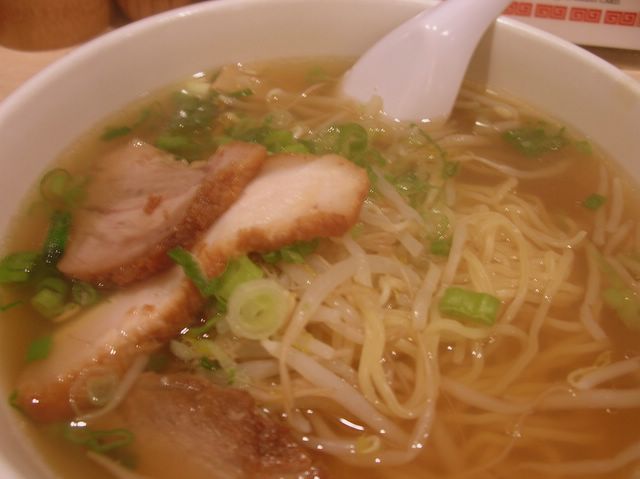
The Menkui-Tei Ramen.

Restaurant 32: Menkui-Tei

RESTAURANT: Menkui-Tei
LOCATION: 60 W. 56th St.
DATE: May 30, 2005
FOOD: Menkui Ramen (Seaweed broth flavored house special noodle soup – 3 pieces of roast pork, bean sprouts, bamboo shoots, and scallion).
BEVERAGE: Tap Water
PRICE: $10.00

An homage to Tampopo, the ultimate film guide to proper noodle(wo)manship

First, I admired the soup - how the surface of the broth glittered with beads of oil; how the pieces of roast pork floated in the embrace of the golden noodles and bean sprouts like floatsam and jetsam from a wrecked ship moored atop seaweed; how the noodles lurked enticingly beneath the surface; how the green of the scallion reflected against the white ceramic bowl.

Second, I tried the noodles. I delicately slid my chopsticks into the steaming liquid in a gesture with enough vague sexuality to make Goro proud. I wrapped the seemingly endless strand around the wooden chopstick, forming coils with as much conduciveness as electrical wire. Then I brought the noodles to my lips, using a few breaths to reduce the soup’s scald. I slurped the noodles in the American fashion the Ms. Manners in Tampopo claims Americans find obnoxious – for a brief moment, I was George Costanza without the paunch and receding hairline.

Third, I savored the flavors. The noodles were delicious – soft but chewy, completely fresh and utterly filling. The broth was a Tokyo rhapsody of seafood and vegetable accents, served at Tampopo’s avowed degree of heat reached right before the liquid begins to boil. The bamboo shoots provided a contrasting crunch, while the scallions a needed pungent sting. It was a reinvigorating stew, light but surprisingly filling – I dreamt of eating the dish in the dead of winter surrounded by the mythical unicorns of Murikami’s snowscape Hard-boiled wonderland.

Fourth, I ate the first of three pieces of roast pork, savoring the meat’s tenderness and the how the seafood broth practically marinated the pork post-roasting, enhancing an already succulent ensemble of flavors. I even closed my eyes, as the enjoyment of this meal was definitely not lost in translation.

And then finally, noodles, pork, and vegetables consumed, I drank the remaining broth. As heartwarming as mom’s chicken soup during a case of the flu, I felt fortified and restored, ready to face the night ahead, even if I was a bit thirsty from the rampant use of sodium in the soup’s base. But one complaint is not enough to dissatisfy. My first experience with Japanese ramen concluded, I was ready to travel East and hone my noodle technique in the home of noodles – and slurping.

RATING: 7.4/10

Thursday, June 02, 2005

Jean-Georges Photos


Clockwise from top left: Grapefruit Gelee with Honey-Ginger Ice Cream; Amuse; Artic Char; Sea Scallops.

Restaurant 31: Jean-Georges

RESTAURANT: Jean-Georges
LOCATION: 1 Central Park West
DATE: May 30, 2005
FOOD: 1st Course: Sea Scallops, Caramelized Cauliflower, Caper-Raisin Emulsion; 2nd Course: Arctic Char, Rhubarb Compote, Gingered Sugar Snap Peas; Dessert: “Citrus” Tasting – Warm White Chocolate Cake, Mandarin Carpaccio, Grapefruit Gelee, Blood Orange, Tarragon, Honey-Ginger Ice Cream
BEVERAGE: Black Cherry-Yuzu Soda
PRICE: $48.00

During Manhattan’s restaurant week earlier this year, I ate lunch at Nougatine, the more moderately priced café offshoot of Jean-Georges. Nougatine is located in a separate room from the formal main dining room and the division evoked the feel of an exclusive club for which I couldn’t obtain membership. Like the fat kid no team picks in gym class, I was left on the culinary sidelines and I vowed to return for a lunch in the “real” restaurant. Memorial Day presented the occasion for this visit.

Of course, the lunch at Nougatine had been incredible, and I had no source for dissatisfaction other than wounded pride. Now, I see the Asian-European fusion cuisine of Nougatine as preparation for the indulgence of Jean-Georges. But regardless, lunch at Jean-Georges transcended Nougatine’s best efforts and I was left in an enraptured state from all that I tried. It was quickly apparent why Jean-Georges is one of the five current restaurants in New York with four stars from The New York Times.

The restaurant is beautiful if a bit austere. A clean, contemporary, sparsely furnished space, at mid-day, Jean-Georges, becomes brilliantly lit from the sun streaming through Central Park’s greenery. The wait staff displays a serious demeanor as they go about their jobs which I found at some points too intense for a meal amongst friends. While I didn’t expect the levity of Babbo, Jean-Georges was more like dining in a museum than my dinner at The Modern. Perhaps such gravity is necessary to maintain a four-star reputation and a clientele willing to drop multiple hundreds of dollars on wine at lunch.

However, the food is beyond all criticism. At Jean-Georges, lunch is ordered in courses – two for $24, with each additional course $12 extra – as close to a Luby’s (a Texas cafeteria chain and horror from my childhood for which I will never forgive my father) a la carte buffet as a Hampton home owner will ever get. Choosing two courses from the menu was like attempting to select only two books from all of the Western Canon – everything (even the beef dishes) sounded fantastic. My hardest decision was forgoing the porcini risotto, which Libby ordered and upon tasting, made me wish she had filled up on bread, so that I could finish her leftovers. Unfortunately, I had no such luck.

I selected the sea scallops largely based on the intriguing caper-raisin emulsion with which it was served. Three sautéed scallops, so perfectly prepared using the word tender as a description would be like labeling Nabakov mildly intelligent, came crowned with thin slices of caramelized cauliflower. But the emulsion was what made the dish exceptional. Combining the flavors of east and west as is common in much of Jean-Georges’ (the chef, not the restaurant) cooking, hints of Asian curry and North African spices brought my mouth to life. Grocery stores shelves are stocked with KC Masterpiece and Ken’s Steakhouse Dressings, but I crave for this sauce to be available for take-home purchase. The sweetness of the raisins added to the sugared cauliflower, and united with the goat-cheese texture of the scallops for a blissful symphonic.

My second course was just as luminous. The artic char, similar to Salmon in appearance and taste, came as a filet topped with grains of coarse rock salt. Additionally, our waiter added sweet snap peas in a ginger butter sauce to the char tableside from a tiny metal container. The presentation was ornate, the flavor sensational. For concealed beneath the char like a railcar stowaway was a rapturous layering of rhubarb compote and what I took to be artichoke hearts. The dish staged a play on sweet and salty as masterful as a Stoppard dialogue.

Unlike Prince Charles, dessert lived up-to its predecessors high standards. Two small, but distinct desserts come with each order, centered around a common theme. I opted for the “Citrus”, though the “Rhubarb” Courtney ordered and the “Exotic” selected by Danny and Libby were both tempting. The warm chocolate cake was as soft and pliant as warm banana bread and greatly enhanced by the Italian ice like mandarin carpaccio. The grapefruit gelee and honey ginger was a tad overwhelmed by the intensity of the blood-orange, but the soup-like nature of the gelee nodded at Jello reinvented for a new century. My drink was my only slight disappointment, as the black cherry was too diminished by the bubbles of club soda. However, our entire lunch at Jean-Georges left me astounded. As we exited the main dining room through the holiday diners lunching at Nougatine, for just a moment, I felt like a dignitary or at least someone a little less ordinary. Class divisions may revolt me, but based on Jean-Georges and Nougatine, culinary separations definitely work in all our flavors (it’d been too long since I included a bad pun).

RATING: 9.1/10

Wednesday, June 01, 2005

Stamatis Photos


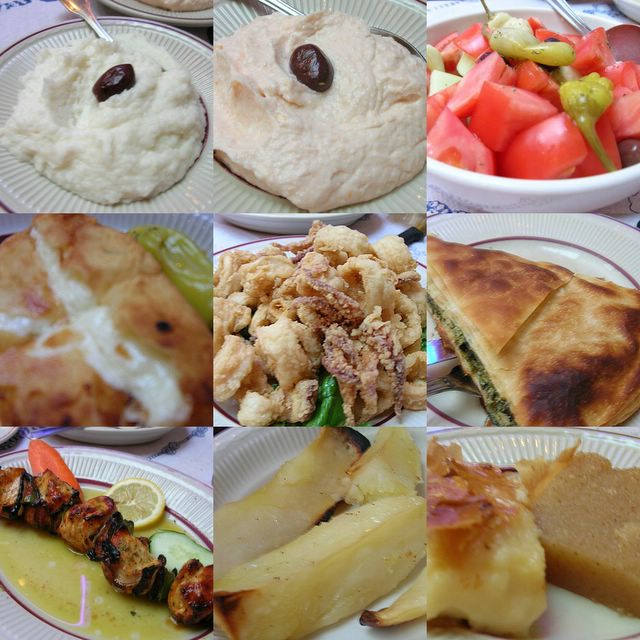
Row 1: Garlic Dip; Salmon Roe Dip; Tomato and Cucumber Salad; Row 2: Fried Cheese; Fried Calamari; Spinach Pie; Row 3: Chicken Kebab; Lemon Potatoes; Desserts, Complimentary but Bad.

Restaurant 30: Stamatis

RESTAURANT: Stamatis
LOCATION: 31-14 Broadway, Astoria, Queens
DATE: May 29, 2005
FOOD: Split orders of the following: Fried Calamari, Spinach Pie, Garlic Dip, Salmon Roe Dip, Fried Cheese, Small Cucumber and Tomato Salad, Chicken Kebab with Lemon Potatoes. Complimentary Dessert of Custard Filled Phyllo Square.
BEVERAGE: Two Mythos (Greek Beer)
PRICE: $36.00

As much as I love the Greek-gone-gourmet of such Manhattan noveau-Aegean restaurants as Molyvos and Pylos, authentic Greek cuisine in its un-rarified form still holds a special place in my stomach. Northern Virginia may be the universe’s leader in strip malls and McMansions, but it’s also home to many excellent Greek restaurants. I grew up on my mother’s incomparable spinach pie and gyros and slouvaki aplenty. Thus, both of my visits to Astoria have felt reminiscent of a homecoming – at least gastrointestinally – despite the fact Edith Hamilton is the closest I’ve ever been to the Isles.

On my first visit in February, Danny and I tired Taverna Klycades, and I left amazed at every dish we sampled. I decided to venture back to Greece’s home away from home, this time with Libby, making her inaugural visit to Queens. Stamatis, one of two family run Astoria-based restaurants of the same name, was our destination. While Taverna Klycades had had the Sunday night dinner buzz of families and singles a like, Stamatis was only half-filled and subdued. But the food did the talking and I once again exited Astoria immensely happy and wishing I lived amongst the pages of Corelli’s Mandolin or in the city-states of Thucydides and Plato.

The Mediterranean diet has gained notoriety recently for the health benefits of its vegetable based lifestyle. Vegetables and fitness are all well and good, but Stamatis’ fried calamari and fried cheese squares would make even Body By Jake take a night off. The cheese oozes between twin sheets of crisp phyllo and reminds one of why the monstrosity that is American mozzarella sticks should remain relegated to the likes of TGI Fridays and Ruby Tuesdays. Once the cheese cools, it’s not nearly as flavorful, so inhaling the greasy delicacies as soon as they reach tableside is advisable. The calamari is light and has an appropriate level of resistant chew, instead of the pulpy tenderizing or silly putty stringiness of many a more expensive restaurant. Served with a plate of lemon wedges, the generous portion is enough to feed three or four.

Stamatis really excelled at dips. The pinkish hue of Salmon roe dip frequently hides Great Salt Lake quantities of sodium, but Stamatis’ version avoided this failure. Covering the point of a grilled pita triangle, the dip provides all the taste of caviar, but with a creamy texture to replace the obnoxious spherical eggs. As fluffy as a cloud, the garlic dip was best when placed on our other dishes – from the surprisingly moist but greasy grilled chicken kebabs to the forgettable lemon potatoes the chicken came with (which once they lost their heat, because almost inedible) to the aforementioned calamari. The garlic taste was present, but so low key it would be easy to tell blind Oedipus it was bean dip and have him believe you.

Libby’s seemingly nonplus selection of the tomato and cucumber salad proved surprisingly delightful. The tomatoes were perfectly ripe and firm and the cucumbers tasted fresh from the garden. Libby and I both found the spinach pie mediocre. The feta in the spinach filling had fully melted and had become a runny mess. And while one should never complain about free desserts, Stamatis’ should keep their sweets to themselves. The custard wrapped in phyllo was alright, but a brown square that tasted like honey soaked sand, disgusted Libby and I both.

However, the meal was less about individual dishes, and more about the wholesome rewards of many tastes taken together. It’s seldom when a dinner contains nothing that stands out and yet diners can leave completely satisfied. But we did. Thus, Stamatis illustrates why Astoria is the Greek capital of the U.S. Stamatis might not make Greek newcomers like Libby crave the food at all hours, it certainly offers ample reason to remember that though Zeus and Athena may have fallen, their descendants are still finding ways to soar to grand, if not Olympic, heights.

RATING: 7.1/10

Veniero's Photos


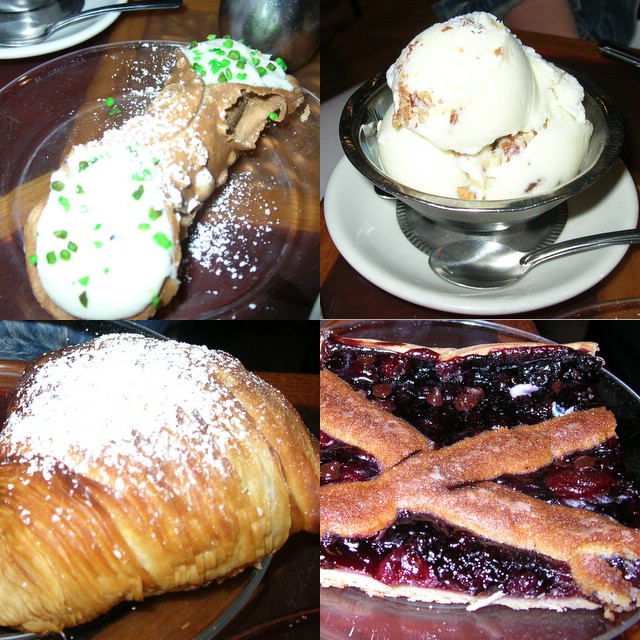
Clockwise from top left: Cannoli, Hazelnut Gelato; Blueberry Pie; Sfogliatella

Just Desserts 8: Veniero's

RESTAURANT: Veniero’s
LOCATION: 342 E 11th Street
DATE: May 28, 2005
DESSERTS: Sfogliatella, Cannoli, Hazelnut Gelato, Blueberry Italian Pie
BEVERAGE: Decaf Hazelnut Coffee
PRICE: $20.00

There must be a secret ingredient Italians use in their desserts that make the sweets especially addictive. Perhaps there’s something in the water of Italy and the dough in Italian pastries becomes infused with the same lighthearted spirit which has led the country to have as many governments since Mussolini as Jenna Jamison has had “male encounters”. Whatever the cause, in my experience, Italian desserts are best enjoyed in gangs of four, as just like listening to the band of the same name, once is never enough.

Veniero’s reputation extends well beyond the East Village and even New York. Lines have formed under its easily distinguishable neon sign for over a hundred years, hungry eyes taking in the wide variety of desserts in the display cases with a desire akin to that of a five year old at FAO Schwartz.

Let down by a sold-out sign at Chick-a-licious, Libby and I wandered into Veniero’s intent on sugar satisfaction. Though I should have known better, I ordered a cannoli, and I blame my post-Madonia disappointment as much on myself as on any fault of Veniero’s. Theirs is an average cannoli and having already tasted perfection once that day, I should have left well enough alone.

Luckily, my date flashed the quick thinking skills requisite of anyone crazy enough to teach in the St. Louis Public School System, and ordered an Italian version of blueberry pie. Served warm and in appearance like a French tart, the pie was splendid, the filling delightfully containing many whole blueberries and enriched in a syrupy glaze which rested on top of a crust with the flakiness of a biscuit. When we added spoonfuls of the hazelnut gelato to the pie, America a la mode suddenly went Roman. The gelato doesn’t measure up to Otto’s and melts extremely quickly, but was still very tasty. Finally, we ordered my Veniero’s stand-by, the lemon and ricotta filled Sfogliatella. Shaped like a clam shell, the taste is anything but fishy, and has become one of my favorite desserts because it satisfies the sweet tooth without being too sugary and the citrus hints at limoncello, making the pastry distinctly Italian.

What makes Veniero’s special is its bustling environment. The tables sit practically on top of each other, which when paired with the irresistible temptation to share desserts, causes Veniero’s to take on an intimacy lacking in most late night establishments. Your voices get lost in the din of all those around you, but oddly you can always hear every interesting comment from your companion. Veniero’s is a comfortable space despite its fervent activity, and this is a hard balance to maintain. Lucky for us, it finds such an equilibrium – oh yeah, and the desserts are pretty damn good as well.

RATING: 7.3/10

Roberto's Photos


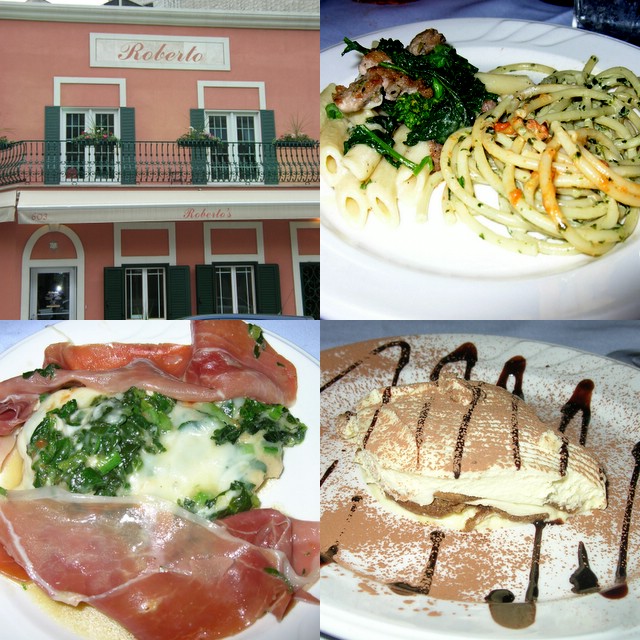
Clockwise from top left: Roberto's in the Bronx; Penne and Buccatini family style; Tiramisu; Pollo alla Chef.

Restaurant 29: Roberto's

RESTAURANT: Roberto’s
LOCATION: 603 Crescent Ave., The Bronx
DATE: May 28, 2005
FOOD: Appetizer: Gamberi & Fagoli (Shrimp tossed with white cannellini beans and a sprinkling of balsamic vinegar); Pasta: Bucatini alla tre salse (Long, thick pasta with a blend of three sauces: pesto, mascarpone cheese and a touch of tomato sauce); Penne con salsiccia e broccoli di rapa (Penne with Italian sausage and broccoli rabe sauteed in garlic and oil); Entrée: Pollo alla Chef (Chicken with spinach, proscuitto, mozzarella, and sherry wine); Dessert: Tiramisu; Tartuffo.
BEVERAGE: San Giorgio in Villa, Chianti Classico 2001; Decaf Cappucino
PRICE: $80.00 (for two, courtesy of Libby, with much thanks)

Roberto’s opens for dinner at four p.m. on Saturdays. By five, there’s already a line and by six, the wait for a table is at least an hour. Situated just east of Arthur Avenue, Roberto’s is the highest rated Bronx restaurant in Zagat’s, with a 26 overall. But in the same way ESPN’s pre-season college basketball rankings become inconsequential once the season starts, so too must a restaurant prove itself on its actual food and not exist solely on its reputation. Unfortunately, based on our visit, Roberto’s might be thriving more from hype than substance.

While the atmosphere is buoyant, the portions large and served family style, and the staff more than willing to accommodate any request, Roberto’s Italian fare is only average – a classic example of good but definitely not great offerings. Maybe it’s because traditional Italian has been as overplayed as a CD of the Rolling Stones “Satisfaction” (at Roberto’s, I didn’t get no) stuck on repeat. Or maybe it’s because traditional Italian presents a chef with limitations that inhibit the type of intense flavor innovations utilized so deftly by the likes of Mario Battali and Scott Covent. Whatever the reason, our meal at Roberto’s was more about what went on outside of the kitchen than what emerged from within.

The Gamberi and Fagoli with which we started was an oily mix of shrimp, cannelini beans, bruschetta chunks and balsamic vinegar. While the shrimp was overcooked and the bruschetta sunk by an over application of oil olive, the dish showed some promise, as it was apparent that the saltiness of the beans could contrast well with more expertly prepared shrimp. However, as served, the appetizer tasted like chunky hummus flavored with fish seasoning.

Though the pasta with “tres salse” typically comes with farfalle, Danny and I both prefer wearing bow-ties to eating them, so our waiter graciously allowed us to substitute bucatini. The noodles themselves had been cooked nicely, the long tubes left with a subtle chew. The three sauces however, turned out to be more like one and half, with the rather bland pesto dominating the dish, while the mascarpone and tomato sauce were as absent as John Bolton at an employee sensitivity training session.

Better was the penne, a garlic and olive oil base harmonizing well with the excellent crumbles of Italian sausage and broccoli rabe (which was slightly limpid). With a sprinkling of cheese, this course would have been outstanding, but it was worthwhile even without the dairy, the hearty Italian sausage carrying the other ingredients.

Libby and I split the Pollo alla Chef, which was a surprisingly tender chicken cutlet literally smothered (imagine the type of extra extra extra cheese pizza Rosie O’Donnell must enjoy) in mozzarella. Beneath this white cloud, there was some very tasty spinach and to help alleviate Libby’s fear of all things pork, our waiter served the proscuitto on the side (as in both sides of my plate). While the cheese, like the oil in our opener, was layered too heavily, both Libby and I enjoyed the entrée, despite feeling that we could have easily made the chicken ourselves. There were no secret ingredients for my tongue to decipher – the four components listed on the menu were the only four in the dish.

For dessert, a light and creamy tiramisu was wonderful, while the coffee grind coating on the tartuffo was too thick to allow a fluid blend of ice cream and chocolate shell to form. As our meal concluded, I was struck by both the many near misses of the evening. Every course had seemed to be lacking that certain something to make it really exceptional. There’s no question Roberto’s provides it’s customers with a great night out and a glimpse of the boisterous Italian spirit I’ve come to know only through the cinema. But Zagat’s might need to redo its rating on Roberto’s – like many a preseason All-American has found, the awards handed out before the game starts mean nothing once it does.

RATING: 6.0/10

Tuesday, May 31, 2005

Madonia Bakery Photo


Madonia Bakery's miraculous cannoli.

Just Desserts 7: Madonia Bakery

BAKERY: Madonia Bakery
LOCATION: 2348 Arthur Avenue, The Bronx
DATE: May 28, 2005
DESSERT: Regular Filled Cannoli
PRICE: $1.50

Disclaimer…If you don’t like cannolis, there is no point in reading any further, for just as St. Augustine’s confession of pure faith would have repelled Marx, so too will my passionate articulation of Madonia Bakery’s otherworldly cannolis be incomprehensible to the cannoli hater. However, if you have functional tastebuds, read on…

It’s simply the best cannoli in New York. Get out of Manhattan, away from Little Italy, and find Arthur Avenue in the Bronx. Because it’s there, in the inauspicious Madonia bakery that you’ll find the holy grail of cannolis. When you arrive, don’t be confused when there are no cannolis waiting in the display cases. At Madonia, they fill your cannoli when you order. This prevents the soggy crusts and stale ricotta filling commonly equated with the city’s cannolis. All you have to do is ask a server and the cannoli shall be yours.

The shell sparkles with grains of cinnamon sugar, like a Cinnamon Toast Crunch square undergoing genetic mutation. When you bite into it, it actually crunches (you can hear the snap) – the pastry doesn’t have to be pried away with tiger like tenacity because of excessive dampness. Be prepared, if you are anything like myself, this crispness may catch you unawares, having suffered through countless flimsy tubes in days past.

And then there’s the filling. Those awful cannolis available in every two-bit pizza joint have deadened your senses – you expect the ricotta cheese to be so sweet that your face will end in a pucker usually reserved for the smells emanating from dogs and babies. Madonia’s ricotta won’t do this to you. You can actually taste the cheese, and the chocolate chips taste oddly like chocolate rather then the usual hardened black drops of Splenda. As your lips became coated in powdered sugar and your bites continue with greater and greater rapidity, you’re overwhelmed. You’ve found it. This is it. It’s simply the best cannoli in New York.

RATING: 9.0/10

Convivium Photos


Clockwise from top left: Roasted Artichoke; Artichoke Ravioli; Berry Panna Cotta; Pistachio Crusted Lamb Shank.

Restaurant 28: Convivium (Multitude of Drops 1)

RESTAURANT: Convivium (Multitude of Drops 1)
LOCATION: 68 Fifth Avenue, Park Slope, Brooklyn
DATE: May 27, 2005
FOOD: Appetizers – Whole Roasted Artichoke; Watercress Salad with Gorgonzola and Walnuts; Primi – Artichoke Ravioli; Entree – Pistachio Crusted Braised Lamb Shank with Cauliflower (Me); Pari-Pari Roast Chicken (Libby); Desserts – Blackberry and Blueberry Panna Cotta; Flourless Chocolate Cake
BEVERAGE: Split a bottle of Pinot Grigio, Decaf Cappucino
PRICE: $178.00 (for two)

Perhaps a dinner based on a discussion of Jonathan Safran Foer’s Everything Is Illuminated should begin with a focus on the restaurant’s lighting. Convivium, a rustic Mediterranean restaurant in Park Slope (where Foer lives, hence the choice), is lit almost exclusively by the cocktail glass sized candles burning atop the unfinished wood of its communal farm tables. Convivium has the atmosphere of a half-forgotten memory, its ethereal glow and untranslated Portuguese menu evocative of a foreign local witnessed only in old movies. The food however, demands to be remembered, Portuguese, Spanish, and Italian elements merging in dishes both singular and delicious.

Mimicking the success of Infinite Feast, Libby and I decided to start our own book club – Multitude of Drops. Everything Is Illuminated was our first selection. Convivium’s cuisine worked perfectly with our discussion, which ranged over Foer’s innovative meta-narrative and moving depiction of the Holocaust’s lasting impact on the survivors and history as a whole. The food, while notable, was more familiar than revolutionary. It was excellent without making too much of a fuss, thoroughly enjoyable without drawing more attention to itself than we would have wanted to give.

The list of non-vegetarian appetizers was less than exciting, so we ordered the watercress salad with gorgonzola and walnuts and the whole roasted artichoke, the later perhaps Convivium’s best known dish. The salad was a bit too simple and needed some type of dressing to make it less boring. When ordering a salad at a restaurant, it’s always a bit disappointing to be served a plate of the same untouched greens readily available in grocery store salad starter kits nationwide. However, the artichoke was delectable. The stem and even some of the bristly leaves, normally inedible parts of the vegetable, had been tenderized by a roasting process I can only imagine must take a very precise oven. Served in a chicken soup colored broth, the artichoke pleased us both, a light and invigorating way to begin the meal.

What followed was one of the two our unanimous best dishes of the nice – artichoke stuffed ravioli dusted with parmesan cheese shavings. It was a perfect example of the type of pan-European flavors Convivium excels at uniting. The pasta was supple; the artichoke filling vibrant. There was nothing surprising about the pasta – it was just that all the ingredients had been integrated flawlessly.

While Libby feasted on the peppery Peri-Peri roast chicken, I was enthralled by my entrée, the pistachio crusted lamb shank. While using nuts as a dusting for lamb has now become commonplace, Convivium still managed to infuse the dish with some novel vitality. The meat was succulent and complimented well by the braised saucing. And while normally my affinity for cauliflower is on par with George Bush the First’s love of broccoli, the vinegar glaze coating Convivium’s made the ugly white vegetable a side I would actually look forward to eating.

Dessert was as a whole the most consistent and tasty course. The flourless chocolate cake gratified like a freshly baked brownie. But even better was the panna cotta, a dessert I usually loathe but in this case was my favorite plate of the evening. If you took the berry filling of your favorite pie, the creaminess of Italy’s best vanilla gelato, and the texture of Spain’s smoothest flan, you would have Convivium’s panna cotta. Also, I generally don’t comment on cappuccino or coffee, but Convivium’s cappuccino deserves mention. It was wonderful; a cup that remembered cappuccino should still taste like coffee and not just heated froth.

So as the first meeting of Multitude of Drops came to an end, and Libby and I began to talk less of the book and more of each other, I realized such a conversational path should have been far from unexpected. Convivium is a romantic restaurant. As we sipped the remarkable Pinot Grigio our waiter had recommended and pondered the intricacies of Foer’s art, I couldn’t help noticing that Convivium is made for couples. While the space is tiny, Convivium is intimate and not claustrophobic. It’s easy to be lost in the moment, your conversations made somehow more important, the world a distant place to be dealt with later. Convivium is private while being public, and I was able to focus on the one thing I wanted to – namely, the woman sitting across from me – without any distractions. The food is reward enough, but if you find the right person to go with, Convivium can be more than just amazing – it can become magical as well.

RATING: 7.8/10

Friday, May 27, 2005

Al Di La Photos


Clockwise from top left: Al Di La in Park Slope; Paccheri with Pork Ragu; Pear and Chocolate Chunk Cake; Braised Rabbit.

Restaurant 27: Al Di La (Infinite Feast XVIII)

RESTAURANT: Al Di La
LOCATION: 248 5th Avenue, Brooklyn (Park Slope)
DATE: May 23, 2005
FOOD: Paccheri with Pork Ragu and Goat Cheese (Special); Braised Rabbit with Black Olives and Polenta; Half a side of Grilled Swisschard Stems; Apricot and Pecan Torta (Special); Torta Di Pere E Cioccollato (Pear Cake with bitter chocolate chunks)
BEVERAGE: At least 20 glasses of water
PRICE: $60.00

So you and a fellow Reader happen to be walking along Park Slope’s 5th Avenue restaurant row, when you chance upon Al Di La. You’ve both been reading Italo Calvino’s, If on a winter’s night a traveler, so your minds are already on the look out for cosmic coincidences which in reality aren’t coincidental in the least. So the appearance of Al Di La strikes you as being more than opportune – perhaps a stroll you thought was purposeless, was in fact intended to lead you to this trattoria all along. After all, you are hungry, you’ve been reading an Italian novel by the foremost Italian novelist of the 20th century, and Al Di La is one of the best Italian restaurants in the city. Such a conglomeration of events seems too harmonious to be accidental.

You and the fellow Reader enter Al Di La through the black curtain hanging over the door and are immediately struck by the delicious aromas wafting from the kitchen. Olive oil and garlic linger in the air like a meaningful conversation and you wonder if by walking through that curtain you somehow left Brooklyn and have been transported to a rustic Venetian villa. But the smells remind your stomachs of their pressing needs, so you ignore the momentary dislocation and sit down at the end of a crowded line of tables. Candles illuminate the room and wine bottles of nights past rest on a mantel, their silhouettes casting faint shadows on the wall.

Your waitress is cute and knowledgeable, and she recites the night’s specials effortlessly, before having to repeat them because some of the dishes sounded so enticing, you stopped listening mid-way through her speech. No matter, she is patient and comments on the fact that she has started If on a winter’s night a traveler many times, but never finished the book. This seems appropriate, as it is a book about false starts, and your conviction that this night is shaded with an element of pre-determinism grows stronger.

Deciding what to order was hard for your fellow Reader, but especially difficult for you. Literally everything on the menu (save beef for which you have an aversion) sounded appetizing. But in the night’s spirit of novelty, you order the night’s special pasta, paccheri with pork ragu to begin. The paccheri appear a cross of lasagna noodles and rigatoni and are lightly covered in an impeccable red sauce based around roasted pork. A dollop of goat cheese and parmesan shavings complete the dish. From your first bite you are possessed by a paradoxical feeling – this dish is so luminary, such a blissful combination occurs between the country style sauce, velvety cheese, and al dente noodles, that you fear the time your plate will inevitably become empty. You begrudgingly trade your fellow Reader the paccheri to taste his swiss-chard gnocchi and are again sent into a higher culinary atmosphere. You decide the paccheri is one of the top five pastas you’ve had in New York, and this includes your meals at Babbo, Lupa, L’Impero, and Cacio e Pepe.

For your entrée you decided on the braised rabbit, partially because you are craving polenta and partially because the Easter bunny screwed you over as a kid. It, like the paccheri before, is splendidly prepared – the meat cooked to a tender flush, the polenta creamy despite being made without cheese, the Mediterranean influences of olives adding a flavorful contrast of acidity. Again, the coming close of the dish disheartens as you ponder ordering the course a second time. But no, there is dessert to be had, and you are a dessert fiend.

You had been set on the warm pear cake with chocolate chunks, but then your affable waitress informs you of yet another special. The apricot and pecan torta she describes speaks on your frequency and in a rare moment of decisiveness, you order the tart. It is everything you could have wanted and more. The slightly sour slices of apricot and hearty pecans will make your mouth water days later as you write your Al Di La review. You then decide the dinner is about to end, so you impulsively order the pear cake previously overlooked. Two desserts is nothing for you, as even the waitress is confident in your ability to finish the second sweet. Her confidence is well-founded, but so too is the pear cake, delicate pears and potent dark chocolate gratifyingly offset by a buttery, flaky crust. As your put the last fork full into your mouth, you realize there is no more room in your stomach to prolong the meal. But you are no longer melancholy. You remember you can return to Al Di La anytime – and if this night is any indication of things to came, you have a feeling the universe’s possibly underlying order will lead you back to Al Di La again.

RATING: 8.7/10

If on a winter's night a traveler, by Italo Calvino


If on a winter's night a traveler, by Italo Calvino

Book 9: If on a winter's night a traveler, by Italo Calvino (Infinite Feast XVIII)

Paperback: 276 Pages
Publisher: Harvest/HBJ Book (October 1, 1982)

You are about to begin Rockefeller’s review of If on a winter’s night a traveler, the masterful and clever novel by the Italian novelist Italo Calvino. Sit back. Take your shoes off. Grab a beer if you’re not at work and if you are, grab one anyway. Focus on this review and this review alone. Push all of life’s other distractions to the periphery. Tell those around you to shut up, to stop reading blogs out loud at work, that you’ll take your lunch hour later.

Now that you’re comfortable, you can start the review. It’s not that you expect to gain anything in particular from this analysis, after all, you still carry a partial disdain for bloggers and their rampant self-indulgent and unprofessional writing. You’re not expecting Rockefeller to suddenly become Harold Bloom after all. From his previous reviews, you can tell he’s still a bit immature and covers up for a lack of understanding by making his language incredibly dense. But perhaps you have a spare minute during the day to kill or you remember that If on a winter’s night a traveler is a book you’ve always wanted to read but have never gotten around to. And just maybe Rockefeller will say something that makes you decide to stop delaying and head directly to the bookstore – you never know, stranger things have happened.

So you plunge in only to discover that you’re already on the third paragraph and the review is still in its infancy. You think this Rockefeller might be better suited to reviewing fast food chains than canonical literature, but withhold your judgment for a moment more, willing to give him the benefit of the doubt just this once. Still, you wonder if he’s ever going to describe how Calvino interweaves ten separate beginnings of partially imagined novels into a grander discourse on the reasons for reading in general. You wonder if he’ll mention Ludmilla or her twin sister, and their contrasting views on how to read – whether it is better to let a work exist in its own artistically constructed universe or if all books are only mouthpieces for ideologies like feminism and deconstructionism. Hopefully he’ll get to all those points.

You remember that Calvino is frequently compared to Borges and more recently Paul Auster, but you’re sure this Rockefeller hasn’t read widely enough to know this. So he probably also missed the meta-textuality of the novel, the way a narrative is contained within another narrative, which is contained within another narrative, which is contained…Rockefeller certainly has no idea that Calvino’s characters in If on a winter’s night a traveler are deliberately unlike typical “characters” per se, so abstract they more closely resemble concepts than people. Or is this an unfair critique of Calvino – doesn’t his novel focus on the detrimental effects of over-interpretation or a reading conducted with tunnel vision? Well regardless, Rockefeller will glaze over all these intricacies and probably comment only on how the love interest of Reader to reader is an ingenious way to juxtapose reader and author, reader and words. Or he’ll say the cover is pretty, what with the train steaming words. Yes, you’ve come to expect such superficial accounts from this amateur.

But maybe, just maybe, Rockefeller will describe how Calvino’s ultimate achievement is his exuberant defense of reading’s place in our lives. How Calvino shows that reading brightens our existences. How no matter what or why we read, reading is always worth our effort. How If on a winter’s night a traveler is about everything, it is the world, how in certain ways it could be viewed as so encompassing as to be the end of literature – and yet, when finished, all one wants to do is read more.

Yeah, this review will surely fail to grasp any of that.

Thursday, May 26, 2005

Being and Time, by Martin Heidegger


Stambaugh's translation of Sein und Zeit.

Book 8: Being and Time, by Martin Heidegger

A Translation of Sein und Zeit by Joan Stambaugh
Paperback: 487 pages
Publisher: State University of New York Press (October 30, 1996)

Reading Heidegger is like trying to learn to ride a bike in the thickest of San Francisco fogs during an earthquake measuring 8.2 on the Richter scale. At certain times in his most renowned work, Being and Time (Sein und Zeit), Heidegger’s density of language makes reading Nietzsche or Kierkegaard seem like perusing Tuesdays With Morrie in comparison. Two oft-quoted examples of Heideggerrean constructions are the sentences, “Being is always the being of a being” (7) and “’I’ means the being that is concerned about the being of the being which it is” (296). But despite the gravity of Heidegger’s writing, his influence on contemporary philosophy in general and existentialism in particular (especially Sartre), are undeniable. He is a thinker that rewards rereading and focused self-reflection.

To many readers, the complexity of philosophical treatises tend to beg the question, “What is the point of reading this”. If the writing is overly confounded, few of us are willing to stay the course on a book, no matter the quality of ideas expressed. Admittedly, Being and Time is arduous – I started reading it in Professor Alan Megill’s course on contemporary thought during my third year at the University of Virginia and it took be until now, nearly three years later to finish the volume. However, my steadfastness was justly rewarded by Heidegger’s insights. Especially in today’s world that is dominated by Dr. Phil self-help guides and pop psychology, reading Heidegger reminds one that not all self-conscious analysis must be subsumed by jarringly simplified platitudes.

Being and Time’s core argument is that Dasein (the only Being that is cognizant of its own being – namely, humans) is the most important creature in the world. While one can see how the Nazis could and did exploit this for their own ends (Heidegger briefly joined (reminiscent of the Pope) the Nazi party in order to maintain his university professorship and the decision has damaged his legacy), in Being and Time, Heidegger is much less interested in a Nietzschean Zarathustra-esque dominant Will to Power than he is by every individual’s possibility of being. Read one way, Heidegger could be considered one of the most optimistic 20th century philosophers. His belief that Dasein is always in the process of becoming, moving towards the utmost possibilities they can strive for, is existentialism at its most progressive. Implicit in this “being towards” is that we never can reach the end of possibility – life presents us with projects to undertake and these can improve us but Dasein’s personal evolution is never complete. We’re never an end. Clearly influenced by Asian religious ideology, Being and Time presents various ways to live a more satisfying and meaningful life.

The concept of the “Other” or the “They” permeates Being and Time. Dasein’s essence is defined by care, namely interest and activity in the world consummated by the projects we undertake. However, the “They” keep us from living our authentic existence, distracting us with their water cooler talks about American Idol and pressure to accept cultural conformity. Heidegger seems to be calling for a more intellectual version of the mantra favored by pre-school teachers and guidance counselors alike, specifically “You are unique and like no one else in the world.” Heidegger’s position on the “They” has corollaries to works on exploitation, imperialism, and post-colonialism, by writers diverse as Fanon, Foucault, and Naipaul. It is an update to Kant’s “social unsociability” – we need society, but as it pulls us into its web of uniformity, our individuality (exemplified in “being-towards” our greatest possibilities) is watered down and destroyed. This conflict is ongoing and Heidegger beckons us to attune our awareness to the struggle.

In the same way the “They” keeps us from ourselves, it keeps us from thinking about and fully understanding the only inescapable and universal possibility of life –death. When we are mired in the influence of the “They” we don’t properly comprehend that all life leads towards death and that we are mortal whether we want to believe that or not. Roger Daltry might rock about his generations desire to die young, but this doesn’t mean they’re any closer to accommodating the reality. Like Sartre, Heidegger views anyone that decides to not commit suicide as accepting all that life brings, including our ultimate demise. Strangely, Heidegger’s words on the subject are far from morose or depressing. Without death we would have no reason to force ourselves to progress. We could be happily complacent. But faced with death, we have to act and act decisively.

Being and Time weighs heavily, both literally and figuratively. Heidegger’s lines of reasoning are often impossible to follow and his references are obscure. Yet, like most philosophers, he’s better read in the original than in someone else’s synopsis. If for no other reason than to be exposed to a towering intellect whose thought affected many of the 20th century’s brightest minds, Heidegger returns the time investment of readers many times over.