RESTAURANT: Murray’s Ice Cream and Cookies
LOCATION: 4120 Pennsylvania Ave Kansas City, MO
DATE: May 14, 2005
DESSERT: Waffle Cone with a scoop of Pecan Cinnamon Roll Ice Cream and a scoop of 3-Nut Tub; English Toffee w/Pecans Cookie
DRINK: Tap Water
PRICE: $6.50
(a dialogue that may or may not have actually occurred)
MURRAY’S ICE CREAM (MIC from here on): You know you want me. I’m tasty, I’m creamy. In fact, I’m offering you everything you like in a dessert.
ME: But see, I have this thing with milk and cream. It can really hurt my stomach. If the ice cream isn’t made with high quality products, after I eat, my stomach feels like a balloon that is about to pop.
MIC: I promise I won’t do that to you. I’m hi-qual, I swear. And look at the wide selection of waffle cones you can have me on.
ME: Is that a brownie waffle cone…?
MIC: That’s right…looks delicious doesn’t it?
ME: No, I can’t. I’m traveling with two girls, one of which is my girlfriend. I can’t be cramping like PreFontaine the rest of the afternoon. If I eat you, I’ll be depleting the ozone layer like one of the cows from my dad’s dairy farm past.
MIC: You’re traveling with girls, or you are one yourself? I didn’t realize I was talking to a timid baby. Wait, even babies like ice cream. In fact, everyone does. Are you saying you’re better than everyone?
ME: No, I didn’t say that, now don’t put words in my mouth.
MIC: Just put me in your mouth and you won’t have room for anything else.
(pause, while I contemplate the offer)
ME: Fine, but you better not be lying to me.
MIC: Look at these caramel swirls, would they lie to you? I’m as honest as my pecan cinnamon roll ice cream is blissful.
ME: Okay. I’ll go with the pecan cinnamon roll on…hmmm. What’s the best way to have you?
MIC: You can have me anyway you want me. I’m good on everything.
ME: Wow. How did this turn sexual? Let’s just stick to dessert. I’ll go with the regular waffle cone, no frills needed. One scoop…wait, is that an ice cream with three different types of nuts? I love nuts…
MIC: (suppresses a giggle)
ME: Come on, nothing sexual, I thought we were gonna be mature about this. Okay so that’ll be my second scoop. Happy now?
MIC: There are cookies too. The English toffee with pecans would go great with the caramel in the cinnamon roll ice cream.
ME: Damnit. Fine. A cookie too. I’m basically a bottomless pit. Didn’t I just have Arthur Bryant’s, where is all this sugar gonna go?
(fifteen minutes later – ice cream and cookie have vanished)
ME: Sweet lord that was good. The 3-Nut Tub was a little innocuous, but man, the pecan cinnamon roll was almost like a concrete in and of itself, blending the flavors of breakfast pastry with the silky luxury of ice cream. And the cookie was so buttery and soft it practically dissolved in my mouth. If I lived in Kansas City, I’d come here all the time…wait a minute. The ice cream is gone. Who exactly am I talking to?
LIBBY: I don’t know honey, we were just gonna let you go on for a while longer. No one wants to interrupt a crazy person.
STEPH: Yeah, conversations with ice cream? Next thing, you’ll be thinking people actually want to hear your ramblings about everything you eat...
ME: Umm, right. Well, whatever, Murray’s ice cream was really good.
(exit stage right to a spattering of boos, hisses, and catcalls (I assume for the girls, though perhaps also for the ice cream))
RATING: 7.5/10
Thursday, May 19, 2005


Wednesday, May 18, 2005
Arthur Bryant's Photos

Clockwise from top left: The menu at Arthur Bryant's, painting of the restaurant's founder, the meat, pickles, meat and fries together.
Restaurant 21: Arthur Bryant's (Kansas City, Missouri)
RESTAURANT: Arthur Bryant’s Barbeque
LOCATION: 1727 Brooklyn Ave. Kansas City, Missouri
DATE: May 14, 2005
FOOD: Mixed Meat Sandwich of Pork & Sausage, side of French Fries, Pickles
BEVERAGE: Pitcher of Boulevard Pale Ale (Kansas City based brew)
PRICE: $15.00
The smell of meat, thick as quality barbeque sauce permeates the air. Men flash knives and brisk smiles as they slice and sweat behind the glass partition separating creator from customer. Massive racks of ribs, half chickens, vats of sauce clutter an already hectic kitchen. A line of people, nearly extending out the door, wait patiently to order, their feet shuffling over sticky linoleum floors. Eclectic in composition, these people of diverse backgrounds inspect walls crammed with photographs and press clippings, all pulled here by the same lure. Outside, bright sunshine illuminates an otherwise neglected Kansas City neighborhood, the affluence of former patrons like Steven Spielberg and Sally Fields forgotten amidst abandoned lots of overgrown weeds and cracked sidewalks.
Arthur Bryant’s is as much an institution of Kansas City as the Chiefs or the memory of the Negro-league Monarchs. Founded in the early 1920s, Arthur Bryant’s has been delighting customers from all over the world ever since. Lauded by many magazines as the “best barbeque in the United States”, the original Arthur Bryant’s remains an unassuming and humble establishment, with cheap red seats and iron bars across the door. Entering the restaurant, it’s quickly apparent that this is the environment in which great barbeque thrives.
In a city where debates about the best barbeque are as heated as a Washington filibuster argument, Arthur Bryant’s has maintained its reputation despite competition from the likes of Gates and LC’s. Kansas City barbeque has a ketchup base, a stark contrast to the mustard blends of the Carolinas. Perhaps the sauce is the best place to begin any evaluation of a barbeque restaurant. Arthur Bryant’s is luxuriously thick, tangy, but burning with a soft fire of spice that leaves the tongue humming. Unlike the watery pretenders purchased in stores, it’s quickly apparent that this sauce has barely been strained (if it has at all), the component of thick, sweet molasses obvious in every licked finger and ruined paper napkin.
The procedure to order at Arthur Bryant’s is part of the restaurant’s attraction. The options are limited: sandwich or just barbeque; three selections of sides: fries, beans and coleslaw. Extra sauce? Pickles? The main decision is what meat (or meats) to have. The take-out orders are rolled in maroon butcher paper, fries and meat compressed in a heap of flavors. This isn’t Blue Smoke. One thing Arthur Bryant’s lacks is any sign of pretension.
The sandwiches come with Carnegie Deli sized piles of meat. It is a vegan’s nightmare, a carnivore’s utopia (Libby, overwhelmed by the smells and sights of meat couldn’t even go through the line and had to find a table in back while Steph and I ordered). My selection, the two meat combo of pulled pork and sausage was beyond words. The sausage was robust, but without the heat of Italian sausage, like gyro meat or doner kebab. The pork managed to be even tenderer than Dinosaur’s, pliable enough to be served in a retirement home cafeteria and fatty like moist spare ribs. Food done by experts is always the best.
The health food fad has clearly passed Arthur Bryant’s, as all sandwiches come served on plain Wonder Bread, loafs of which are stacked behind the glass ordering divider. They are the perfect bread for this meat, used to absorb juice and oil and as a convenient way to handle the sandwich, rather than to add any flavor. The meat has hints of sauce, but hasn’t been drowned in it. Coupled with the salty fries and the surprisingly tasty Kansas City brewed Boulevard Pale Ale, Arthur Bryant’s left me in a state no other barbeque has ever been able to. Stuffed, we were put into food comas that left us in a sleepy daze, lingering among the leftovers on our plates. I needed time to recover, but it was mostly because the barbeque had been so amazing and less because I was full. If this wasn’t the best Kansas City barbeque, I would love to be the taste tester to decide what was. Arthur Bryant’s alone is motivation enough to come back to the city.
Arthur Bryant’s has survived for a reason. By the door there hangs one of many testimonials from Arthur Bryant’s loyal customers. There is one particular that caught our attention. A photo shows a middle-aged man with his arms spread and radiating life. An attached letter informs the reader that he was the husband of the letter’s writer, and had died suddenly. Knowing him to be a life-long lover of Arthur Bryant’s, his widow asked the restaurant to keep her husband’s memory alive by hanging his photo. It is the first thing you see entering the restaurant and the last thing you see leaving. As mentioned earlier, this isn’t just barbeque, it’s a community institution.
RATING: 8.5/10
LOCATION: 1727 Brooklyn Ave. Kansas City, Missouri
DATE: May 14, 2005
FOOD: Mixed Meat Sandwich of Pork & Sausage, side of French Fries, Pickles
BEVERAGE: Pitcher of Boulevard Pale Ale (Kansas City based brew)
PRICE: $15.00
The smell of meat, thick as quality barbeque sauce permeates the air. Men flash knives and brisk smiles as they slice and sweat behind the glass partition separating creator from customer. Massive racks of ribs, half chickens, vats of sauce clutter an already hectic kitchen. A line of people, nearly extending out the door, wait patiently to order, their feet shuffling over sticky linoleum floors. Eclectic in composition, these people of diverse backgrounds inspect walls crammed with photographs and press clippings, all pulled here by the same lure. Outside, bright sunshine illuminates an otherwise neglected Kansas City neighborhood, the affluence of former patrons like Steven Spielberg and Sally Fields forgotten amidst abandoned lots of overgrown weeds and cracked sidewalks.
Arthur Bryant’s is as much an institution of Kansas City as the Chiefs or the memory of the Negro-league Monarchs. Founded in the early 1920s, Arthur Bryant’s has been delighting customers from all over the world ever since. Lauded by many magazines as the “best barbeque in the United States”, the original Arthur Bryant’s remains an unassuming and humble establishment, with cheap red seats and iron bars across the door. Entering the restaurant, it’s quickly apparent that this is the environment in which great barbeque thrives.
In a city where debates about the best barbeque are as heated as a Washington filibuster argument, Arthur Bryant’s has maintained its reputation despite competition from the likes of Gates and LC’s. Kansas City barbeque has a ketchup base, a stark contrast to the mustard blends of the Carolinas. Perhaps the sauce is the best place to begin any evaluation of a barbeque restaurant. Arthur Bryant’s is luxuriously thick, tangy, but burning with a soft fire of spice that leaves the tongue humming. Unlike the watery pretenders purchased in stores, it’s quickly apparent that this sauce has barely been strained (if it has at all), the component of thick, sweet molasses obvious in every licked finger and ruined paper napkin.
The procedure to order at Arthur Bryant’s is part of the restaurant’s attraction. The options are limited: sandwich or just barbeque; three selections of sides: fries, beans and coleslaw. Extra sauce? Pickles? The main decision is what meat (or meats) to have. The take-out orders are rolled in maroon butcher paper, fries and meat compressed in a heap of flavors. This isn’t Blue Smoke. One thing Arthur Bryant’s lacks is any sign of pretension.
The sandwiches come with Carnegie Deli sized piles of meat. It is a vegan’s nightmare, a carnivore’s utopia (Libby, overwhelmed by the smells and sights of meat couldn’t even go through the line and had to find a table in back while Steph and I ordered). My selection, the two meat combo of pulled pork and sausage was beyond words. The sausage was robust, but without the heat of Italian sausage, like gyro meat or doner kebab. The pork managed to be even tenderer than Dinosaur’s, pliable enough to be served in a retirement home cafeteria and fatty like moist spare ribs. Food done by experts is always the best.
The health food fad has clearly passed Arthur Bryant’s, as all sandwiches come served on plain Wonder Bread, loafs of which are stacked behind the glass ordering divider. They are the perfect bread for this meat, used to absorb juice and oil and as a convenient way to handle the sandwich, rather than to add any flavor. The meat has hints of sauce, but hasn’t been drowned in it. Coupled with the salty fries and the surprisingly tasty Kansas City brewed Boulevard Pale Ale, Arthur Bryant’s left me in a state no other barbeque has ever been able to. Stuffed, we were put into food comas that left us in a sleepy daze, lingering among the leftovers on our plates. I needed time to recover, but it was mostly because the barbeque had been so amazing and less because I was full. If this wasn’t the best Kansas City barbeque, I would love to be the taste tester to decide what was. Arthur Bryant’s alone is motivation enough to come back to the city.
Arthur Bryant’s has survived for a reason. By the door there hangs one of many testimonials from Arthur Bryant’s loyal customers. There is one particular that caught our attention. A photo shows a middle-aged man with his arms spread and radiating life. An attached letter informs the reader that he was the husband of the letter’s writer, and had died suddenly. Knowing him to be a life-long lover of Arthur Bryant’s, his widow asked the restaurant to keep her husband’s memory alive by hanging his photo. It is the first thing you see entering the restaurant and the last thing you see leaving. As mentioned earlier, this isn’t just barbeque, it’s a community institution.
RATING: 8.5/10
The City Diner Photos

Clockwise from top left: A tire serves as a fan at The City Diner in Kansas City, the blueberry pancake, the wall of successful pancake eaters, "Eastern" omelet.
Restaurant 20: The City Diner (Kansas City, Missouri)
RESTAURANT: The City Diner
LOCATION: 301 Grand Blvd. Kansas City, Missouri
DATE: May 14, 2005
FOOD: Eastern Omelet (Ham, Onions, Peppers, Mushrooms, Tomatoes, American Cheese), Hash Browns, ½ Blueberry Pancake
BEVERAGE: Decaf Coffee
PRICE: $12.00
Often times I grow nostalgic for the America I never knew. The “simpler” America of the 1950s when the American dream could be remarked upon without cynical asides and diners dotted city street-corners with promises of hashbrowns, home-style pancakes and fried eggs. Ah, oh how perfect it was.
Then I remember segregation, McCarthyism, Red scare blacklists, and the wide usage of happy pills by women supposedly content to be stay at home moms. So maybe America was no better then than now, but at least some of the diners survive to hint at the era that never was. And guess what? They still serve pancakes.
The City Diner in Kansas City, Missouri offers such a trip to the ghost of culinary times past. Old-school in feel and biker/Western open-road/Johnny Cash in décor, this diner is exactly the type of place I imagined Kansas City would be home to. Luckily, though the furnishings are old, the food is fresh, time-honored stand-bys done right.
Steph’s parents had suggested The City Diner as an old family favorite, recommending the pancakes and the chance to write your name on the restaurant’s walls if you could finish two of the flapjacks in a sitting. Typically such a challenge would perk my interest, but knowing that I would be sitting down at Arthur Bryant’s a few hours later, I opted to base my manhood on something other than the hollowness of my stomach.
So instead, Libby and I split a blueberry pancake, which was every bit as good as Steph had foretold. While neither as fluffy nor transcendent as Clinton St.’s pancakes, these were still wonderful breakfast fare and like all of Joseph Heller’s works post Catch-22, they should be judged on their own merits and not compared to that which is uniquely monumental. The blueberries in City Diner’s were ripe and spread evenly throughout the light pancake, whose outside was the perfect shade of griddled brown.
I guess I truly was in the Mid-West as my “Eastern” omelet had all the components of the Western omelets I’ve ordered all throughout my life on the Eastern seaboard (the “Western” omelet had bacon instead of ham). The omelet was more of an egg crepe or burrito, as the vegetables and ham were encased inside rather than incorporated into the egg. This detracted from the eggs which were delightful in and of themselves. This is IHOP’s style of omelet preparation and I generally prefer full integration of egg and ingredients. City Diner’s omelet was thus only a partial success though the distribution of cheese inside brought everything together like the conclusion of an Agatha Christie mystery. I especially liked the hashbrowns, crisply fried on the exterior but thick enough so that I could actually taste the spuds, and not have to rely on the texture as sole indicator that I was eating anything at all, as happens with so many restaurant’s burned afterthoughts of hashbrowns.
City Diner was a strong way to kick off my Kansas City dining holiday. My main complaint was that the kitchen was a bit inattentive to details. Libby and I both received white instead of wheat bread and my omelet had American (my least favorite of all cheeses, if you can even call highly processed and congealed oils a cheese) instead of Swiss cheese, though on the order slip used also as receipt, our waitress had written our orders correctly. These weren’t huge mistakes and certainly didn’t ruin an otherwise solid diner breakfast. Perhaps the slip-ups were even appropriate, a reminder that the America of the past was never as ideal as we would like to believe.
RATING: 6.8/10
LOCATION: 301 Grand Blvd. Kansas City, Missouri
DATE: May 14, 2005
FOOD: Eastern Omelet (Ham, Onions, Peppers, Mushrooms, Tomatoes, American Cheese), Hash Browns, ½ Blueberry Pancake
BEVERAGE: Decaf Coffee
PRICE: $12.00
Often times I grow nostalgic for the America I never knew. The “simpler” America of the 1950s when the American dream could be remarked upon without cynical asides and diners dotted city street-corners with promises of hashbrowns, home-style pancakes and fried eggs. Ah, oh how perfect it was.
Then I remember segregation, McCarthyism, Red scare blacklists, and the wide usage of happy pills by women supposedly content to be stay at home moms. So maybe America was no better then than now, but at least some of the diners survive to hint at the era that never was. And guess what? They still serve pancakes.
The City Diner in Kansas City, Missouri offers such a trip to the ghost of culinary times past. Old-school in feel and biker/Western open-road/Johnny Cash in décor, this diner is exactly the type of place I imagined Kansas City would be home to. Luckily, though the furnishings are old, the food is fresh, time-honored stand-bys done right.
Steph’s parents had suggested The City Diner as an old family favorite, recommending the pancakes and the chance to write your name on the restaurant’s walls if you could finish two of the flapjacks in a sitting. Typically such a challenge would perk my interest, but knowing that I would be sitting down at Arthur Bryant’s a few hours later, I opted to base my manhood on something other than the hollowness of my stomach.
So instead, Libby and I split a blueberry pancake, which was every bit as good as Steph had foretold. While neither as fluffy nor transcendent as Clinton St.’s pancakes, these were still wonderful breakfast fare and like all of Joseph Heller’s works post Catch-22, they should be judged on their own merits and not compared to that which is uniquely monumental. The blueberries in City Diner’s were ripe and spread evenly throughout the light pancake, whose outside was the perfect shade of griddled brown.
I guess I truly was in the Mid-West as my “Eastern” omelet had all the components of the Western omelets I’ve ordered all throughout my life on the Eastern seaboard (the “Western” omelet had bacon instead of ham). The omelet was more of an egg crepe or burrito, as the vegetables and ham were encased inside rather than incorporated into the egg. This detracted from the eggs which were delightful in and of themselves. This is IHOP’s style of omelet preparation and I generally prefer full integration of egg and ingredients. City Diner’s omelet was thus only a partial success though the distribution of cheese inside brought everything together like the conclusion of an Agatha Christie mystery. I especially liked the hashbrowns, crisply fried on the exterior but thick enough so that I could actually taste the spuds, and not have to rely on the texture as sole indicator that I was eating anything at all, as happens with so many restaurant’s burned afterthoughts of hashbrowns.
City Diner was a strong way to kick off my Kansas City dining holiday. My main complaint was that the kitchen was a bit inattentive to details. Libby and I both received white instead of wheat bread and my omelet had American (my least favorite of all cheeses, if you can even call highly processed and congealed oils a cheese) instead of Swiss cheese, though on the order slip used also as receipt, our waitress had written our orders correctly. These weren’t huge mistakes and certainly didn’t ruin an otherwise solid diner breakfast. Perhaps the slip-ups were even appropriate, a reminder that the America of the past was never as ideal as we would like to believe.
RATING: 6.8/10
Tuesday, May 17, 2005
1111 Mississippi Photos
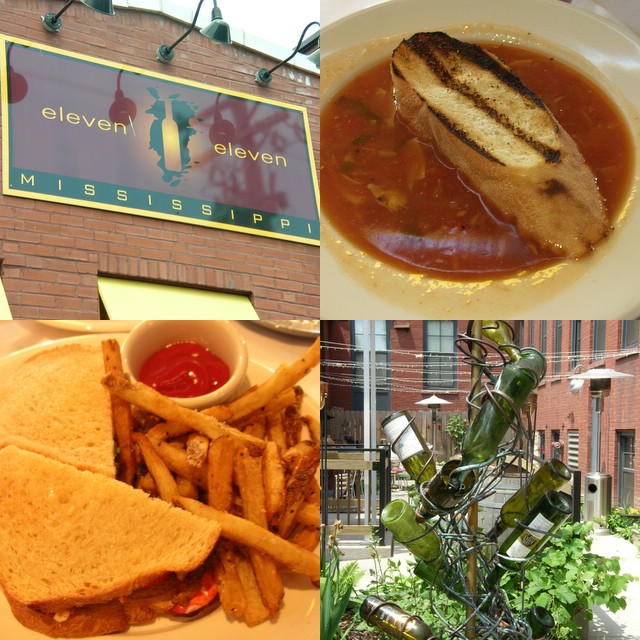
Clockwise from top left: 1111 Mississippi in St. Louis; Artichoke and Tomato Soup; Wine bottle fountain; "BLT".
Restaurant 19: 1111 Mississippi (St. Louis)
RESTAURANT: 1111 Mississippi
LOCATION: 1111 Mississippi Ave, St. Louis, Missouri
DATE: May 13, 2005
FOOD: Fire Roasted Artichoke and Tomato Soup, “1111 BLT”: Lobster, Bourbon Apples, Thyme Rhoulade, Watercress on grilled sourdough
BEVERAGE: Tap Water
PRICE: $15.00
Lunch epitomizes middle child syndrome. Overshadowed by its attention getting big brother dinner and by the cute and adorable endearments of breakfast, even New York power lunches and Hollywood hobnobs, leave lunch the least desirable meal, more perfunctory than pleasing. Well, at least that’s my opinion. Generally, when lunch rolls around, it’s more nuisance than expectation, as I’d either rather be hungry for dinner or I’m still full from breakfast. I know many restaurants can do lunch extremely well. The thing is, most days, I just don’t care.
But when I have a good reason to miss breakfast, lunch can aid the gastro-void like Catherine Barkley in Farewell to Arms. Such an opportunity presented itself on the initial day of my mini-vacation to Missouri (I know, I should have gone to the Bahamas). Libby, despite the trepidation of having to choose a restaurant for my, let’s face it, snobbish tastes, suggested 1111 Mississippi (guess where it’s located?) for the first of my Missouri musings. Contrary to the course of the rest of our relationship, on this at least, she was right. Will wonders never cease.
Unconfined by the high priced rents and space constrictions of New York City, 1111 has the room to create a slick, contemporary design with colors as bright as a Van Gogh canvas during one of his not-so-crazy periods. Goldenrod canopies overhang the windows and leave diners in a surreal sunshine haze. There is an also an intricate fountain made entirely of wine bottles near the entrance that adds a neighborhoody, “we support local artists” type feel to the place.
The menu, while not overwhelming innovative, also offered more than the tired salads and sandwiches of every other pseudo high-end American cuisine enclave. One such offering, perhaps the most imaginative option on the menu, was the 1111 “BLT”. I left traditional BLTs behind in childhood, figuring it was somewhat senseless to pay for a sandwich that was better made by my mom. But there’s nothing traditional about 1111’s version. The “b” is for the bourbon (granny smith) apples, more tart than sweet, and a sharp contrast to the liquid smooth of the “t” thyme mayonnaise that sits in a slather on the two slices of sourdough. But the “l” is the best part – fresh, unadulterated steamed lobster, tender and delicious. A few fresh sprigs of watercress completed the sandwich which had just as much crunch and crispness as its namesake but far more flavor. Lobster can do so much on its own that it was wonderful to see 1111 understood this and let the lobster alone. It made this a sandwich I will crave forever after and changed the way I will look at bacon versions of BLTs from now on. I might have to suggest the whole lobster bit to my mom the next time she offers to make me a sandwich.
The seasoned fries accompanying the BLT were also amazing, heavy on the pepper and salt in a manner that shows 1111 would rather be bold than passive. The seasoning helped the fries stand out and be more than a typical side. I was however, disappointed by the roasted artichoke and tomato soup Libby and I split to begin the meal. Pepper was the dominant flavor in this soup, with the tomato and artichoke as lost as Linda Tripp in a GNC. Thankfully this was how we began our meal, while the BLT was how I ended it.
1111 made me optimistic about the St. Louis food scene. I came expecting Ruby Tuesday’s and left with something closer to a Manhattan bistro, which was fine by me. If Danny Meyer’s Shake Shack can copy St. Louis’ custard, St. Louis can copy New York’s flair. Just don’t expect me to start extolling lunch’s merits anytime soon.
RATING: 7.4/10
LOCATION: 1111 Mississippi Ave, St. Louis, Missouri
DATE: May 13, 2005
FOOD: Fire Roasted Artichoke and Tomato Soup, “1111 BLT”: Lobster, Bourbon Apples, Thyme Rhoulade, Watercress on grilled sourdough
BEVERAGE: Tap Water
PRICE: $15.00
Lunch epitomizes middle child syndrome. Overshadowed by its attention getting big brother dinner and by the cute and adorable endearments of breakfast, even New York power lunches and Hollywood hobnobs, leave lunch the least desirable meal, more perfunctory than pleasing. Well, at least that’s my opinion. Generally, when lunch rolls around, it’s more nuisance than expectation, as I’d either rather be hungry for dinner or I’m still full from breakfast. I know many restaurants can do lunch extremely well. The thing is, most days, I just don’t care.
But when I have a good reason to miss breakfast, lunch can aid the gastro-void like Catherine Barkley in Farewell to Arms. Such an opportunity presented itself on the initial day of my mini-vacation to Missouri (I know, I should have gone to the Bahamas). Libby, despite the trepidation of having to choose a restaurant for my, let’s face it, snobbish tastes, suggested 1111 Mississippi (guess where it’s located?) for the first of my Missouri musings. Contrary to the course of the rest of our relationship, on this at least, she was right. Will wonders never cease.
Unconfined by the high priced rents and space constrictions of New York City, 1111 has the room to create a slick, contemporary design with colors as bright as a Van Gogh canvas during one of his not-so-crazy periods. Goldenrod canopies overhang the windows and leave diners in a surreal sunshine haze. There is an also an intricate fountain made entirely of wine bottles near the entrance that adds a neighborhoody, “we support local artists” type feel to the place.
The menu, while not overwhelming innovative, also offered more than the tired salads and sandwiches of every other pseudo high-end American cuisine enclave. One such offering, perhaps the most imaginative option on the menu, was the 1111 “BLT”. I left traditional BLTs behind in childhood, figuring it was somewhat senseless to pay for a sandwich that was better made by my mom. But there’s nothing traditional about 1111’s version. The “b” is for the bourbon (granny smith) apples, more tart than sweet, and a sharp contrast to the liquid smooth of the “t” thyme mayonnaise that sits in a slather on the two slices of sourdough. But the “l” is the best part – fresh, unadulterated steamed lobster, tender and delicious. A few fresh sprigs of watercress completed the sandwich which had just as much crunch and crispness as its namesake but far more flavor. Lobster can do so much on its own that it was wonderful to see 1111 understood this and let the lobster alone. It made this a sandwich I will crave forever after and changed the way I will look at bacon versions of BLTs from now on. I might have to suggest the whole lobster bit to my mom the next time she offers to make me a sandwich.
The seasoned fries accompanying the BLT were also amazing, heavy on the pepper and salt in a manner that shows 1111 would rather be bold than passive. The seasoning helped the fries stand out and be more than a typical side. I was however, disappointed by the roasted artichoke and tomato soup Libby and I split to begin the meal. Pepper was the dominant flavor in this soup, with the tomato and artichoke as lost as Linda Tripp in a GNC. Thankfully this was how we began our meal, while the BLT was how I ended it.
1111 made me optimistic about the St. Louis food scene. I came expecting Ruby Tuesday’s and left with something closer to a Manhattan bistro, which was fine by me. If Danny Meyer’s Shake Shack can copy St. Louis’ custard, St. Louis can copy New York’s flair. Just don’t expect me to start extolling lunch’s merits anytime soon.
RATING: 7.4/10
Thursday, May 12, 2005
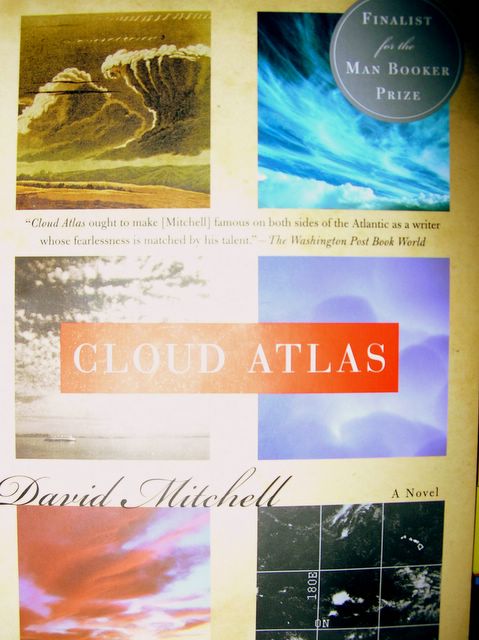
Book 6: Cloud Atlas, by David Mitchell (Infinite Feast XVII)
Paperback: 528 pages
Publisher: Random House Trade Paperbacks (August 17, 2004)
Too often, we end up looking at modernity’s complexities as being especially unique. This ignores the trajectory of history and puts the past into a nostalgic and simple framework, an altogether unfair categorization. But all time is composition of intricate proportions. History speaks in a babel of tongues, so perhaps it is best interpreted by a myriad of voices. For an author to capture all of time, past, present, and future in a single novel, he or she would have to be the ultimate ventriloquist. David Mitchell proves in Cloud Atlas that he is such a magician.
It is erroneous to call Cloud Atlas a book, at least in the traditional sense. Comprised of six distinct narratives set in dramatically different eras, at first glance Cloud Atlas would appear to be closer to a collection of novellas, than a solitary novel. But just as the crimes of one century overlap and bleed into the others, so too do the themes and characters of Mitchell’s novel reappear in each section, the passion of the prose and virtuosity of language on display leaving the reader nothing short of breathless.
Cloud Atlas is like a buffet of only the signature dishes from New York’s finest restaurants. Each section creates a singular world so engaging that the mind becomes lost amidst the pages. Starting with the early 19th century journal of an American notary stranded in the South Pacific, the novel jumps mid-sentence to the Oscar Wilde like meanderings of an aspiring English musician who has traveled to Belgium during the World Wars. Then the scene moves to 1970s California, in what the New York Times review accurately described as a sub-Grisham detective story involving nuclear fallout and government conspiracy. Next comes contemporary England and a book publisher wrongly (or so he thinks) imprisoned in a retirement home, then to a not to distant Korea and a Huxley-esque dystopia showcasing a privileged class of humans exploiting a race of worker drones (not that exploitation is unique to the future). And then finally, the narrative concludes in a future Hawaii, when corporatism has destroyed the majority of the world, and human beings once again live in warring tribes. Mitchell manages these diverse genres masterfully, manipulating language to illuminate the plights and suffering we inflict upon one another. Each section can and does, stand on its own. At one point, while describing a musical score in the Belgium based section, Mitchell also self-consciously reflects on his experimental style and its effectiveness at conveying an emotional capacity, as his character states, “In the first set, each solo is interrupted by its successor: in the second, each interruption is recontinued, in order. Revolutionary or gimmicky? Shan’t know until it’s finished.” Such an inference is not only humorous, but a keen insight into all innovative literature.
Cloud Atlas bears a lot of similarities to Cormac McCarthy’s Blood Meridian. Both works delve into mankind’s seeming obsession with violent self-destruction and the cyclical course of human history. McCarthy ends his novel ambiguously, the possible redeemer killed by evil incarnate. Mitchell, in contrast, offers a chance, however slim, that humanity will stop viewing one another as predators and eventually realize the futility of perpetual cruelty. In one of the novel’s many endings, this occurring in the section set in a post-apocalyptic future Hawaii, the civilized Meronym explains to the more primitive Zachry, “List’n, savages an’ Civ’lizeds ain’t divvied by tribes or b’liefs or mountain ranges, nay, ev’ry human is both yay…Some savages what I knowed got a beautsome Civ’lized heart beatin’ in their ribs…Not ‘nuff to say so their hole tribe, but who knows one day? One day.” It is the promise of this one day that we as readers are left with. The one day may never arrive, but Mitchell offers this as the only olive branch we have to cling on to. For some reason, humanity survives century after century despite itself.
And thus emerges the dominant idea flowing through Cloud Atlas’ myths. Violence seems the most elementary aspect of human nature, the factor we can not eradicate from our souls. But as Mitchell plays this motif out over centuries of wars, he parades a litany of concurring thoughts as well. One of the most prevalent is the power of words and literature, as the only factor connecting the narratives are the novel’s other narratives. In each segment, a character happens upon the book, journal, memoir, etc, that comprises another section of Cloud Atlas. This begs the question of whether any of these stories are supposed to be “real” – or if this even matters. For we may pass violent aggression on from generation to generation like our genetics, but when we die, all that truly survives us are the written accounts of our lives. This notion goes as far back as Homer, but Mitchell makes the importance of oral and written traditional freshly relevant.
Cloud Atlas is my favorite of the many incredible selections Danny and I have read for “Infinite Feast”. In Mitchell’s adeptness at adaptability, his impersonation of lesser writers only highlights his skills all the more. At times poetic and touching, at others as harsh as the violence he depicts, his prose is always controlled and luminescent. Through his forgery of other genres and existences, Mitchell is able to create something truly original.
Cloud Atlas’ final passage, the conclusion of “The Pacific Journal of Adam Ewing”, is perhaps the finest demonstration of Mitchell’s prodigious ability to capture all of human life in his prose. He writes:
“Belief is both prize & battlefield, within the mind & in the mind’s mirror, the world. If we believe humanity is a ladder of tribes, a colosseum of confrontation, exploitation & bestiality, such a humanity is surely brought into being…why fight the “natural” (oh, weaselly word!) order of things? Why? Because of this: - one find day, a purely predatory world shall consumer itself…for the human species, selfishness is extinction. If we believe that humanity may transcend tooth & claw, if we believe divers races & creeds can share this world as peaceably as the orphans share their candlenut tree, if we believe leaders must be just, violence muzzled, power accountable & the riches of the Earth & its Oceans shared equitably, such a world will come to pass. I am not deceived. It is the hardest of worlds to make real. Torturous advances won over generations can be lost by a single stroke of a myopic president’s pen or a vainglorious general’s sword…He who would do battle with the many-headed hydra of human nature must pay a world of pain & his family must pay it along with him! & only as you gasp your dying breath shall you understand your life amounted to no more than one drop in a limitless ocean!” Yet what is any ocean but a multitude of drops?”
Mitchell stares at the reality of human nature with a frank determinism, saying I’ve seen your worst, but I will continue to try to better this world, come what may. As individuals we may just be tiny drops, but united we are an ocean. Cloud Atlas asks if one day we will have the courage and selflessness to make the world more than just potential, more than unfulfilled wishes. He elicits hope without being either too uncomplicated or sentimental, just one of his many talents. Mitchell and his characters show us it’s not enough to be a drifting cloud – you have to be the whole sky. Perhaps that will happen – one day.
Publisher: Random House Trade Paperbacks (August 17, 2004)
Too often, we end up looking at modernity’s complexities as being especially unique. This ignores the trajectory of history and puts the past into a nostalgic and simple framework, an altogether unfair categorization. But all time is composition of intricate proportions. History speaks in a babel of tongues, so perhaps it is best interpreted by a myriad of voices. For an author to capture all of time, past, present, and future in a single novel, he or she would have to be the ultimate ventriloquist. David Mitchell proves in Cloud Atlas that he is such a magician.
It is erroneous to call Cloud Atlas a book, at least in the traditional sense. Comprised of six distinct narratives set in dramatically different eras, at first glance Cloud Atlas would appear to be closer to a collection of novellas, than a solitary novel. But just as the crimes of one century overlap and bleed into the others, so too do the themes and characters of Mitchell’s novel reappear in each section, the passion of the prose and virtuosity of language on display leaving the reader nothing short of breathless.
Cloud Atlas is like a buffet of only the signature dishes from New York’s finest restaurants. Each section creates a singular world so engaging that the mind becomes lost amidst the pages. Starting with the early 19th century journal of an American notary stranded in the South Pacific, the novel jumps mid-sentence to the Oscar Wilde like meanderings of an aspiring English musician who has traveled to Belgium during the World Wars. Then the scene moves to 1970s California, in what the New York Times review accurately described as a sub-Grisham detective story involving nuclear fallout and government conspiracy. Next comes contemporary England and a book publisher wrongly (or so he thinks) imprisoned in a retirement home, then to a not to distant Korea and a Huxley-esque dystopia showcasing a privileged class of humans exploiting a race of worker drones (not that exploitation is unique to the future). And then finally, the narrative concludes in a future Hawaii, when corporatism has destroyed the majority of the world, and human beings once again live in warring tribes. Mitchell manages these diverse genres masterfully, manipulating language to illuminate the plights and suffering we inflict upon one another. Each section can and does, stand on its own. At one point, while describing a musical score in the Belgium based section, Mitchell also self-consciously reflects on his experimental style and its effectiveness at conveying an emotional capacity, as his character states, “In the first set, each solo is interrupted by its successor: in the second, each interruption is recontinued, in order. Revolutionary or gimmicky? Shan’t know until it’s finished.” Such an inference is not only humorous, but a keen insight into all innovative literature.
Cloud Atlas bears a lot of similarities to Cormac McCarthy’s Blood Meridian. Both works delve into mankind’s seeming obsession with violent self-destruction and the cyclical course of human history. McCarthy ends his novel ambiguously, the possible redeemer killed by evil incarnate. Mitchell, in contrast, offers a chance, however slim, that humanity will stop viewing one another as predators and eventually realize the futility of perpetual cruelty. In one of the novel’s many endings, this occurring in the section set in a post-apocalyptic future Hawaii, the civilized Meronym explains to the more primitive Zachry, “List’n, savages an’ Civ’lizeds ain’t divvied by tribes or b’liefs or mountain ranges, nay, ev’ry human is both yay…Some savages what I knowed got a beautsome Civ’lized heart beatin’ in their ribs…Not ‘nuff to say so their hole tribe, but who knows one day? One day.” It is the promise of this one day that we as readers are left with. The one day may never arrive, but Mitchell offers this as the only olive branch we have to cling on to. For some reason, humanity survives century after century despite itself.
And thus emerges the dominant idea flowing through Cloud Atlas’ myths. Violence seems the most elementary aspect of human nature, the factor we can not eradicate from our souls. But as Mitchell plays this motif out over centuries of wars, he parades a litany of concurring thoughts as well. One of the most prevalent is the power of words and literature, as the only factor connecting the narratives are the novel’s other narratives. In each segment, a character happens upon the book, journal, memoir, etc, that comprises another section of Cloud Atlas. This begs the question of whether any of these stories are supposed to be “real” – or if this even matters. For we may pass violent aggression on from generation to generation like our genetics, but when we die, all that truly survives us are the written accounts of our lives. This notion goes as far back as Homer, but Mitchell makes the importance of oral and written traditional freshly relevant.
Cloud Atlas is my favorite of the many incredible selections Danny and I have read for “Infinite Feast”. In Mitchell’s adeptness at adaptability, his impersonation of lesser writers only highlights his skills all the more. At times poetic and touching, at others as harsh as the violence he depicts, his prose is always controlled and luminescent. Through his forgery of other genres and existences, Mitchell is able to create something truly original.
Cloud Atlas’ final passage, the conclusion of “The Pacific Journal of Adam Ewing”, is perhaps the finest demonstration of Mitchell’s prodigious ability to capture all of human life in his prose. He writes:
“Belief is both prize & battlefield, within the mind & in the mind’s mirror, the world. If we believe humanity is a ladder of tribes, a colosseum of confrontation, exploitation & bestiality, such a humanity is surely brought into being…why fight the “natural” (oh, weaselly word!) order of things? Why? Because of this: - one find day, a purely predatory world shall consumer itself…for the human species, selfishness is extinction. If we believe that humanity may transcend tooth & claw, if we believe divers races & creeds can share this world as peaceably as the orphans share their candlenut tree, if we believe leaders must be just, violence muzzled, power accountable & the riches of the Earth & its Oceans shared equitably, such a world will come to pass. I am not deceived. It is the hardest of worlds to make real. Torturous advances won over generations can be lost by a single stroke of a myopic president’s pen or a vainglorious general’s sword…He who would do battle with the many-headed hydra of human nature must pay a world of pain & his family must pay it along with him! & only as you gasp your dying breath shall you understand your life amounted to no more than one drop in a limitless ocean!” Yet what is any ocean but a multitude of drops?”
Mitchell stares at the reality of human nature with a frank determinism, saying I’ve seen your worst, but I will continue to try to better this world, come what may. As individuals we may just be tiny drops, but united we are an ocean. Cloud Atlas asks if one day we will have the courage and selflessness to make the world more than just potential, more than unfulfilled wishes. He elicits hope without being either too uncomplicated or sentimental, just one of his many talents. Mitchell and his characters show us it’s not enough to be a drifting cloud – you have to be the whole sky. Perhaps that will happen – one day.
Wednesday, May 11, 2005
Clinton St. Baking Co. Photos (Just Desserts)
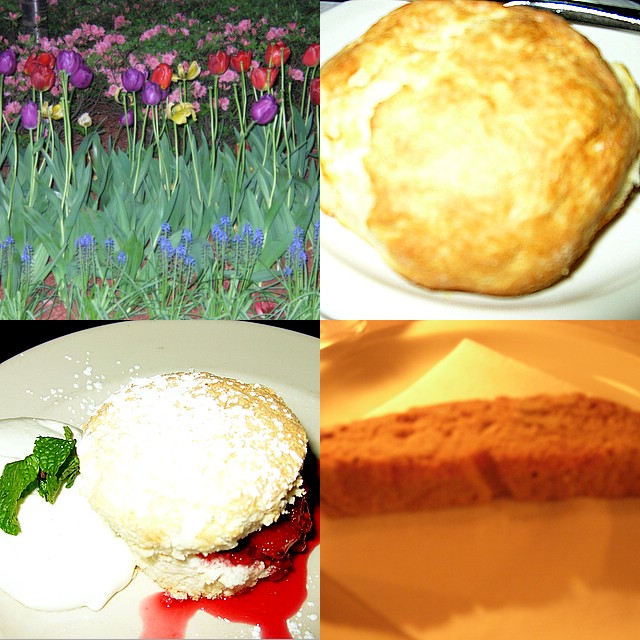
Clockwise from top left: Poetic flowers for an unpoetic post, Clinton St. Biscuit, Hazelnut Biscotti, Angel Food Cake with Berries.
Just Desserts 2: Clinton St. Baking Co. (remix)
RESTAURANT: Clinton St. Baking Co.
LOCATION: 4 Clinton St.
DATE: May 9, 2005
DESSERT: Biscuit, Hazelnut Biscotti, shared order of Angel Food Cake with Masticated Berries BEVERAGE: Tap Water
PRICE: $6.50
“Clinton St”
***prepare to be underwhelmed
I had been to Clinton St. for the pancakes one time before
This time I came strictly for the biscuit…well, and the dessert du jour
The biscuit was feathery, flaky, and buttery just like a biscuit should be
So damn tasty, oh, if only Pillsbury had as nearly as good a recipe
But though it was huge and it really should have been enough
I couldn’t resist trying the angel food cake, a dessert I love
Even lighter than the biscuit and with fresh whipped cream like woah(!)
This shouldn’t be a seasonal special but a menu staple fo sho
Now I know I ain’t street and that I really can’t rhyme
But the berries and biscotti forced me to jot down a line
Masticated (not masturbated) meant these berries were a little smashed
All the same to me, so frickin’ tasty, they were gone in a flash
The biscotti packed a nutty crunch perfect for coffee dipping
I ain’t lying to you, for desserts Clinton St certainly isn’t tripping
Another successful visit to this homey, comfortable place
Baked goods consistently able to put a smile on my unpoetic face
(wow that was a horrorshow)
RATING: 7.5/10
LOCATION: 4 Clinton St.
DATE: May 9, 2005
DESSERT: Biscuit, Hazelnut Biscotti, shared order of Angel Food Cake with Masticated Berries BEVERAGE: Tap Water
PRICE: $6.50
“Clinton St”
***prepare to be underwhelmed
I had been to Clinton St. for the pancakes one time before
This time I came strictly for the biscuit…well, and the dessert du jour
The biscuit was feathery, flaky, and buttery just like a biscuit should be
So damn tasty, oh, if only Pillsbury had as nearly as good a recipe
But though it was huge and it really should have been enough
I couldn’t resist trying the angel food cake, a dessert I love
Even lighter than the biscuit and with fresh whipped cream like woah(!)
This shouldn’t be a seasonal special but a menu staple fo sho
Now I know I ain’t street and that I really can’t rhyme
But the berries and biscotti forced me to jot down a line
Masticated (not masturbated) meant these berries were a little smashed
All the same to me, so frickin’ tasty, they were gone in a flash
The biscotti packed a nutty crunch perfect for coffee dipping
I ain’t lying to you, for desserts Clinton St certainly isn’t tripping
Another successful visit to this homey, comfortable place
Baked goods consistently able to put a smile on my unpoetic face
(wow that was a horrorshow)
RATING: 7.5/10
Shake Shack Photos
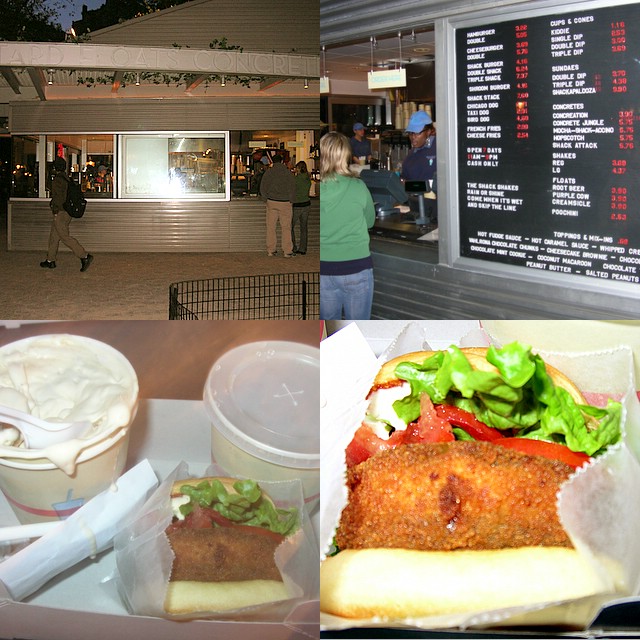
Clockwise from top left: Shack Shake in Madison Square Park, The Menu and order line, Shroom Burger, Hopscotch Concrete and burger.
Restaurant 18: Shake Shack
RESTAURANT: Shake Shack
LOCATION: Madison Square Park, SE Corner
DATE: May 9, 2005
FOOD: “Shroom” Burger, Hopscotch Concrete (hot caramel sauce, chocolate toffee, vahlrona chocolate chunks) w/ salted peanuts.
BEVERAGE: Tap Water
PRICE: $11.50
April is the cruelest month – for the weather, but also because Shack Shake’s extended hours didn’t start until May. That meant Danny Meyer’s Madison Square Park burger joint was open while I was at work, closed when I left (while the stand was open on weekends, the lines are notoriously long). But April showers bring May’s hours and my first visit to Shake Shack.
NY Metro, TimeOut NY, bloggers galore, seems like everyone and their mother loves Shake Shack’s burgers and numerous outlets have named it the best in New York. Sucks for me. The hot dogs are all beef as well, so that left the ‘Shroom Burger as my only option. In the end though, I was the big winner. I’ll leave the cows to the rest of y’all. This was the best non-beef burger I’d ever had.
Portobellos are meaty mushrooms. But facts are facts and most Portobello burgers I’ve tried in the past, are, well…they leave something to be desired (like meat). Not so Shake Shack’s. One of Meyer’s gastrointestinal savants must have figured out that non-beef eaters don’t like their burgers to have a mushy outside anymore than the rest of society. But most veggie burgers are as soggy as an Englishman’s disposition. The answer to this situation? Like so much in life – the deep fryer.
Fried like a crab cake (and using the same concept as Dinosaur’s fried green tomatoes), the Portobello burger is surrounded by a firm coating which provides a crunch missing in others’ veggie renditions. But the inside makes this burger, a luscious combination of chopped mushroom, onion, seasonings and melted cheese. The cheese is an insightful addition, bursting forth upon first bite. It gushed out, saturating bun and mushroom in its semi-liquidity. Throw in Shake Shack’s thousand island dressing like special sauce and this is a burger even Dr. Atkins could love. I should have ordered a second, but in a rare moment of self-control decided against it.
Along with my burger, I ordered the Hopscotch concrete with salted peanuts slapped on to boot. The vanilla custard was solid, neither too runny nor too thick. While the chocolate chunks were too bulky and the chocolate toffee got lost in the shuffle, the concrete as a whole was delicious. The custard of Kopf’s in Milwaukee and Ted Drewes (review upcoming) in St. Louis are better, but Shake Shack did a noble imitation of a very Midwestern dessert.
So as the temperatures climb and the days outlast the night, Shake Shack becomes a more and more appealing way to spend a summer night. I know I’ll be back for the burgers – the Portobello burgers that is. And to all those clamoring for cow, I’ll paraphrase Marie Antoinette and say, let them eat beef.
RATING: 7.7/10
LOCATION: Madison Square Park, SE Corner
DATE: May 9, 2005
FOOD: “Shroom” Burger, Hopscotch Concrete (hot caramel sauce, chocolate toffee, vahlrona chocolate chunks) w/ salted peanuts.
BEVERAGE: Tap Water
PRICE: $11.50
April is the cruelest month – for the weather, but also because Shack Shake’s extended hours didn’t start until May. That meant Danny Meyer’s Madison Square Park burger joint was open while I was at work, closed when I left (while the stand was open on weekends, the lines are notoriously long). But April showers bring May’s hours and my first visit to Shake Shack.
NY Metro, TimeOut NY, bloggers galore, seems like everyone and their mother loves Shake Shack’s burgers and numerous outlets have named it the best in New York. Sucks for me. The hot dogs are all beef as well, so that left the ‘Shroom Burger as my only option. In the end though, I was the big winner. I’ll leave the cows to the rest of y’all. This was the best non-beef burger I’d ever had.
Portobellos are meaty mushrooms. But facts are facts and most Portobello burgers I’ve tried in the past, are, well…they leave something to be desired (like meat). Not so Shake Shack’s. One of Meyer’s gastrointestinal savants must have figured out that non-beef eaters don’t like their burgers to have a mushy outside anymore than the rest of society. But most veggie burgers are as soggy as an Englishman’s disposition. The answer to this situation? Like so much in life – the deep fryer.
Fried like a crab cake (and using the same concept as Dinosaur’s fried green tomatoes), the Portobello burger is surrounded by a firm coating which provides a crunch missing in others’ veggie renditions. But the inside makes this burger, a luscious combination of chopped mushroom, onion, seasonings and melted cheese. The cheese is an insightful addition, bursting forth upon first bite. It gushed out, saturating bun and mushroom in its semi-liquidity. Throw in Shake Shack’s thousand island dressing like special sauce and this is a burger even Dr. Atkins could love. I should have ordered a second, but in a rare moment of self-control decided against it.
Along with my burger, I ordered the Hopscotch concrete with salted peanuts slapped on to boot. The vanilla custard was solid, neither too runny nor too thick. While the chocolate chunks were too bulky and the chocolate toffee got lost in the shuffle, the concrete as a whole was delicious. The custard of Kopf’s in Milwaukee and Ted Drewes (review upcoming) in St. Louis are better, but Shake Shack did a noble imitation of a very Midwestern dessert.
So as the temperatures climb and the days outlast the night, Shake Shack becomes a more and more appealing way to spend a summer night. I know I’ll be back for the burgers – the Portobello burgers that is. And to all those clamoring for cow, I’ll paraphrase Marie Antoinette and say, let them eat beef.
RATING: 7.7/10
Dinosaur Barbeque Photos

Row 1: Inside Dinosaur, Extreme Sampler, one of the many old horror movie posters on Dinosaur's walls; Rows 2-3: Rhubarb pie, views of Harlem near Dinosaur.
Restaurant 17: Dinosaur Barbeque
RESTAURANT: Dinosaur Barbeque
LOCATION: 646 W. 131 St., New York, NY
DATE: May 8, 2005
FOOD: Appetizers: Mild and Hot Chicken Wings, Fried Green Tomatoes (Original), Drunken Spicy Shrimp Boil; Entrée: Sample Extreme (1/2 Chicken, ½ Rack of Ribs, Pulled Pork (substitution for Brisket)) with Cornbread, Macaroni & Cheese, and French Fries; Dessert: Rhubarb Pie with Vanilla Ice Cream
BEVERAGE: Three of Dinosaur home brewed ales, Decaf Coffee
PRICE: Unknown
Pigs are disgusting, filthy animals, sired from putrescent loins into a life of contaminated breaths drawn in squalid sties of pollution.
But they sure do taste good.
Dinosaur Barbeque in Harlem, an offshoot from the original Syracuse locations opened by two bikers, marinates their porkers’ ribs in a dry spice rub for up to 24 hours before slow roasting them to a tender perfection. New York is frequently criticized for its sub-par barbeque, but travel a little north of Manhattan’s ubiquitous Dallas BBQs and Texas Rotisseries and you’ll find there’s good barbeque to be had in the city. Harlem now has two distinguished exiles of America’s south – Bill Clinton and Dinosaur’s barbeque.
Three blocks away, the smell of smoke permeates the air. By the time I walked in the door on Mother’s Day Sunday, my mouth was already salivating. Luckily, Dinosaur’s wide selection of draft beers offer plenty of ways to quench your thirst and awaken your hunger. Once seated, our waitress, Strawberry, informed us she was a mother herself and quickly gave Mrs. Goldberg a high five. The celebration was underway.
Come hungry or don’t come at all should really be Dinosaur’s mantra. While the portions are far from grotesquely large, it’s hard not to keep eating until you engorged self bears an uncanny resemblance to a late in life Marlon Brando (what, too soon? Come on, the fat jokes were okay before he died). But though the ribs are the offer you can’t refuse, the traditional appetizers and desserts are the rub, the dishes you assume are random fillers, but end up being anything but.
The drunken shrimp, boiled in beer and Cajun spices, come with a habanero cocktail sauce, a combination that reminds one of how great non-Emeril New Orleans cuisine can be. The same can be said for the fried green tomatoes, pecorino cheese topping the crisp encasing which surround the succulent, melt-in-your mouth tomato interior. Even the wings are amazing (and I am not a wings fan), most notably the honey flavor covering the mild variety, sweet and salt mixing in a Texas-sky sized swath of taste.
But seriously, on to what we came for – the ribs. “Falling off the bone” is to meat reviews what “genius” is to literary criticism, but in Dinosaur’s case, the moniker actually applies. Gently nudge the meat on the half-rack that comes with the “Extreme Sampler” (enough food to feed the entire population of many Mississippi towns or one Houston (“fattest city in America five years running”) child. Neither Jordan, Alexis or I came anywhere close to finishing the meal – but Strawberry kindly provided Dino-bags) and the pork practically jumps from bone to plate. In reality, it seems the bones on Dinosaur’s ribs are no more than temporary kebab skewers, a device used merely to get the roasted delicacy to the table in the easiest manner possible. While I am no barbeque expert, these are hands down the best tasting ribs I’ve ever eaten, charcoal and ketchup-based glaze exploding with a wide spectrum of spicy, slightly saccharine, and smoky flavors (apparently all adjectives are required to begin in an “s”). The pulled pork is also incredibly tender and would be great on a sandwich. The chicken is less memorable, but still worth ordering if for nothing else than an additional way to sop up Dinosaur’s marvelous sauces. On a previous visit I ordered the baked beans (very good) and salt potatoes (not my thing). This time, I opted for the crunchy and delightful fries and gooey masterpiece that is the Mac & Cheese.
Despite not having room for dessert, I ordered it anyway, deciding as soon as I heard the words “Strawberry & Rhubarb Pie” leave Strawberry’s mouth. Rose Water’s crumble had been great, but Dinosaur’s pie (more like a crumble itself) was amazing. Served a la mode, the pie was like a good southern style tea, sweet and bitter at the same time.
So thank God for pigs. In a room bedecked with mothers and families adorned in their Sunday best, Dinosaur was a dazzling way to spend Mother’s Day. From perfect ribs, to a smiling and garrulous wait staff, to a beautiful view of the river, Dinosaur had a little bit of everything. Upon leaving, stomach and mind were united in satisfaction – on this day, there was nothing more I could’ve possibly wanted.
**** And a Happy Mother’s Day to my mom. Sorry I couldn’t be there. Hope the coffee was at least a passable substitute.
RATING: 8.0/10
LOCATION: 646 W. 131 St., New York, NY
DATE: May 8, 2005
FOOD: Appetizers: Mild and Hot Chicken Wings, Fried Green Tomatoes (Original), Drunken Spicy Shrimp Boil; Entrée: Sample Extreme (1/2 Chicken, ½ Rack of Ribs, Pulled Pork (substitution for Brisket)) with Cornbread, Macaroni & Cheese, and French Fries; Dessert: Rhubarb Pie with Vanilla Ice Cream
BEVERAGE: Three of Dinosaur home brewed ales, Decaf Coffee
PRICE: Unknown
Pigs are disgusting, filthy animals, sired from putrescent loins into a life of contaminated breaths drawn in squalid sties of pollution.
But they sure do taste good.
Dinosaur Barbeque in Harlem, an offshoot from the original Syracuse locations opened by two bikers, marinates their porkers’ ribs in a dry spice rub for up to 24 hours before slow roasting them to a tender perfection. New York is frequently criticized for its sub-par barbeque, but travel a little north of Manhattan’s ubiquitous Dallas BBQs and Texas Rotisseries and you’ll find there’s good barbeque to be had in the city. Harlem now has two distinguished exiles of America’s south – Bill Clinton and Dinosaur’s barbeque.
Three blocks away, the smell of smoke permeates the air. By the time I walked in the door on Mother’s Day Sunday, my mouth was already salivating. Luckily, Dinosaur’s wide selection of draft beers offer plenty of ways to quench your thirst and awaken your hunger. Once seated, our waitress, Strawberry, informed us she was a mother herself and quickly gave Mrs. Goldberg a high five. The celebration was underway.
Come hungry or don’t come at all should really be Dinosaur’s mantra. While the portions are far from grotesquely large, it’s hard not to keep eating until you engorged self bears an uncanny resemblance to a late in life Marlon Brando (what, too soon? Come on, the fat jokes were okay before he died). But though the ribs are the offer you can’t refuse, the traditional appetizers and desserts are the rub, the dishes you assume are random fillers, but end up being anything but.
The drunken shrimp, boiled in beer and Cajun spices, come with a habanero cocktail sauce, a combination that reminds one of how great non-Emeril New Orleans cuisine can be. The same can be said for the fried green tomatoes, pecorino cheese topping the crisp encasing which surround the succulent, melt-in-your mouth tomato interior. Even the wings are amazing (and I am not a wings fan), most notably the honey flavor covering the mild variety, sweet and salt mixing in a Texas-sky sized swath of taste.
But seriously, on to what we came for – the ribs. “Falling off the bone” is to meat reviews what “genius” is to literary criticism, but in Dinosaur’s case, the moniker actually applies. Gently nudge the meat on the half-rack that comes with the “Extreme Sampler” (enough food to feed the entire population of many Mississippi towns or one Houston (“fattest city in America five years running”) child. Neither Jordan, Alexis or I came anywhere close to finishing the meal – but Strawberry kindly provided Dino-bags) and the pork practically jumps from bone to plate. In reality, it seems the bones on Dinosaur’s ribs are no more than temporary kebab skewers, a device used merely to get the roasted delicacy to the table in the easiest manner possible. While I am no barbeque expert, these are hands down the best tasting ribs I’ve ever eaten, charcoal and ketchup-based glaze exploding with a wide spectrum of spicy, slightly saccharine, and smoky flavors (apparently all adjectives are required to begin in an “s”). The pulled pork is also incredibly tender and would be great on a sandwich. The chicken is less memorable, but still worth ordering if for nothing else than an additional way to sop up Dinosaur’s marvelous sauces. On a previous visit I ordered the baked beans (very good) and salt potatoes (not my thing). This time, I opted for the crunchy and delightful fries and gooey masterpiece that is the Mac & Cheese.
Despite not having room for dessert, I ordered it anyway, deciding as soon as I heard the words “Strawberry & Rhubarb Pie” leave Strawberry’s mouth. Rose Water’s crumble had been great, but Dinosaur’s pie (more like a crumble itself) was amazing. Served a la mode, the pie was like a good southern style tea, sweet and bitter at the same time.
So thank God for pigs. In a room bedecked with mothers and families adorned in their Sunday best, Dinosaur was a dazzling way to spend Mother’s Day. From perfect ribs, to a smiling and garrulous wait staff, to a beautiful view of the river, Dinosaur had a little bit of everything. Upon leaving, stomach and mind were united in satisfaction – on this day, there was nothing more I could’ve possibly wanted.
**** And a Happy Mother’s Day to my mom. Sorry I couldn’t be there. Hope the coffee was at least a passable substitute.
RATING: 8.0/10
Tuesday, May 10, 2005
Sullivan Street Bakery Photos
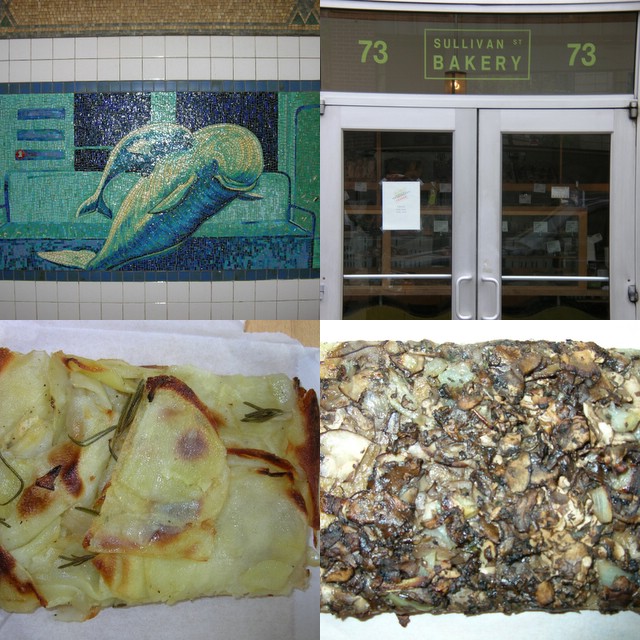
Clockwise from top left: Houston Street Subway Station, Sullivan Street Bakery, Pizza Funghi, Pizza Patate.
Restaurant 16: Sullivan Street Bakery
RESTAURANT: Sullivan Street Bakery
LOCATION: 73 Sullivan Street
DATE: May 8, 2005
FOOD: Slice of Pizza Patate (Potato Pizza), Slice of Pizza Funghi (Mushroom Pizza)
BEVERAGE: None
PRICE: $5.00
Bread or Pizza?
Thin, crackery crust, layered toppings, comes in slices – all signs point to pizza.
But there’s no sauce. And no cheese. So really, it’s just an open-faced sandwich and open-faced sandwiches are always served on a piece of…BREAD. Must be bread.
Sullivan Street Bakery calls this pizza though. The roasted potatoes on this slice are lightly dosed in extra virgin olive oil and fresh sprigs of rosemary, a few stray white onions adding balance to this delicious au-gratin express. And on this slice, the cremini mushrooms are chopped into miniature cubes, hinted with thyme and seasoned perfectly with salt and pepper. The mushrooms would be great even without the pizza crust…
But isn’t this a bakery? And everything else they serve is bread. That raisin loaf looks stellar. Will have to wait for another visit, unfortunately. This is bread. Has to be. It was served at room temperature, wasn’t heated at all. Just like bread. But it would have been better hot. And maybe you’re supposed to take it home and heat it there. Definitely better hot. Pizza…
But, it came in a bread bag for god’s sake, it’s gotta be bread.
Isn’t pizza dough a form of bread? Could this be a game of semantics?
In my English classes, semantics never tasted like this. Wow. The olive oil on these slices is…wow.
Maybe another bite will make this easier.
No answers on that front. Decide which one is better. That’ll be something at least. The mushroom is superior. Clearly. Well wait, nope it’s the potato. That rosemary is amazing. But what about the thyme? Maybe it’s the mushroom? Another bite of the potato should settle the uncertainty.
Nope. Still unclear. But damn it tastes good. If only all mysteries were this mouthwatering. And all for five dollars. Maybe enough cash for another. That’ll help. One more, everything will come into focus…
RATING: 7.9/10
LOCATION: 73 Sullivan Street
DATE: May 8, 2005
FOOD: Slice of Pizza Patate (Potato Pizza), Slice of Pizza Funghi (Mushroom Pizza)
BEVERAGE: None
PRICE: $5.00
Bread or Pizza?
Thin, crackery crust, layered toppings, comes in slices – all signs point to pizza.
But there’s no sauce. And no cheese. So really, it’s just an open-faced sandwich and open-faced sandwiches are always served on a piece of…BREAD. Must be bread.
Sullivan Street Bakery calls this pizza though. The roasted potatoes on this slice are lightly dosed in extra virgin olive oil and fresh sprigs of rosemary, a few stray white onions adding balance to this delicious au-gratin express. And on this slice, the cremini mushrooms are chopped into miniature cubes, hinted with thyme and seasoned perfectly with salt and pepper. The mushrooms would be great even without the pizza crust…
But isn’t this a bakery? And everything else they serve is bread. That raisin loaf looks stellar. Will have to wait for another visit, unfortunately. This is bread. Has to be. It was served at room temperature, wasn’t heated at all. Just like bread. But it would have been better hot. And maybe you’re supposed to take it home and heat it there. Definitely better hot. Pizza…
But, it came in a bread bag for god’s sake, it’s gotta be bread.
Isn’t pizza dough a form of bread? Could this be a game of semantics?
In my English classes, semantics never tasted like this. Wow. The olive oil on these slices is…wow.
Maybe another bite will make this easier.
No answers on that front. Decide which one is better. That’ll be something at least. The mushroom is superior. Clearly. Well wait, nope it’s the potato. That rosemary is amazing. But what about the thyme? Maybe it’s the mushroom? Another bite of the potato should settle the uncertainty.
Nope. Still unclear. But damn it tastes good. If only all mysteries were this mouthwatering. And all for five dollars. Maybe enough cash for another. That’ll help. One more, everything will come into focus…
RATING: 7.9/10
Gobo Photos

Row 1: Washington Square on the way to Gobo, Gobo's watching Buddha, bread and sweet potato spread; Row 2: Wheat Grass shot, New England rolls, Yam & Yucca Fries; Row 3: Butternut Squash Risotto, Green Tea Noodles, Inside Entrance to Gobo.
Restaurant 15: Gobo (Infinite Feast XVII)
RESTAURANT: Gobo
LOCATION: 401 Avenue of the Americas
DATE: May 7, 2005
FOOD: Cranberry Walnut Bread with Sweet Potato Spread (complimentary); Split the following: New England Rolls; White Bean, Root Vegetable and Pumpkin Soup; Yam & Yucca Fries; Green Tea Noodle with Vegan Bolognese Sauce; Butternut Squash Risotto with Toasted Almonds; Carrot Cake with Hard Sake Sauce.
BEVERAGE: 2 oz. shot of Wheat Grass with Lemon
PRICE: $42.00
Flower power, hippies, and free love aren’t as prevalent in 21st century Manhattan as Vietnam War era California (well maybe the free love part, at least let’s hope). But if you needed any further confirmation that the 60s are officially over, the vegan-gone-elegant food of Gobo hammers the point home one final time. Apparently, the baby boomers have beaten the ideals of the Beat Generation into a bloodied, moneyed pulp.
Gobo, located in the West Village, is truly the perfect restaurant for the area. No peace signs or yin-yangs grace the walls, but there is a large Buddha statue resting over the open kitchen, surveying the customers on his way to enlightenment. The atmosphere is somberly tranquil but unromantic, more Zen temple then L’Impero love shack. Gobo seems like a “Sex in the City” restaurant, offering above average vegetarian Asian food stir-fried in West Village wealthy faux-bohemianism. While Gobo can’t provide a transcendent experience, it does prove that going out for vegetarian doesn’t mean you have to sacrifice taste.
I chose Gobo to match the Far-East eclectic influences of Cloud Atlas. Like Mitchell’s luminous novel, Gobo dabbles in multiple genres, crossing the cultural boundaries of Korea, China, Japan, and Pacific Rim to create a more universal aesthetic. But whereas Cloud Atlas is one display of virtuosity after another, Gobo doesn’t quite reach this level of fluent multi-lingualism, doing many things well, but nothing exceptional.
The menu caters to sharers, so Danny and I had no problem sampling a multitude of dishes. The house bread is crusty, thick and delicious, one slice a multi-grain variety, the other a cranberry-walnut to rival (but not quite measure up to) the Modern’s. The Moroccan spiced sweet potato spread accompaniment makes the bread a meal in and of itself, and was a great way to jump start the taste-buds. The pumpkin and bean soup we began with was a drab disappointment though, tasting like the canned vegetable broth which served as the base of many an elementary school soup calamity. I didn’t taste nearly enough of the pumpkin which should have been the featured attraction of the medley.
But the New England rolls and yucca & yam fries that followed quickly made me forget the soup. The fries came with a kicked up dip somewhere between cocktail and sweet and sour sauce. The contrasting textures of the yam and yucca were also interesting, though the yucca was a bit too papery and tough at times, while the yam fries were pure gold (of the non Yukon variety). Filled with soy ham, crunchy vegetables and served in red tortillas, the New England rolls were Mexican in appearance, Far Pacific in flavor, but a success anywhere.
Our entrees came with as many ups and downs as Joan Rivers’ career. The green tea noodles with a vegan Bolognese sauce reminded me of lasagna stripped of everything but sauce, and were excellent, the soy mimicking beef as well as a bean derivative product can. The green tea was more apparent in the color of the noodles than in their flavor but I enjoyed this course nonetheless. The risotto, however, was a study in Moby Dick duality, mildly creamy and sweet in one bite, and mushy and Congee Village porridge like in the next. The kitchen forgot to include the toasted almonds in our order which are supposed to come atop the rice (many of the eaters around us ordered the dish and the almonds were remembered) and Danny and I both agreed this would have made the dish much better, as a hard crunch was needed to offset the rather limp risotto. I don’t think soy milk and soy cheese are suitable substitutes for real and milk and cheese, at least in Italian dishes.
Dessert presented a wide spectrum of possibilities, but unfortunately I selected the poorly. My carrot cake should have been called a loaf, as it was overly firm and as dense as a fruit cake. The nondescript and tasteless sake hard sauce softened the cake, but in a way that freezer burn leaves a frozen waffle mushy even after toasting. Danny’s hazelnut napoleon was a much better choice, sweet hazelnut puree sandwiched between thin wafers.
I also endured a shot of Wheat Grass, ordered more for its novelty than any expectation of pleasure. Its smell of fresh cut grass (was that lawn mower gasoline as well?) was enough to turn my stomach, but its crabgrass taste was something like the gymnastics lesson I took at age four – once, but never, NEVER again.
Gobo is Confucius turned Renaissance man, ready to try its luck in every field rather than perfect one. And while the vegan cooking comes with a dose of yuppie, Gobo is worth a visit, if for nothing else then to at least see for a night how the non-carnivorous live. Gobo succeeds in making it temporarily possible to imagine being a vegetarian, to learn the various gradations of tofu, to contemplate embracing a life of soy and whole grains like Hugh Heffner embraces silicon - but just for a moment. Babbo is located nearly across the street and I as I left Gobo, I suddenly developed a hankering for some beef cheek ravioli.
RATING: 7.0/10
LOCATION: 401 Avenue of the Americas
DATE: May 7, 2005
FOOD: Cranberry Walnut Bread with Sweet Potato Spread (complimentary); Split the following: New England Rolls; White Bean, Root Vegetable and Pumpkin Soup; Yam & Yucca Fries; Green Tea Noodle with Vegan Bolognese Sauce; Butternut Squash Risotto with Toasted Almonds; Carrot Cake with Hard Sake Sauce.
BEVERAGE: 2 oz. shot of Wheat Grass with Lemon
PRICE: $42.00
Flower power, hippies, and free love aren’t as prevalent in 21st century Manhattan as Vietnam War era California (well maybe the free love part, at least let’s hope). But if you needed any further confirmation that the 60s are officially over, the vegan-gone-elegant food of Gobo hammers the point home one final time. Apparently, the baby boomers have beaten the ideals of the Beat Generation into a bloodied, moneyed pulp.
Gobo, located in the West Village, is truly the perfect restaurant for the area. No peace signs or yin-yangs grace the walls, but there is a large Buddha statue resting over the open kitchen, surveying the customers on his way to enlightenment. The atmosphere is somberly tranquil but unromantic, more Zen temple then L’Impero love shack. Gobo seems like a “Sex in the City” restaurant, offering above average vegetarian Asian food stir-fried in West Village wealthy faux-bohemianism. While Gobo can’t provide a transcendent experience, it does prove that going out for vegetarian doesn’t mean you have to sacrifice taste.
I chose Gobo to match the Far-East eclectic influences of Cloud Atlas. Like Mitchell’s luminous novel, Gobo dabbles in multiple genres, crossing the cultural boundaries of Korea, China, Japan, and Pacific Rim to create a more universal aesthetic. But whereas Cloud Atlas is one display of virtuosity after another, Gobo doesn’t quite reach this level of fluent multi-lingualism, doing many things well, but nothing exceptional.
The menu caters to sharers, so Danny and I had no problem sampling a multitude of dishes. The house bread is crusty, thick and delicious, one slice a multi-grain variety, the other a cranberry-walnut to rival (but not quite measure up to) the Modern’s. The Moroccan spiced sweet potato spread accompaniment makes the bread a meal in and of itself, and was a great way to jump start the taste-buds. The pumpkin and bean soup we began with was a drab disappointment though, tasting like the canned vegetable broth which served as the base of many an elementary school soup calamity. I didn’t taste nearly enough of the pumpkin which should have been the featured attraction of the medley.
But the New England rolls and yucca & yam fries that followed quickly made me forget the soup. The fries came with a kicked up dip somewhere between cocktail and sweet and sour sauce. The contrasting textures of the yam and yucca were also interesting, though the yucca was a bit too papery and tough at times, while the yam fries were pure gold (of the non Yukon variety). Filled with soy ham, crunchy vegetables and served in red tortillas, the New England rolls were Mexican in appearance, Far Pacific in flavor, but a success anywhere.
Our entrees came with as many ups and downs as Joan Rivers’ career. The green tea noodles with a vegan Bolognese sauce reminded me of lasagna stripped of everything but sauce, and were excellent, the soy mimicking beef as well as a bean derivative product can. The green tea was more apparent in the color of the noodles than in their flavor but I enjoyed this course nonetheless. The risotto, however, was a study in Moby Dick duality, mildly creamy and sweet in one bite, and mushy and Congee Village porridge like in the next. The kitchen forgot to include the toasted almonds in our order which are supposed to come atop the rice (many of the eaters around us ordered the dish and the almonds were remembered) and Danny and I both agreed this would have made the dish much better, as a hard crunch was needed to offset the rather limp risotto. I don’t think soy milk and soy cheese are suitable substitutes for real and milk and cheese, at least in Italian dishes.
Dessert presented a wide spectrum of possibilities, but unfortunately I selected the poorly. My carrot cake should have been called a loaf, as it was overly firm and as dense as a fruit cake. The nondescript and tasteless sake hard sauce softened the cake, but in a way that freezer burn leaves a frozen waffle mushy even after toasting. Danny’s hazelnut napoleon was a much better choice, sweet hazelnut puree sandwiched between thin wafers.
I also endured a shot of Wheat Grass, ordered more for its novelty than any expectation of pleasure. Its smell of fresh cut grass (was that lawn mower gasoline as well?) was enough to turn my stomach, but its crabgrass taste was something like the gymnastics lesson I took at age four – once, but never, NEVER again.
Gobo is Confucius turned Renaissance man, ready to try its luck in every field rather than perfect one. And while the vegan cooking comes with a dose of yuppie, Gobo is worth a visit, if for nothing else then to at least see for a night how the non-carnivorous live. Gobo succeeds in making it temporarily possible to imagine being a vegetarian, to learn the various gradations of tofu, to contemplate embracing a life of soy and whole grains like Hugh Heffner embraces silicon - but just for a moment. Babbo is located nearly across the street and I as I left Gobo, I suddenly developed a hankering for some beef cheek ravioli.
RATING: 7.0/10
Monday, May 09, 2005
Veselka Photos
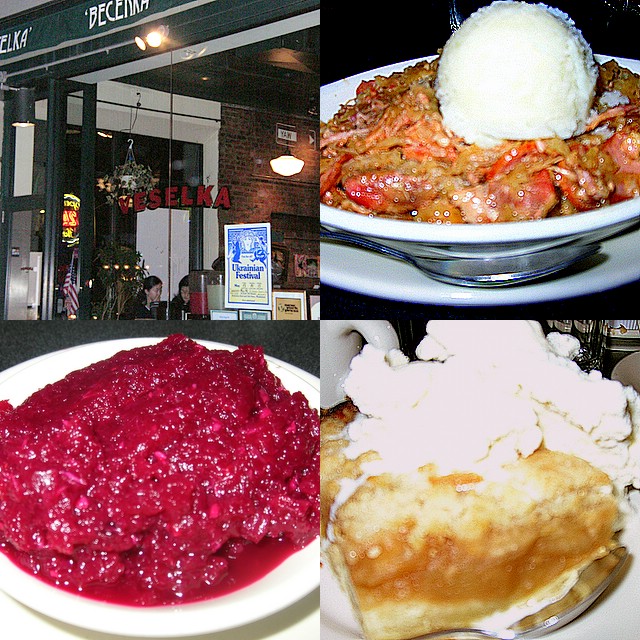
Clockwise from top left: Veselka on 2nd Avenue and 9th street; the salt haven that is Bigos (topped with mashed potatoes); Apple Crumb Cake a la mode; Beet and Horseradish salad.
Restaurant 14: Veselka
RESTAURANT: Veselka
LOCATION: 144 2nd Ave.
DATE: May 6, 2005
FOOD: Bigos with mashed potatoes, beet and horseradish salad. Apple crumb cake with vanilla ice cream
BEVERAGE: Decaf coffee
PRICE: $24.00
Excuse me the bloat gloat, but I can put away. My wiry, 160 pound frame and chicken legs (as labeled by my mother and Libby) have never been able to stop me from eating tremendous amounts of foods. Whether it was the seven slices of sausage and mushroom pie I devoured at Di Fara’s or the nickname “Fat American Bastard” Danny so thoughtfully gave me after an all you can eat sushi binge at Bay Ridge, I’ve never had a problem with eating too little. I’ve frequently compared myself to the rat in psychology textbooks that keeps eating because doctors have given him drugs that suppress the hormone indicating fullness. He just eats and eats, fatter and fatter, until he dies. If only the same would happen to the mice in my apartment.
So it’s a rare and seldom moment that a restaurant portion bests my appetite. Veselka’s bigos, however, beat me. I should have been more prepared, as any selection that a menu describes as “A Meal Fit For A Hunter” won’t be Mary Kate Olsen-esque fair (I hope that’s the right one, I can never keep those two talented actresses straight).
I love Veselka and it’s my favorite late night food spot in the city. Danny and I had been obsessed with the bigos dish since seeing it on the menu in July during our first post-drinking visit. What could a meal fit for a hunter invovle, we asked ourselves? We finally decided to try it after our Vintage Bar Crawl. Everything I’ve ordered at Veselka in the past, from the blueberry pancakes, to the pierogies, to the meatless Ukranian special, has been excellent. Unfortunately, I can’t say the same about the bigos.
Perhaps it’s because I’ve fired a gun once in my life and so really have no idea what it takes to be a hunter, but I can’t imagine why even a Boston Marathon runner would need as much sodium as bigos provides. I imagined bigos would be a Brunswick stew like concoction, but instead the kielbasa, roast pork, sauerkraut, and onions arrived stewed solely in their own juices, with almost no sauce whatsoever. Unless, of course, you count salt as a sauce, which after eating the bigos, I just might have to consider doing. The bigos had all the elements to be a really tasty dish, as Veselka’s kielbasa on its own is a wonderful relative to the brats I grew up on. But this was like a Kelly Clarkson song that hadn’t been mixed right (though I’m not sure if any are). Even the delicious beet salad and mashed potatoes of almost purely spuds failed to make the bigos anything better than alright. The bigos wasn't awful, in fact the meat by itself would have been a dish of hearty heaven. But taken together, I won’t be ordering the bigos the next time I’m at Veselka at 3 a.m, that is for sure.
I woke up with a stomachache and an extreme thirst the morning a.b. (after bigos). Neither Danny nor I wanted to criticize the dish too severely, as it maybe the best bigos this side of the Ukraine, but just not something either of our palates quite comprehend and Veselka has been like the dog I was never allowed to have, consistently faithful.
To avoid complete disappointment, I ordered the apple crumb cake for dessert, which I’d had before and knew I liked. It had stayed the same. Flaky and buttery at once, like a Sunday coffee cake, with pieces of apples layered on the top and when served a la mode, downright sinfully good. My taste buds might have been desensitized by the bigos, but perhaps the best quality of the crumb cake was that, as far as I could tell, it contained little, if any salt.
RATING: 5.2/10
LOCATION: 144 2nd Ave.
DATE: May 6, 2005
FOOD: Bigos with mashed potatoes, beet and horseradish salad. Apple crumb cake with vanilla ice cream
BEVERAGE: Decaf coffee
PRICE: $24.00
Excuse me the bloat gloat, but I can put away. My wiry, 160 pound frame and chicken legs (as labeled by my mother and Libby) have never been able to stop me from eating tremendous amounts of foods. Whether it was the seven slices of sausage and mushroom pie I devoured at Di Fara’s or the nickname “Fat American Bastard” Danny so thoughtfully gave me after an all you can eat sushi binge at Bay Ridge, I’ve never had a problem with eating too little. I’ve frequently compared myself to the rat in psychology textbooks that keeps eating because doctors have given him drugs that suppress the hormone indicating fullness. He just eats and eats, fatter and fatter, until he dies. If only the same would happen to the mice in my apartment.
So it’s a rare and seldom moment that a restaurant portion bests my appetite. Veselka’s bigos, however, beat me. I should have been more prepared, as any selection that a menu describes as “A Meal Fit For A Hunter” won’t be Mary Kate Olsen-esque fair (I hope that’s the right one, I can never keep those two talented actresses straight).
I love Veselka and it’s my favorite late night food spot in the city. Danny and I had been obsessed with the bigos dish since seeing it on the menu in July during our first post-drinking visit. What could a meal fit for a hunter invovle, we asked ourselves? We finally decided to try it after our Vintage Bar Crawl. Everything I’ve ordered at Veselka in the past, from the blueberry pancakes, to the pierogies, to the meatless Ukranian special, has been excellent. Unfortunately, I can’t say the same about the bigos.
Perhaps it’s because I’ve fired a gun once in my life and so really have no idea what it takes to be a hunter, but I can’t imagine why even a Boston Marathon runner would need as much sodium as bigos provides. I imagined bigos would be a Brunswick stew like concoction, but instead the kielbasa, roast pork, sauerkraut, and onions arrived stewed solely in their own juices, with almost no sauce whatsoever. Unless, of course, you count salt as a sauce, which after eating the bigos, I just might have to consider doing. The bigos had all the elements to be a really tasty dish, as Veselka’s kielbasa on its own is a wonderful relative to the brats I grew up on. But this was like a Kelly Clarkson song that hadn’t been mixed right (though I’m not sure if any are). Even the delicious beet salad and mashed potatoes of almost purely spuds failed to make the bigos anything better than alright. The bigos wasn't awful, in fact the meat by itself would have been a dish of hearty heaven. But taken together, I won’t be ordering the bigos the next time I’m at Veselka at 3 a.m, that is for sure.
I woke up with a stomachache and an extreme thirst the morning a.b. (after bigos). Neither Danny nor I wanted to criticize the dish too severely, as it maybe the best bigos this side of the Ukraine, but just not something either of our palates quite comprehend and Veselka has been like the dog I was never allowed to have, consistently faithful.
To avoid complete disappointment, I ordered the apple crumb cake for dessert, which I’d had before and knew I liked. It had stayed the same. Flaky and buttery at once, like a Sunday coffee cake, with pieces of apples layered on the top and when served a la mode, downright sinfully good. My taste buds might have been desensitized by the bigos, but perhaps the best quality of the crumb cake was that, as far as I could tell, it contained little, if any salt.
RATING: 5.2/10
Vintage Bar Crawl Photos

Row 1: Loreley's Beer and Bretzels, a pieta on the way to Chumley's, wall of draft beer at Chumley's; Row 2: Honoring NYC's firefighters at Chumley's, the secret entrance, Ear Inn, above the bar at Ear Inn; Row 3: Don't ask for this beer at Ear Inn (they don't really serve it), McSorley's, Light and Dark, McSorley's needs a maid; Row 4: McSorley's presidential walls, Bedford entrance to Chumley's, Hemingway and the like at Chumley's, outside a church (apparently Jesus would drink).
Tour 2: Vintage Bar Crawl
TOUR: Vintage Bar Crawl
BARS: Loreley, Chumley’s, Ear Inn, McSorley’s
DATE: May 6, 2005
On Friday night the weather was as inconsistent as Vladimir Putin’s relationship with democracy. But despite the vacillations of rain and wind, Danny and I set out on a Vintage Bar Crawl to let off a little work week stress. We vowed not to go above 14th street (as there are really very few reasons to ever go above Union Square) and to start at Loreley, despite the fact that this German restaurant can in no way be considered a vintage bar (we considered their authentic Bretzels the best absorption for massive amounts of alcohol). But even though our rules were a bit nebulous, our purpose was not.
We had been to Loreley (7 Rivington) for dinner on a previous occasion, but this time we focused exclusively on the massive .5L beer steins (they also serve full liter steins, but anyone that likes fruit based martinis as much as I do, is in no way man enough for a full liter of German beer). And, of course, the Bretzels ($5). The Bretzels lived up to my memory of them, soft and doughy on the inside, but with the crisp baked exterior of New York bagels. These bready salt snacks went nicely with the Spaten Lager ($6) recommended to me by our waitress. It was no wonder why Loreley was packed.
But young men go west and so we did too, heading to Chumley’s (86 Bedford St.) and the merge of alcoholism and the New York literary scene of old. Chumley’s gets my endorsement as the best vintage bar we visited. Its atmosphere of literary unpretentious mixed with a fratastic crowd that in any other place might have bothered me, but here, oddly, didn’t. However, it was the bar itself that exceeded expectations. The secret entrance on Pamela Court adds an element of adventure to any bender. Not to mention that the homemade beer I tried, “Wing and A Prayer Wheat” ($6), was outstanding, light, crisp (I sound like a commercial), and accented with a lemon wedge whose acidity cut into the hops nicely.
The Ear Inn followed (326 Spring St.), a prime contender for oldest bar in Manhattan status. Unlike Chumley’s and Loreley, the beer selection wasn’t all that distinctive, but I ended up liking the rather chill feel and eclectic, slightly older clientele of Ear Inn more than I would’ve thought. We both opted for Boddington’s Pub Ale ($6 (noticing a price theme here?)) on tap, watched the Wizards win their first playoff series during my lifetime, and used the provided crayons to engage in some childhood nostalgia all across the paper tabletops. Ear Inn has survived all these years for a reason. It’s casual and comfortable without a hint of pretension.
Finally we landed on McSorley’s (15 E. 7th St.) sawdust floors. McSorley’s long-standing reputation needs little elaboration here, but I will add my approval (as if they need it) for the “Twinkie”-sized “light and dark” beers ($4), which contrary to other’s reports, tasted very different. I preferred the dark beer which was not overly bitter as dark beers so frequently are. The dust covered wall and ceiling fixtures, the white-apron wearing bartenders, and overall “I love the Irish (but had Colin Farell)”pub authenticity was the best way to end this vintage evening. Maybe we hadn’t gone back in time, but we had proved Friday night escapes can take many forms.
BARS: Loreley, Chumley’s, Ear Inn, McSorley’s
DATE: May 6, 2005
On Friday night the weather was as inconsistent as Vladimir Putin’s relationship with democracy. But despite the vacillations of rain and wind, Danny and I set out on a Vintage Bar Crawl to let off a little work week stress. We vowed not to go above 14th street (as there are really very few reasons to ever go above Union Square) and to start at Loreley, despite the fact that this German restaurant can in no way be considered a vintage bar (we considered their authentic Bretzels the best absorption for massive amounts of alcohol). But even though our rules were a bit nebulous, our purpose was not.
We had been to Loreley (7 Rivington) for dinner on a previous occasion, but this time we focused exclusively on the massive .5L beer steins (they also serve full liter steins, but anyone that likes fruit based martinis as much as I do, is in no way man enough for a full liter of German beer). And, of course, the Bretzels ($5). The Bretzels lived up to my memory of them, soft and doughy on the inside, but with the crisp baked exterior of New York bagels. These bready salt snacks went nicely with the Spaten Lager ($6) recommended to me by our waitress. It was no wonder why Loreley was packed.
But young men go west and so we did too, heading to Chumley’s (86 Bedford St.) and the merge of alcoholism and the New York literary scene of old. Chumley’s gets my endorsement as the best vintage bar we visited. Its atmosphere of literary unpretentious mixed with a fratastic crowd that in any other place might have bothered me, but here, oddly, didn’t. However, it was the bar itself that exceeded expectations. The secret entrance on Pamela Court adds an element of adventure to any bender. Not to mention that the homemade beer I tried, “Wing and A Prayer Wheat” ($6), was outstanding, light, crisp (I sound like a commercial), and accented with a lemon wedge whose acidity cut into the hops nicely.
The Ear Inn followed (326 Spring St.), a prime contender for oldest bar in Manhattan status. Unlike Chumley’s and Loreley, the beer selection wasn’t all that distinctive, but I ended up liking the rather chill feel and eclectic, slightly older clientele of Ear Inn more than I would’ve thought. We both opted for Boddington’s Pub Ale ($6 (noticing a price theme here?)) on tap, watched the Wizards win their first playoff series during my lifetime, and used the provided crayons to engage in some childhood nostalgia all across the paper tabletops. Ear Inn has survived all these years for a reason. It’s casual and comfortable without a hint of pretension.
Finally we landed on McSorley’s (15 E. 7th St.) sawdust floors. McSorley’s long-standing reputation needs little elaboration here, but I will add my approval (as if they need it) for the “Twinkie”-sized “light and dark” beers ($4), which contrary to other’s reports, tasted very different. I preferred the dark beer which was not overly bitter as dark beers so frequently are. The dust covered wall and ceiling fixtures, the white-apron wearing bartenders, and overall “I love the Irish (but had Colin Farell)”pub authenticity was the best way to end this vintage evening. Maybe we hadn’t gone back in time, but we had proved Friday night escapes can take many forms.
Friday, May 06, 2005
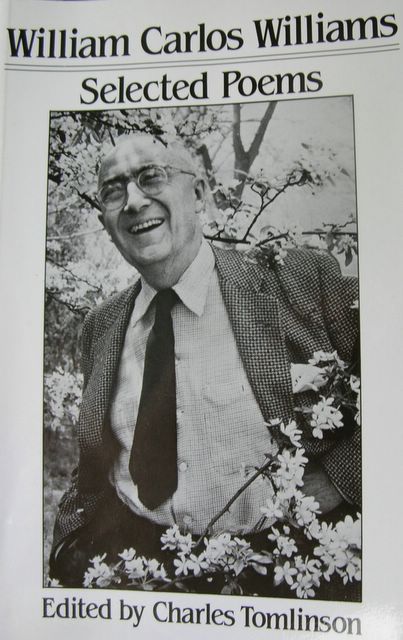
Thursday, May 05, 2005
Book 5: William Carlos Williams Selected Poems, edited by Charles Tomlinson
Paperback: 302 pages
Publisher: New Directions Publishing Corporation (June 1, 1985)
The poetry of William Carlos Williams is difficult for literary scholars to place into a distinct sect or “school”. The physician-poet who inspired the Beat generation with his words, has a greater affinity to Ginsberg than to the poets of his own era, Eliot or Stevens for example. Williams' work fails to assimilate with even one of his closest admirers and friends, Ezra Pound, though the two share in their desires to experiment with form and style. Williams’ poetry is a conflicting menagerie of imagination, avant-garde forms, and soulful ruminations on the power of the mind. He was one of the first American poets who stayed home rather than turning to Europe for inspiration and elevated colloquial, everyday language to art. His body of work stands as a testament to the devotion an individual can feel towards the written word and the power language contains.
Perhaps Williams was aware of some of the key problematic elements in his work. Like many great artists, he admits the urge to create came to him from unknown forces. In “Apology” when he writes, “Why do I write today?/The beauty of/the terrible faces/of our nonentities/stirs me to it" touches on the artist's alienation from knowing where his art emerges from. This urge often leads him to a doctoral self-examination and deconstruction. But the most important strand in the poetry is an ever fervent defense of poetry’s beauty and utility, even in the modern world. Williams poetry can be political, as in “Asphodel, That Greeny Flower,” when he touches about nuclear energy with such lines as, “The mere picture/of the exploding bomb/fascinates us/so that we cannot wait/to prostrate ourselves/before it.” What can mere words to in the face of this destruction? Does poetry still have a place in a contemporary world bent on self—annihilation? For Williams, the answer is yes.
Ultimately, it is in his defense of the scope of poetry that Williams is his most powerful. He is a man that believed in words and believed the will of the mind was the greatest source of strength in the world. Poetry is all around us, but it is for the poet’s mind to decipher nature’s codes. “Paterson”, his longest poem and a piece that at some points seems to spiral out of control, still retains a core of integrity that exemplifies the poet’s work. The world is the poet’s to interpret Williams elucidates with “…The birds/and leaves are designed to be woven/in his mind eating and.../altogether for his purposes.” The world might not have been made explicitely for the poet's pen, but the poet is free to interpret it this way.
Williams poetry illustrates how language can shape what it describes in the same way that the mind shapes the way in which we perceive the “things” of the world. Williams frequently uses form to highlight this parallel relationship, as in “The Red Wheel Barrow”, where words are revealed slowly, sometimes with only one to a line, a divergent perception from the more immediate facility of the mind. The mind and poet, however, are kin – neither is objective, but rather insert their perspective into the view of life. However, subjectivity doesn’t mean the death null for certainty. We must look to the world and its objects for understanding as the resounding phrase, “No end but among words/looking to the past,/plaintive and unschooled,/wanting a discipline” and later in the same poem, “The Sound of Waves”, “…words blowing in/taking the shape of stone/Past that, past the image”. Language in general and poetry specifically, are our best tools to decipher the world, a place at once mysterious, awful, wretched, beautiful, and sublime.
In “A Sort of a Song”, Williams expresses this idea most clearly, writing, “…-through metaphor to reconcile/the people and the stones./Compose. (No ideas/but in things) Invent!” He wants us to use words, metaphors, descriptions. He extols common people because of their commonness, as in his loving description of a poor woman eating plums. Beauty surrounds us, we just have to see it for what it is. This is an avant-garde notion, that now, seems less artsy than humanistic. This idea seems even more important today, in a world filled with images, and the way we can absorb these ubiquituous flashes without the active participation of our mind. Words force us to construct, force us to think for ourselves. Williams poetry may be a lament for the prominence that poetry has lost, but it’s also a justification for its continued place in our society, even with the medium of television – and, decades later, it remains a deeply moving testimony at that.
Publisher: New Directions Publishing Corporation (June 1, 1985)
The poetry of William Carlos Williams is difficult for literary scholars to place into a distinct sect or “school”. The physician-poet who inspired the Beat generation with his words, has a greater affinity to Ginsberg than to the poets of his own era, Eliot or Stevens for example. Williams' work fails to assimilate with even one of his closest admirers and friends, Ezra Pound, though the two share in their desires to experiment with form and style. Williams’ poetry is a conflicting menagerie of imagination, avant-garde forms, and soulful ruminations on the power of the mind. He was one of the first American poets who stayed home rather than turning to Europe for inspiration and elevated colloquial, everyday language to art. His body of work stands as a testament to the devotion an individual can feel towards the written word and the power language contains.
Perhaps Williams was aware of some of the key problematic elements in his work. Like many great artists, he admits the urge to create came to him from unknown forces. In “Apology” when he writes, “Why do I write today?/The beauty of/the terrible faces/of our nonentities/stirs me to it" touches on the artist's alienation from knowing where his art emerges from. This urge often leads him to a doctoral self-examination and deconstruction. But the most important strand in the poetry is an ever fervent defense of poetry’s beauty and utility, even in the modern world. Williams poetry can be political, as in “Asphodel, That Greeny Flower,” when he touches about nuclear energy with such lines as, “The mere picture/of the exploding bomb/fascinates us/so that we cannot wait/to prostrate ourselves/before it.” What can mere words to in the face of this destruction? Does poetry still have a place in a contemporary world bent on self—annihilation? For Williams, the answer is yes.
Ultimately, it is in his defense of the scope of poetry that Williams is his most powerful. He is a man that believed in words and believed the will of the mind was the greatest source of strength in the world. Poetry is all around us, but it is for the poet’s mind to decipher nature’s codes. “Paterson”, his longest poem and a piece that at some points seems to spiral out of control, still retains a core of integrity that exemplifies the poet’s work. The world is the poet’s to interpret Williams elucidates with “…The birds/and leaves are designed to be woven/in his mind eating and.../altogether for his purposes.” The world might not have been made explicitely for the poet's pen, but the poet is free to interpret it this way.
Williams poetry illustrates how language can shape what it describes in the same way that the mind shapes the way in which we perceive the “things” of the world. Williams frequently uses form to highlight this parallel relationship, as in “The Red Wheel Barrow”, where words are revealed slowly, sometimes with only one to a line, a divergent perception from the more immediate facility of the mind. The mind and poet, however, are kin – neither is objective, but rather insert their perspective into the view of life. However, subjectivity doesn’t mean the death null for certainty. We must look to the world and its objects for understanding as the resounding phrase, “No end but among words/looking to the past,/plaintive and unschooled,/wanting a discipline” and later in the same poem, “The Sound of Waves”, “…words blowing in/taking the shape of stone/Past that, past the image”. Language in general and poetry specifically, are our best tools to decipher the world, a place at once mysterious, awful, wretched, beautiful, and sublime.
In “A Sort of a Song”, Williams expresses this idea most clearly, writing, “…-through metaphor to reconcile/the people and the stones./Compose. (No ideas/but in things) Invent!” He wants us to use words, metaphors, descriptions. He extols common people because of their commonness, as in his loving description of a poor woman eating plums. Beauty surrounds us, we just have to see it for what it is. This is an avant-garde notion, that now, seems less artsy than humanistic. This idea seems even more important today, in a world filled with images, and the way we can absorb these ubiquituous flashes without the active participation of our mind. Words force us to construct, force us to think for ourselves. Williams poetry may be a lament for the prominence that poetry has lost, but it’s also a justification for its continued place in our society, even with the medium of television – and, decades later, it remains a deeply moving testimony at that.
Wednesday, May 04, 2005
Kittichai Photos

Row 1: Lychee Martini, Ginger Lemongrass Highball, Rock Shrimp; Row 2: Chocolate Ribs, Sea Bass, Pineapple Rice; Row 3: Wall of bottled flowers, Bird Cage Aquarium, Outside Kittichai at 60 Thompson St.
Restaurant 13: Kittichai
RESTAURANT: Kittichai
LOCATION: 60 Thompson St.
DATE: May 2, 2005
FOOD: Family Style Sharing of the following: Appetizers - Chocolate back ribs marinated in Thai spices; Crispy rock shrimp, grilled eggplant, chili lime juice; Salad of banana blossom, artichokes, and roasted chili vinaigrette; Limestone tartlet with Northern Style minced chicken, dried chili and coriander; Entrees – Baked Chilean sea bass marinated in yellow salted beans with morning glory; Chiang Mai honey glazed duck with champagne mango and micro bok choy; Wok-fried chicken with roasted cashew nuts, dried chili and green onion. Sides – Jasmine rice; Pineapple fried rice with sweet sausage and shredded egg.
BEVERAGE: Kittichai lychee martini; Ginger lemongrass highball
PRICE: Unknown – Work related dinner
The buzz around Kittichai is unbelievable. The Thai-fusion restaurant seems to be able to please all diners – the most nitpicking foodies to those dabbling in Thai cuisine for the first time. Before my visit on Monday night, I knew the dish recommendations of everyone from Frank Bruni to random bloggers. The only thing about Kittichai I hadn’t heard was a complaint. Apparently, Chocolate ribs and jasmine rice would have been great for the Rodney King debacle – they seem to make us all get along.
Kittichai’s layout is stunning, a postmodern coalescing of Asian and European influences. However, the architecture is there to work with the food, not to out-do it. Fluorescent pastel flowers, candle lit tables, a bird cage that is really a fish tank – these elements combine to set the mood for innovative cuisine like an Iron and Wine song melds perfectly with the feel of a rainy Sunday.
Extreme cocktails seem to radiate with the same neon glow as the elaborate tropical wall displays. Both of the drinks I had were complicated blends of fruit, alcohol and Asian flavors that worked well as a team. The lychee martini was sweet, but not sickly so (as the Longan juice at Zabb was), and had a distinct lime tartness to downplay the sugar. The ginger lemongrass highball was one of the best drinks I’ve had in New York, a lively fraternizing of gin and Cointreau with ginger and lemongrass. The incorporation of the ginger in a beverage made this special, the result a refreshing oblivion, a temporary reprieve for the tongue from American syrup puckering and straight liquor fire.
As we had a party of nine people, we ordered family style and shared around the table. Of the appetizers, I still can’t get over the Chocolate back ribs. These pork ribs were unabashedly chocolate but definitively Thai spiced. The meat practically fell off the bone and the dark chocolate was tangy and only as sweet as Texas barbeque sauce, which allowed for this dish to start a meal and not immediately end it. Patrick commented that the chocolate sauce was a bit rich and it would be difficult to eat a lot of the ribs. There were certainly multiple pieces of Godiva in the covering and for some, the chocolate might be too much, but as an appetizer, you can have two or three of these ribs and be fine for the rest of the meal. The rest of the appetizers generally were also delightful. The minced chicken was the best of the bunch, similar to Moo Shu Pork (sans Plum sauce), while the coin sized crispy rock shrimp snap, crackle and popped with a fried exterior and a subtle chili tang. The banana salad was an overdone Nicholas Sparks-esque disappointment, all glittery overwrought presentation, but little substance to back it up.
The entrees demanded as much attention as the opening volley of tapas. The table’s unanimous favorite was the sea bass, a dish beautifully simple and seemingly unadulterated yet so dense it flavor I wondered if my eyes were playing tricks on me. Howard loved the short rib green curry and I have to admit that I momentarily reconsidered my no-beef vow upon witnessing the dish. I was pleasantly surprised by the duck, which I had heard mediocre reviews about. I found it tender and non-fatty, its aromatic honey broth a tremendous coupling. The chicken was similar to chicken and cashews, but with a red pepper spice wallop that left us all gasping for water. The sausage and pineapple rice was a luminous side, encased as it was in a halved pineapple. Scooping out the fruit’s flesh made the rice even more equatorially inspired. I would have liked the sausage to be a bit more prominent, but the rice was more balancing act than pork showcase.
Praise may thicken the air around Kittichai like Bangkok smog, but so far at least the kitchen isn’t resting on its laurels. Kittichai is that rare restaurant that feeds (bad pun I know) on hype rather than succumbing to it. This is all the better for the rest of us, who just have to show up, eat, lick our fingers, and leave the restaurant in a chili-spiced delirium. Let people say what they will.
RATING: 8.3/10
LOCATION: 60 Thompson St.
DATE: May 2, 2005
FOOD: Family Style Sharing of the following: Appetizers - Chocolate back ribs marinated in Thai spices; Crispy rock shrimp, grilled eggplant, chili lime juice; Salad of banana blossom, artichokes, and roasted chili vinaigrette; Limestone tartlet with Northern Style minced chicken, dried chili and coriander; Entrees – Baked Chilean sea bass marinated in yellow salted beans with morning glory; Chiang Mai honey glazed duck with champagne mango and micro bok choy; Wok-fried chicken with roasted cashew nuts, dried chili and green onion. Sides – Jasmine rice; Pineapple fried rice with sweet sausage and shredded egg.
BEVERAGE: Kittichai lychee martini; Ginger lemongrass highball
PRICE: Unknown – Work related dinner
The buzz around Kittichai is unbelievable. The Thai-fusion restaurant seems to be able to please all diners – the most nitpicking foodies to those dabbling in Thai cuisine for the first time. Before my visit on Monday night, I knew the dish recommendations of everyone from Frank Bruni to random bloggers. The only thing about Kittichai I hadn’t heard was a complaint. Apparently, Chocolate ribs and jasmine rice would have been great for the Rodney King debacle – they seem to make us all get along.
Kittichai’s layout is stunning, a postmodern coalescing of Asian and European influences. However, the architecture is there to work with the food, not to out-do it. Fluorescent pastel flowers, candle lit tables, a bird cage that is really a fish tank – these elements combine to set the mood for innovative cuisine like an Iron and Wine song melds perfectly with the feel of a rainy Sunday.
Extreme cocktails seem to radiate with the same neon glow as the elaborate tropical wall displays. Both of the drinks I had were complicated blends of fruit, alcohol and Asian flavors that worked well as a team. The lychee martini was sweet, but not sickly so (as the Longan juice at Zabb was), and had a distinct lime tartness to downplay the sugar. The ginger lemongrass highball was one of the best drinks I’ve had in New York, a lively fraternizing of gin and Cointreau with ginger and lemongrass. The incorporation of the ginger in a beverage made this special, the result a refreshing oblivion, a temporary reprieve for the tongue from American syrup puckering and straight liquor fire.
As we had a party of nine people, we ordered family style and shared around the table. Of the appetizers, I still can’t get over the Chocolate back ribs. These pork ribs were unabashedly chocolate but definitively Thai spiced. The meat practically fell off the bone and the dark chocolate was tangy and only as sweet as Texas barbeque sauce, which allowed for this dish to start a meal and not immediately end it. Patrick commented that the chocolate sauce was a bit rich and it would be difficult to eat a lot of the ribs. There were certainly multiple pieces of Godiva in the covering and for some, the chocolate might be too much, but as an appetizer, you can have two or three of these ribs and be fine for the rest of the meal. The rest of the appetizers generally were also delightful. The minced chicken was the best of the bunch, similar to Moo Shu Pork (sans Plum sauce), while the coin sized crispy rock shrimp snap, crackle and popped with a fried exterior and a subtle chili tang. The banana salad was an overdone Nicholas Sparks-esque disappointment, all glittery overwrought presentation, but little substance to back it up.
The entrees demanded as much attention as the opening volley of tapas. The table’s unanimous favorite was the sea bass, a dish beautifully simple and seemingly unadulterated yet so dense it flavor I wondered if my eyes were playing tricks on me. Howard loved the short rib green curry and I have to admit that I momentarily reconsidered my no-beef vow upon witnessing the dish. I was pleasantly surprised by the duck, which I had heard mediocre reviews about. I found it tender and non-fatty, its aromatic honey broth a tremendous coupling. The chicken was similar to chicken and cashews, but with a red pepper spice wallop that left us all gasping for water. The sausage and pineapple rice was a luminous side, encased as it was in a halved pineapple. Scooping out the fruit’s flesh made the rice even more equatorially inspired. I would have liked the sausage to be a bit more prominent, but the rice was more balancing act than pork showcase.
Praise may thicken the air around Kittichai like Bangkok smog, but so far at least the kitchen isn’t resting on its laurels. Kittichai is that rare restaurant that feeds (bad pun I know) on hype rather than succumbing to it. This is all the better for the rest of us, who just have to show up, eat, lick our fingers, and leave the restaurant in a chili-spiced delirium. Let people say what they will.
RATING: 8.3/10
Monday, May 02, 2005
Nora's Photos

Clockwise from top left: Mushroom soup; Moroccan inspired lamb; Ginger Strawberry Shortcake; Ginger Creme Brulee
Nora's Photos
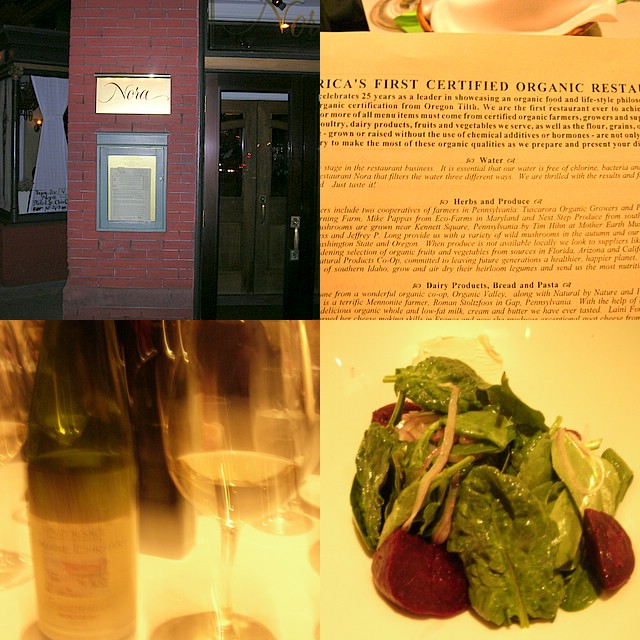
Clockwise from top left: Nora's in NW Washington; The back of the menu highlights the restaurant's commitment to organic food; Beet and goat cheese salad; Wine...and its effects.
Restaurant 12: Nora's
RESTAURANT: Nora’s
LOCATION: 2132 Florida Ave, NW Washington, DC
DATE: April 29, 2005
FOOD: Warm Wild Mushroom Soup served tableside with a Lobster Croquette; Spinach with Roasted Beets, Goat Cheese, Shaved Red Onion, Aged Sherry Vinaigrette; Spring Leg of Lamb in Garden Herb Crust with Chickpea Tabbouleh, Baby Zucchini, Tomato Confit, Olive Jus; Ginger Creme Brulee with Pumpkin Seed Brittle; Ginger Shortcake with Strawberries and Whipped Cream;
BEVERAGE: ½ bottle of Gewuztraimer; Glass of House Red Wine
PRICE: Ask my mom and give a happy birthday to my father
Traditionally, my dad likes his birthday to be a bit anti-climatic. Unlike the rest of the family, he, true to his humble Wisconsin background, desires only a home-cooked meal completed with fresh strawberry-rhubarb pie. But, because we now see each other so infrequently, we decided to take his birthday show on the road and sample a culinary showcase of Washington, D.C. We had originally intended to go the Mid-east Mezze focused up-and-comer, Zaytinya, but after my six hour fiasco on the Chinatown bus and a great deal of collective hunger, we didn’t want to wait an hour before even being seated. My mom remembered loving Nora’s on a previous visit, so we all fell ass-backwards into a thoroughly delightful meal at the country’s first officially designated organic restaurant. How do I know this (not the ass-backwards part, of course, which I’m all too familiar with, but the organic aspect)? Nora’s commitment to organic ingredients occupies the entire backside of the restaurant’s menu, including this historical tidbit, “In April 1999, Nora received organic certification - the first restaurant ever to achieve this designation - meaning that 95% or more of all ingredients used in the restaurant must come from certified organic farmers, growers and suppliers.” Clearly, Nora’s focuses on serving only the best to their customers. For the most part, Nora’s succeeds in this mission marvelously.
To my mind, fresh mushrooms are the food equivalent of mixed-genre literature. Countless variety, innumerable combinations, and the unforgettable and mind-blowing fact that you’re eating fungus(!!) make these rubbery forest growths as eclectic as Cormac McCarthy’s prose. One such permutation is mushroom soup, which apparently Nora’s has decided to reinvent and perfect just because they can. My first course was spectacular from start to finish, from the opening stanza of the soup being poured tableside from a tea kettle-like device, to the first liquid bliss spoonful, to the unexpected explosion of the lobster croquette that I had saved to the near end. The lobster biscuit, outfitted with corn kernels, seemed to tip its hat to New England’s chowder and put the soup in a broader perspective. The soup was an act of devotion, looking and tasting like fresh mushrooms, without the fatty tongue deadening that heavily cream soups typically have, Nora’s foray into the forage closer to sautéed chanterelles than Campbell’s condensed.
My father, mother and I were about as united as Michael Moore and Rush Limbaugh on the salad course, each of us opting for something different. I went with the spinach, goat cheese and beet salad, with a sweet and tangy sherry vinaigrette and red onions. The salad was above average, but missing some key components to be truly great. Firstly, it would have been well accompanied by the crackle of some walnuts (or more adventurous sunflower seeds). Secondly, the cheese on all three of our salads came in huge blocks. This resulted in a lack of integration with the greens, reminding me that a good salad is only as good as the sum of its parts. No one ingredient should dominant the others, but with huge cheese chunks, it was hard to avoid this. My mom had the same complaint about her salad’s Roquefort triangle that went largely uneaten.
On the entrees, though, Nora’s rebounded like Ben Wallace. My mom went with the succulent scallops, tenderly grilled and excellent. I cannot vouch for the halibut which my father ordered, other than to say that he enjoyed it so much his plate was empty before he thought of offering the rest of the table a nibble. However, I was more than content with my choice, getting the Mid-East flavors I had missed from Zaytinya in Nora’s Moroccan spring leg of lamb with chickpea tabbouleh. North African spices flitted through this Casablanca fusion of American and Mid-east cuisines, the lamb hearty enough to make even Bogart happy to stay in the desert. The chickpea puree was impressive as well, akin to hummus, but without an overwhelming garlic plunge, and a silky consistency allowing for a perfect spread or dip across the lamb’s vermillion meat.
My dessert, the ginger strawberry shortcake, was disappointing. The cake itself was too dense, more like a dried out buttermilk biscuit than an appetizing dessert. While the strawberries and cream were alright, I didn’t taste even a hint of ginger until my final two bites of the dish, spending the rest of the time wondering if the kitchen had perhaps forgotten the headline ingredient altogether. However, my mom had ordered astutely, selecting the ginger crème brulee with pumpkin seed brittle and I ended up devouring half of this dessert. The ginger they forgot in the shortcake, the kitchen remembered in the crème brulee and the taste was refreshing and light, like a Chinatown ginger rock candy. The pumpkin seed brittle would be an ideal post-Halloween indulgence and the dual crunches of the brittle and the brulee’s scorched top were an awesome combination, especially when paired with the ginger cream.
Thus, despite a few minor lapses, overall Nora’s cannot be described as anything but astounding. I would happily order the soup, lamb or crème brulee again and it’s remarkable to see that a restaurant can passionately dedicate itself to nutritional concerns and still manage to whip-up innovative and delicious creations. Nora's was a great way to ring in my dad's __ (let's leave it up to the imagination, shall we?) year, a menu not overly daring, but nowhere near boringly mundane and for palate's of all sophistications. In a Washington food scene that has in my experience fallen far short of New York’s, Nora’s excellence measures up anywhere.
RATING: 7.7/10
LOCATION: 2132 Florida Ave, NW Washington, DC
DATE: April 29, 2005
FOOD: Warm Wild Mushroom Soup served tableside with a Lobster Croquette; Spinach with Roasted Beets, Goat Cheese, Shaved Red Onion, Aged Sherry Vinaigrette; Spring Leg of Lamb in Garden Herb Crust with Chickpea Tabbouleh, Baby Zucchini, Tomato Confit, Olive Jus; Ginger Creme Brulee with Pumpkin Seed Brittle; Ginger Shortcake with Strawberries and Whipped Cream;
BEVERAGE: ½ bottle of Gewuztraimer; Glass of House Red Wine
PRICE: Ask my mom and give a happy birthday to my father
Traditionally, my dad likes his birthday to be a bit anti-climatic. Unlike the rest of the family, he, true to his humble Wisconsin background, desires only a home-cooked meal completed with fresh strawberry-rhubarb pie. But, because we now see each other so infrequently, we decided to take his birthday show on the road and sample a culinary showcase of Washington, D.C. We had originally intended to go the Mid-east Mezze focused up-and-comer, Zaytinya, but after my six hour fiasco on the Chinatown bus and a great deal of collective hunger, we didn’t want to wait an hour before even being seated. My mom remembered loving Nora’s on a previous visit, so we all fell ass-backwards into a thoroughly delightful meal at the country’s first officially designated organic restaurant. How do I know this (not the ass-backwards part, of course, which I’m all too familiar with, but the organic aspect)? Nora’s commitment to organic ingredients occupies the entire backside of the restaurant’s menu, including this historical tidbit, “In April 1999, Nora received organic certification - the first restaurant ever to achieve this designation - meaning that 95% or more of all ingredients used in the restaurant must come from certified organic farmers, growers and suppliers.” Clearly, Nora’s focuses on serving only the best to their customers. For the most part, Nora’s succeeds in this mission marvelously.
To my mind, fresh mushrooms are the food equivalent of mixed-genre literature. Countless variety, innumerable combinations, and the unforgettable and mind-blowing fact that you’re eating fungus(!!) make these rubbery forest growths as eclectic as Cormac McCarthy’s prose. One such permutation is mushroom soup, which apparently Nora’s has decided to reinvent and perfect just because they can. My first course was spectacular from start to finish, from the opening stanza of the soup being poured tableside from a tea kettle-like device, to the first liquid bliss spoonful, to the unexpected explosion of the lobster croquette that I had saved to the near end. The lobster biscuit, outfitted with corn kernels, seemed to tip its hat to New England’s chowder and put the soup in a broader perspective. The soup was an act of devotion, looking and tasting like fresh mushrooms, without the fatty tongue deadening that heavily cream soups typically have, Nora’s foray into the forage closer to sautéed chanterelles than Campbell’s condensed.
My father, mother and I were about as united as Michael Moore and Rush Limbaugh on the salad course, each of us opting for something different. I went with the spinach, goat cheese and beet salad, with a sweet and tangy sherry vinaigrette and red onions. The salad was above average, but missing some key components to be truly great. Firstly, it would have been well accompanied by the crackle of some walnuts (or more adventurous sunflower seeds). Secondly, the cheese on all three of our salads came in huge blocks. This resulted in a lack of integration with the greens, reminding me that a good salad is only as good as the sum of its parts. No one ingredient should dominant the others, but with huge cheese chunks, it was hard to avoid this. My mom had the same complaint about her salad’s Roquefort triangle that went largely uneaten.
On the entrees, though, Nora’s rebounded like Ben Wallace. My mom went with the succulent scallops, tenderly grilled and excellent. I cannot vouch for the halibut which my father ordered, other than to say that he enjoyed it so much his plate was empty before he thought of offering the rest of the table a nibble. However, I was more than content with my choice, getting the Mid-East flavors I had missed from Zaytinya in Nora’s Moroccan spring leg of lamb with chickpea tabbouleh. North African spices flitted through this Casablanca fusion of American and Mid-east cuisines, the lamb hearty enough to make even Bogart happy to stay in the desert. The chickpea puree was impressive as well, akin to hummus, but without an overwhelming garlic plunge, and a silky consistency allowing for a perfect spread or dip across the lamb’s vermillion meat.
My dessert, the ginger strawberry shortcake, was disappointing. The cake itself was too dense, more like a dried out buttermilk biscuit than an appetizing dessert. While the strawberries and cream were alright, I didn’t taste even a hint of ginger until my final two bites of the dish, spending the rest of the time wondering if the kitchen had perhaps forgotten the headline ingredient altogether. However, my mom had ordered astutely, selecting the ginger crème brulee with pumpkin seed brittle and I ended up devouring half of this dessert. The ginger they forgot in the shortcake, the kitchen remembered in the crème brulee and the taste was refreshing and light, like a Chinatown ginger rock candy. The pumpkin seed brittle would be an ideal post-Halloween indulgence and the dual crunches of the brittle and the brulee’s scorched top were an awesome combination, especially when paired with the ginger cream.
Thus, despite a few minor lapses, overall Nora’s cannot be described as anything but astounding. I would happily order the soup, lamb or crème brulee again and it’s remarkable to see that a restaurant can passionately dedicate itself to nutritional concerns and still manage to whip-up innovative and delicious creations. Nora's was a great way to ring in my dad's __ (let's leave it up to the imagination, shall we?) year, a menu not overly daring, but nowhere near boringly mundane and for palate's of all sophistications. In a Washington food scene that has in my experience fallen far short of New York’s, Nora’s excellence measures up anywhere.
RATING: 7.7/10
Subscribe to:
Posts (Atom)